7 Ways ChatBridge Solves Multilingual Support Challenges That AI Agents Miss
Key takeaways:
AI agents handle common languages confidently but quietly fail non-native and low-resource language speakers. ChatBridge covers 130+ consistently.
Emotional nuance and mid-conversation language switches break AI agents; human agents with ChatBridge read both naturally.
ChatBridge is native to Salesforce Service Cloud. No fragmented records, no retraining cycles, no extra tools to maintain.
AI is everywhere in customer support right now. Every software company is talking about AI agents, AI-powered responses, AI-driven ticket resolution. And honestly, a lot of it is impressive.
But here's what doesn't get talked about enough: AI agents have a real blind spot when it comes to multilingual support. They can automate a lot of things, but the moment a customer writes in a language the system wasn't trained well on or switches mid-conversation, things start to fall apart quietly.
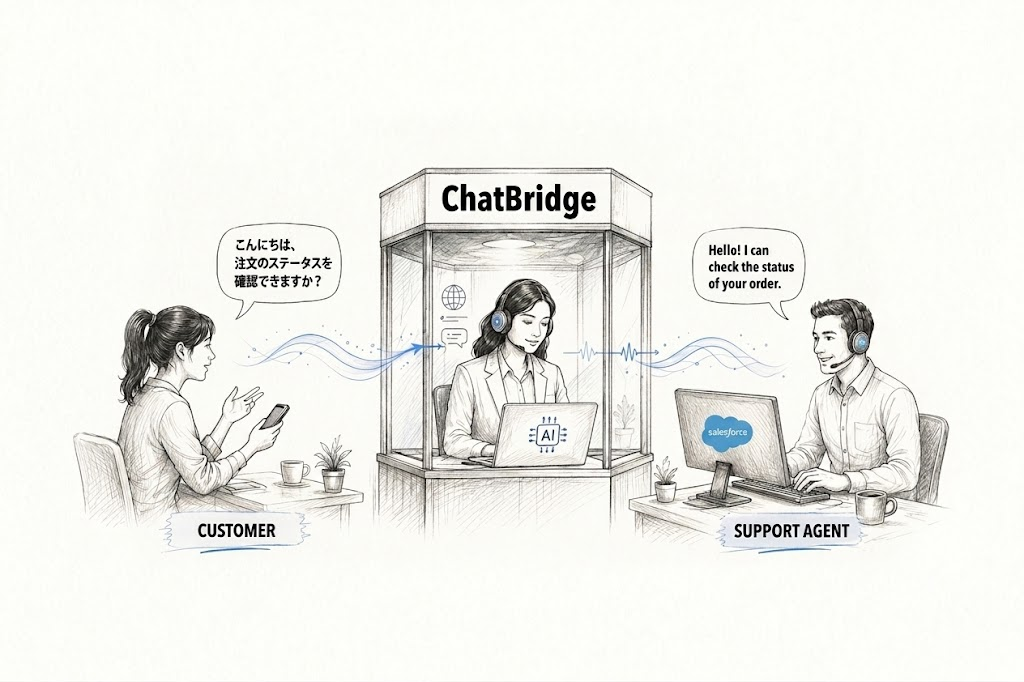
This is where dedicated Salesforce translation apps like ChatBridge do wonders AI agents simply aren't built to do. Not because AI is bad, but because solving language barriers inside a live support environment is a very specific problem that needs a very specific solution. Let's walk through exactly where AI agents fall short and how multilingual Salesforce support with ChatBridge fills those gaps.
1. AI Agents Struggle With Low-Resource Languages
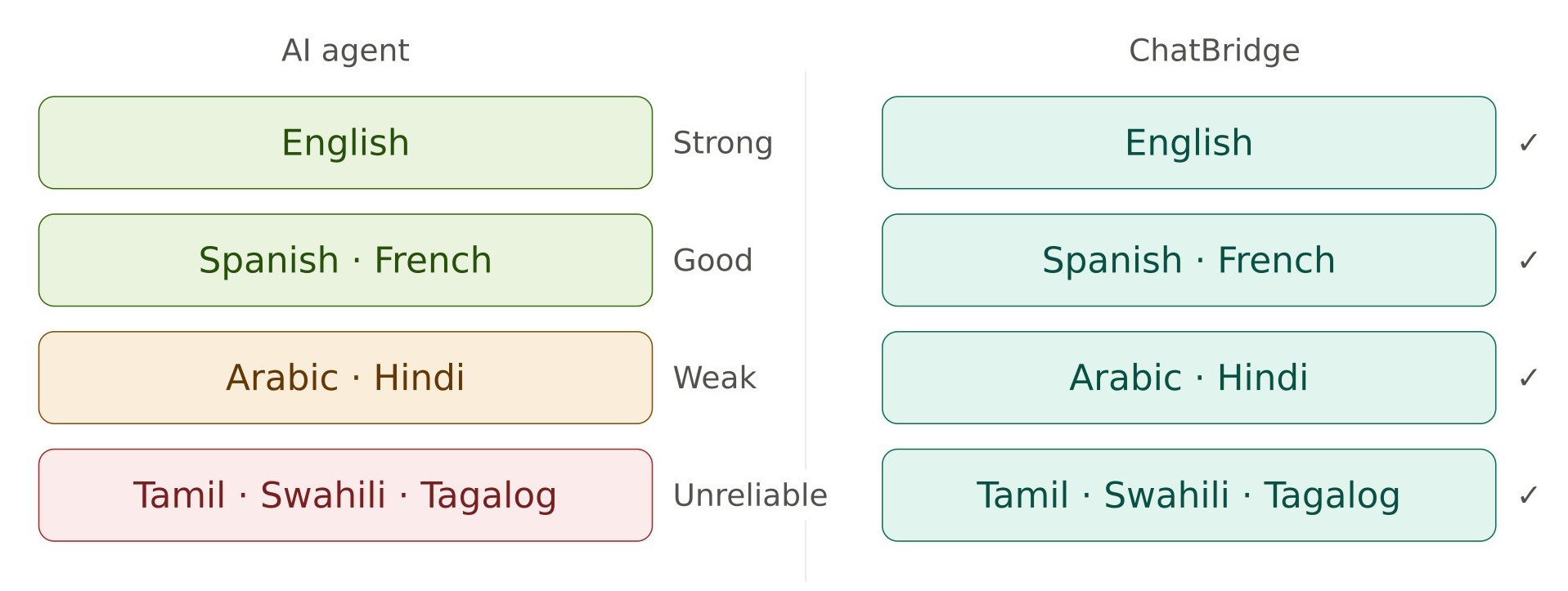
Most AI agents are trained heavily on English. They're pretty good at Spanish, French, and German too. But ask them to handle Tamil, Swahili, Marathi, or Tagalog, and the quality drops noticeably. The AI either:
misunderstands the customer's intent
gives a generic response that doesn't address the actual question,
Or worse, confidently gives the wrong answer.
This is what's called the low-resource language problem. Languages with less data on the internet get less attention in AI training, and that gap shows up directly in your support quality.
ChatBridge handles 130+ languages, including many that AI agents routinely underperform in because it's built around the Salesforce translation solution as the core job, not as a side feature. Your human agents stay in the conversation, bringing judgment and context that no AI model currently matches for niche or regional languages.
So while an AI agent might be great for high-volume English queries, ChatBridge is what keeps your multilingual CRM solution working for customers who speak languages that aren't on the AI's strong list.
2. AI Agents Can't Pick Up on Emotional Nuance Across Languages
Reading a customer's tone is half the job in support. Are they frustrated? Confused? About to escalate? In English, most AI agents have been trained enough to at least flag emotional signals. But in other languages, that sensitivity drops significantly.
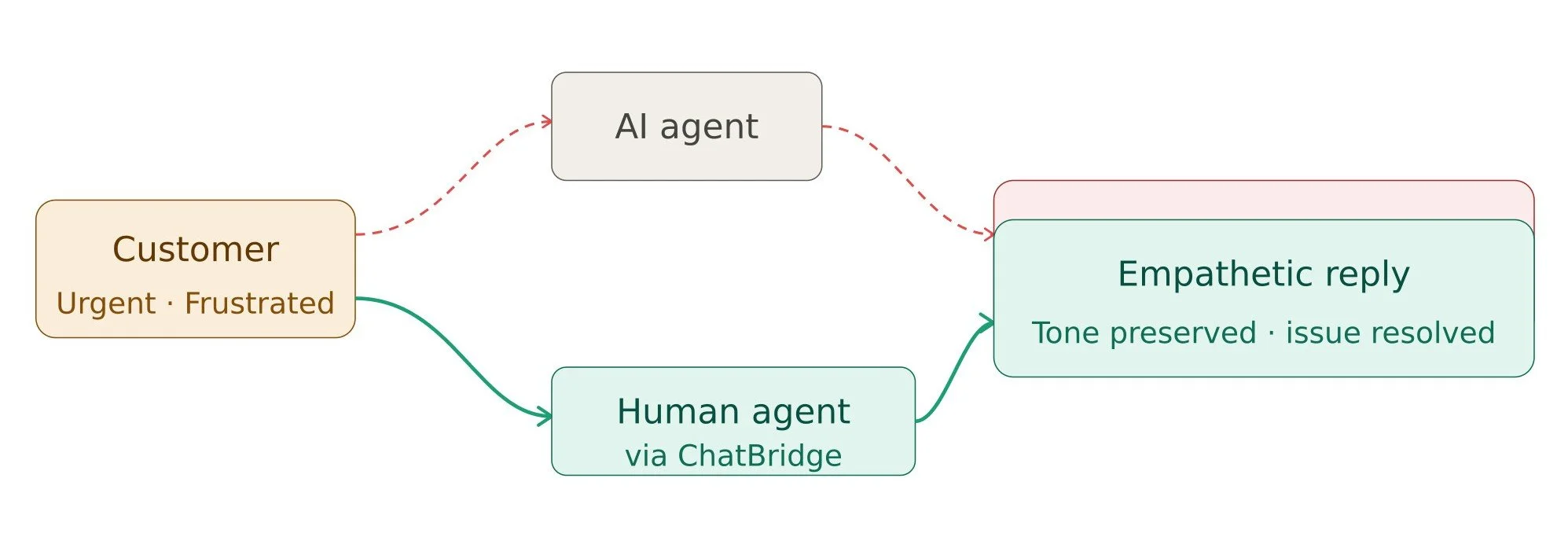
A customer writing in Arabic or Bengali might be expressing genuine urgency, but the AI reads it as a neutral query and responds with a standard template. The customer feels unheard. The situation escalates. And now a human agent has to step in anyway, except now the customer is already annoyed.
Human agents using Salesforce chat translation through ChatBridge actually read the translated message with the same empathy and judgment they'd bring to any conversation. Agents can:
Recognize hesitation, frustration, urgency.
Adjust tone naturally.
Decide when to escalate or when to apologize.
Know when to simply slow down or clarify.
Respond with empathy rather than templates.
That emotional intelligence isn't a soft skill to overlook. It's the thing that separates a resolved ticket from a churned customer.
3. AI Agents Handle Switching Languages Mid-Conversation Poorly
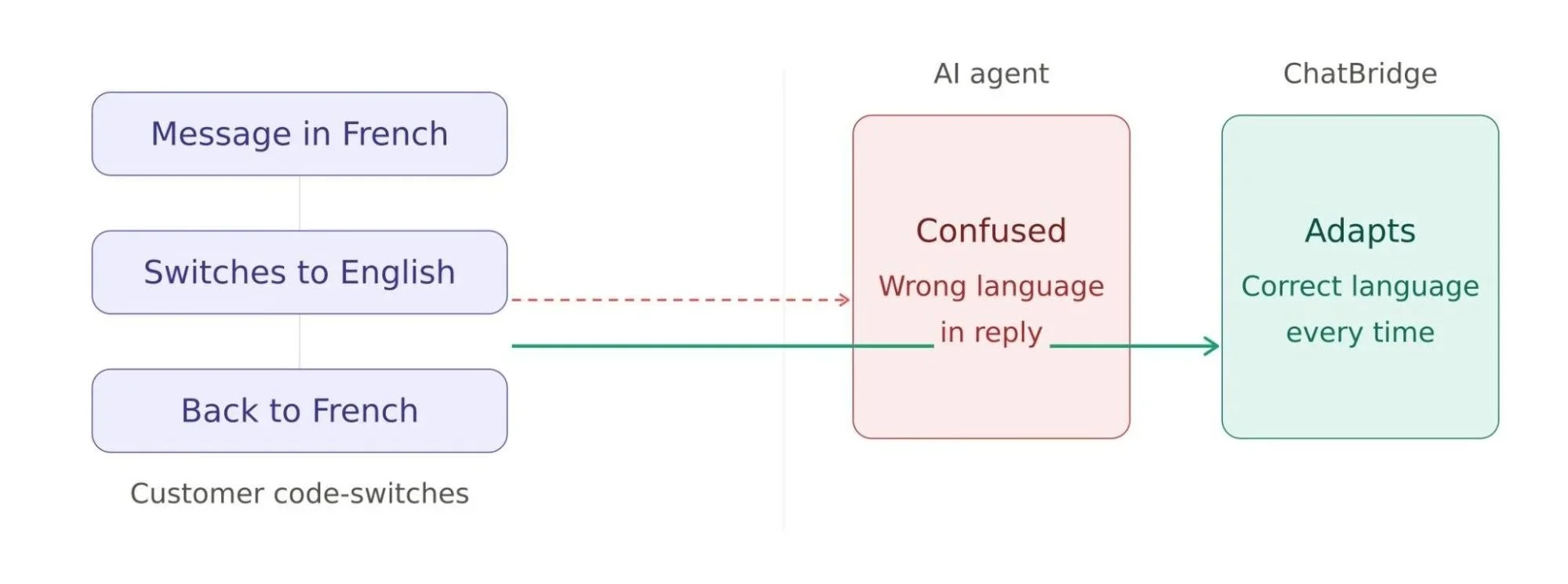
Real customers don't always stay in one language. Someone might start in French, switch to English when they're struggling to explain something technical, and then drop back into French when they're frustrated. Or a bilingual customer might mix both languages in the same message.
Most AI agents hit a wall here. They're designed to operate within one defined language context, and code-switching mid-conversation either confuses them or causes them to respond in the wrong language entirely.
Chatbridge, working alongside your human agent in Salesforce real-time translation, handles this naturally. The agent sees what the customer is saying translated clearly, regardless of how many times the language shifts. The human agent picks up the context and adjusts. No confusion and no wrong language replies.
4. AI Agents Make Confident Errors That Nobody Catches
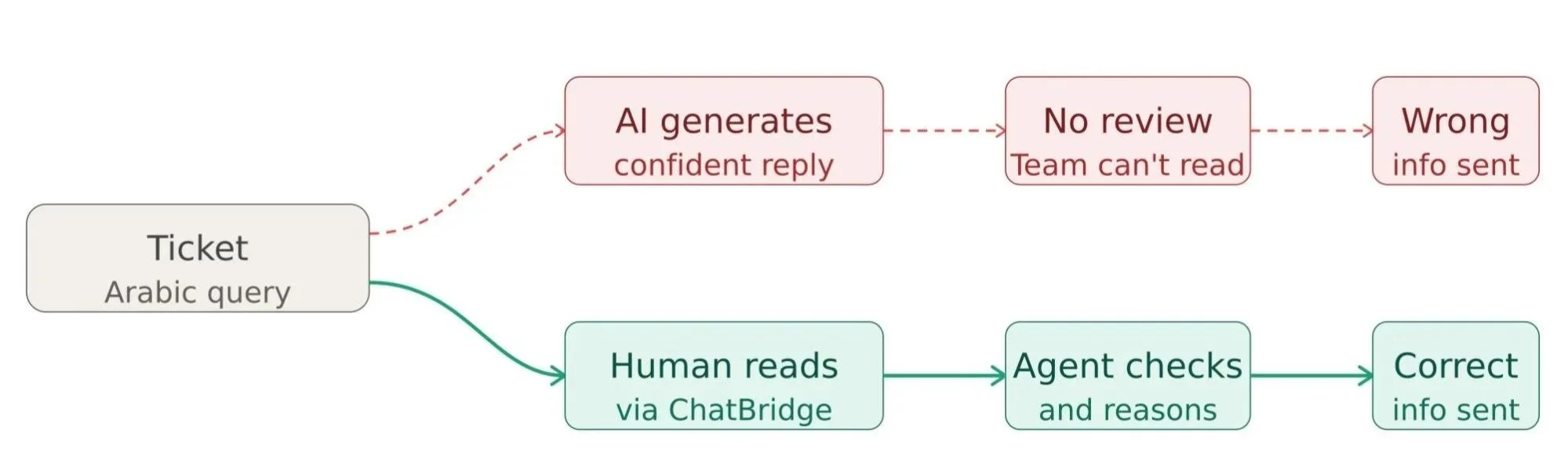
This is the one that should concern support managers the most. AI agents don't always know what they don't know. When an AI misunderstands a query in a language it's not strong in, it doesn't say "I'm not sure." It gives an answer, sometimes a very confident, well-structured answer, that happens to be wrong.
In a support context, that might mean a customer gets:
incorrect product information,
wrong billing details,
misleading policy explanations,
faulty troubleshooting steps,
And all these are delivered in fluent language that sounds authoritative. Nobody on your team catches it because the conversation happened in a language they don't speak, and the AI's response looked clean on the outside.
With ChatBridge and a human agent in the loop, there's always a person accountable for the response. Translation for Salesforce Service Cloud using ChatBridge means agents read the translated message, think through an answer, and send a reply they stand behind. Errors get caught before they reach the customer because a human is actually reading and reasoning, not a model predicting the next most likely token.
5. AI Agents Aren't Built for Salesforce-Native Workflows
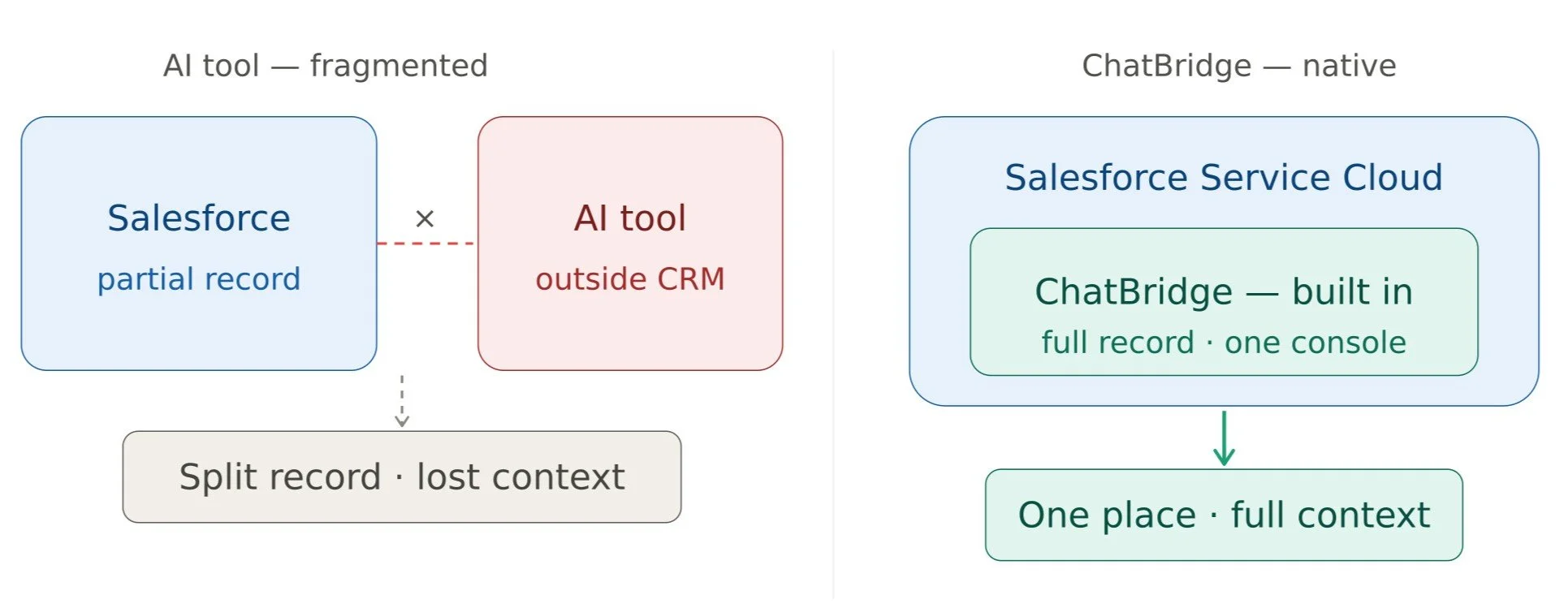
A lot of AI support tools sit outside Salesforce or require complex integration to plug in. They might work as standalone chatbots on a website, or they might connect loosely to your CRM via API. But they weren't designed to work inside Salesforce Service Cloud the way your agents actually use it day to day. That creates friction.
Conversations get split across platforms.
Case records don't update cleanly.
Supervisors reviewing a case see a fragmented picture because part of the conversation happened in an AI tool and part in Salesforce.
ChatBridge is built specifically as a Salesforce chat translation app that lives natively inside Service Cloud. It works inside the console your agents already have open, updates case records the way your team expects, and keeps the full conversation history in one place. For teams already running their support operations in Salesforce, this is a major practical difference.
6. AI Agents Can't Build Real Relationships With Customers
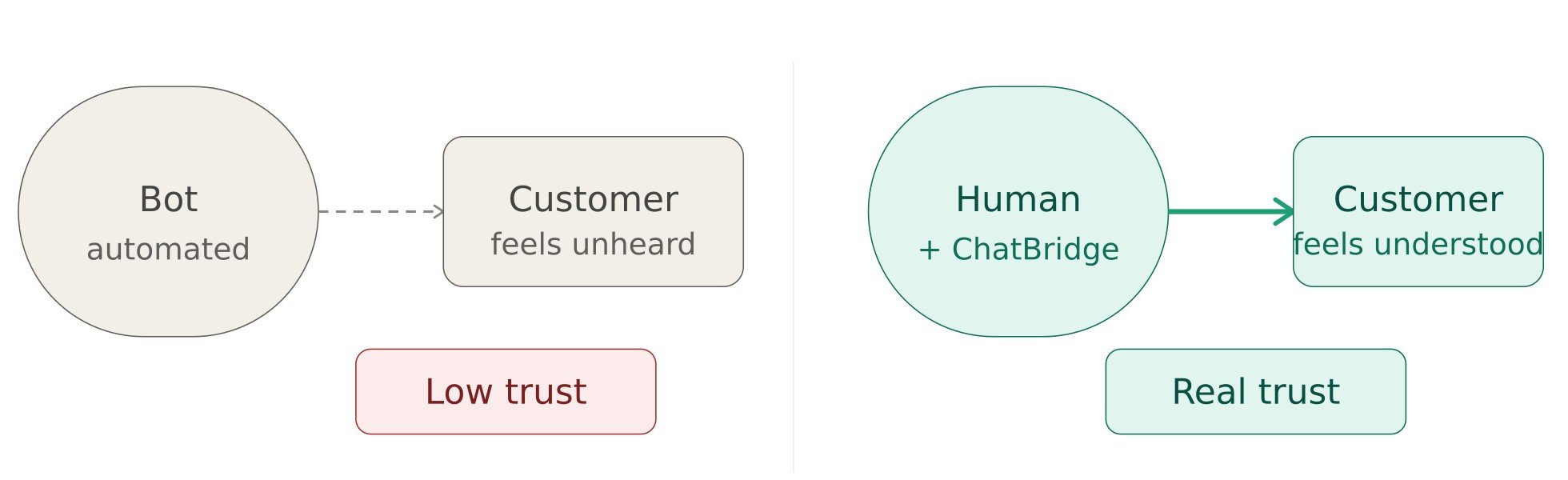
Here's something that's easy to forget in all the automation conversation: a significant portion of your customers don't actually want to talk to a bot. They especially don't want to talk to a bot when something has gone wrong, when they're confused, or when the stakes feel high.
Non-native customers are often in a more vulnerable spot during support interactions. They're already navigating a language barrier, possibly in a country where they don't speak the local language fluently, trying to resolve something that matters to them. What they want is to feel understood by a real person.
Human agents using the Salesforce chat translation app give them exactly that. The customer writes in their language. A real person responds thoughtfully in their language. That real-time interaction builds the kind of trust that an AI reply at three times the speed simply cannot replicate.
Retention and loyalty for international customers often come down to these moments. ChatBridge makes sure a real person is always behind them.
7. AI Agents Require Heavy Setup and Ongoing Maintenance for Multilingual Use
Getting an AI agent to work well in multiple languages isn't a plug-and-play situation. It requires training data in each language, ongoing testing, prompt engineering for different linguistic contexts, and regular monitoring to catch new failure modes as customer language patterns evolve.
For most support teams, that's a significant ongoing investment and the quality still isn't guaranteed to be consistent across all the languages you need.
ChatBridge doesn't require any of that overhead. As a multilingual CRM solution, it's designed to handle language as a background function, not something your team has to configure and babysit. Plug it into your Service Cloud setup, and it works. Across all supported languages. Consistently. Without a dedicated team managing prompts and retraining cycles.
In A Nutshell
AI agents are genuinely useful for a lot of things: triaging tickets, answering common questions in high-volume queues, routing cases to the right teams. There's a real place for them in a modern support stack.
But multilingual support, especially live chat, where speed, nuance, and accuracy all matter simultaneously, is a specific challenge that AI agents aren't reliably solving yet. The gaps are real, and for international customers, those gaps have direct consequences on satisfaction, trust, and whether they come back.
ChatBridge fills exactly those gaps. It keeps your human agents in the conversation, removes the language barrier between them and the customer, and does all of it natively inside Salesforce. That means no overhead, maintenance, or confidence errors that come with AI-led multilingual support.
If your team is already using or considering AI agents in Salesforce, ChatBridge is the layer that makes sure every customer actually gets the support they came for.
Frequently Asked Questions
-
Most AI agents with built-in translation are still handling language as a secondary function, not a core one. That means quality is inconsistent and emotional nuance still gets flattened. ChatBridge is built specifically around translation as its primary job, which means accuracy, tone, and context are preserved in a way that a built-in AI translation layer typically isn't designed to deliver.
-
Neither. ChatBridge sits natively inside your existing Salesforce Service Cloud console. Your agents don't need a new login, a new tab, or a new workflow. Everything happens inside the environment they already use every day, which means zero disruption to your current setup and no learning curve for the team.
-
ChatBridge works alongside your AI setup, not against it. Think of it as the layer that handles everything your AI can't reliably manage: live multilingual chat, cases where a real human needs to step in and actually communicate with the customer. AI handles volume; ChatBridge makes sure the human moments that matter are still handled accurately, regardless of language.
Related Reading