
The ROI of Real-Time Translation in Salesforce Service Cloud

Key Summary:
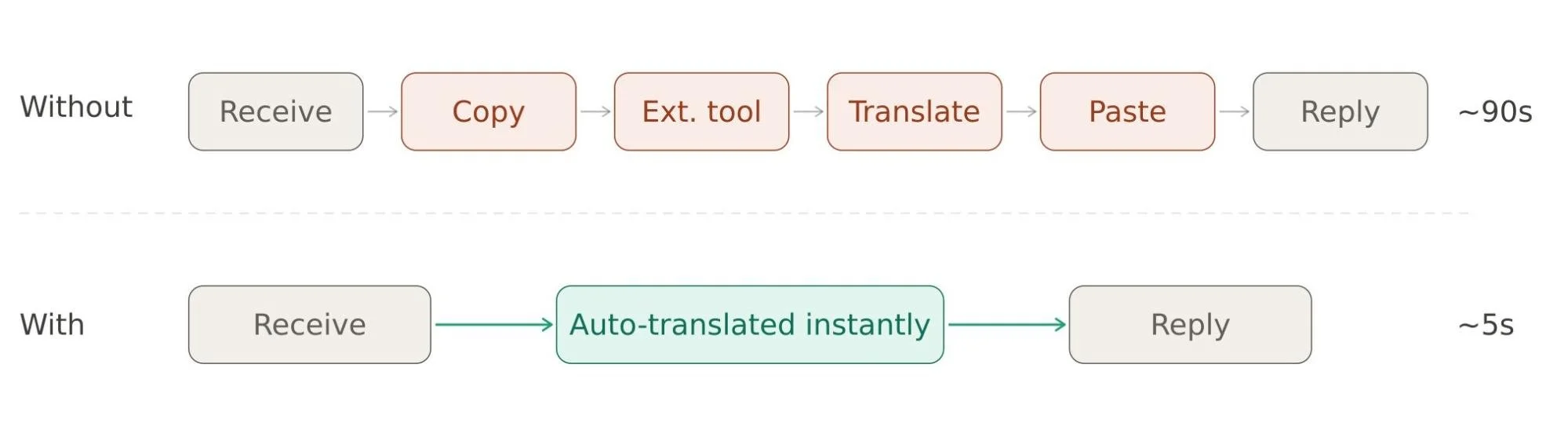
Real-time Salesforce translation significantly reduces Average Handle Time for multilingual chats, boosting agent productivity.
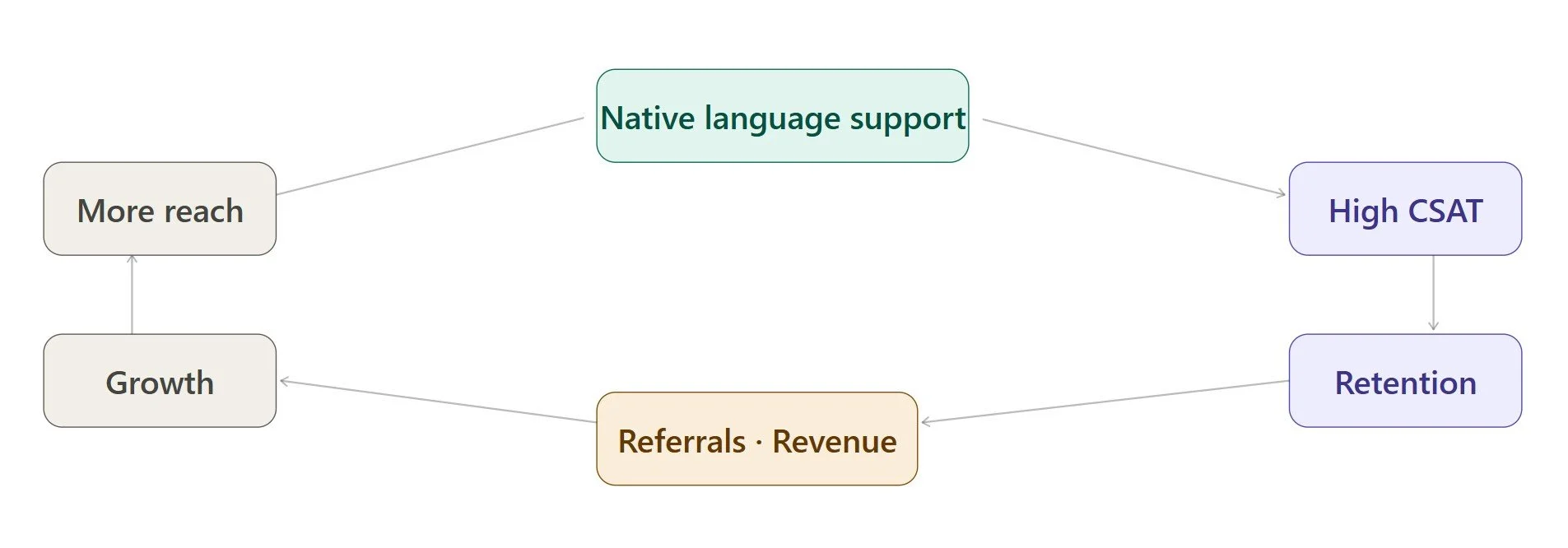
Receiving support in their preferred language increases customer satisfaction (CSAT) scores and customer retention.
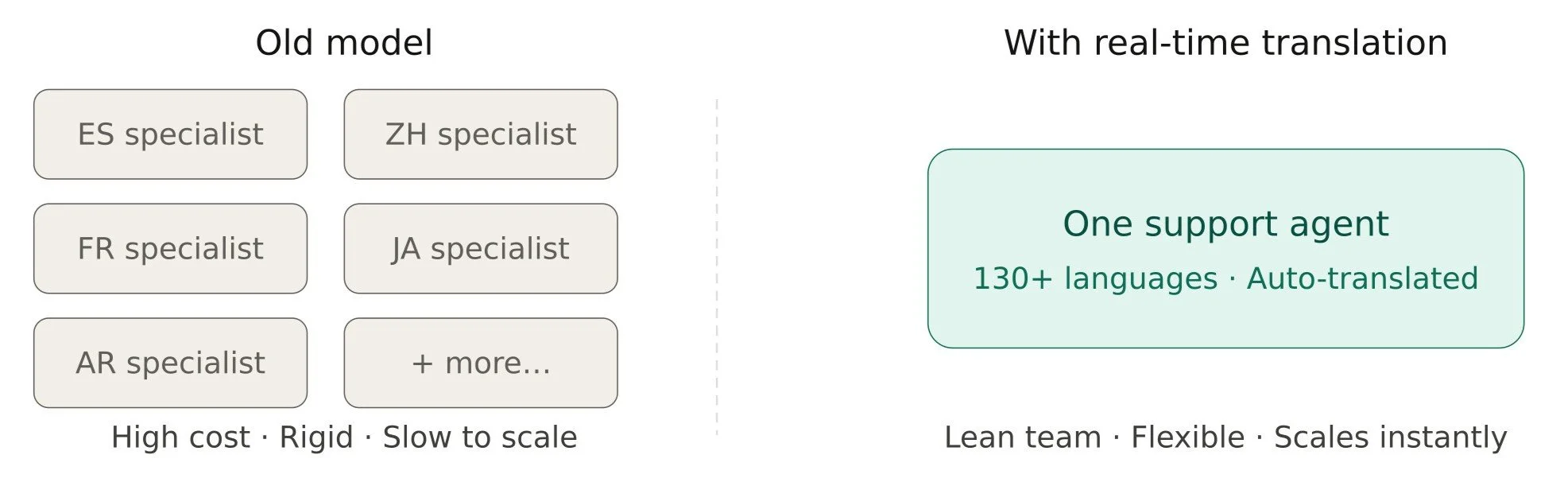
A single agent can serve a global customer base, reducing high costs and the need for specialized multilingual hiring.
Most businesses think about real-time Salesforce translation as a communication tool. It sure is a communication tool, but that’s only part of the story.
When you dig a little deeper, real-time chat translation in Salesforce Service Cloud is actually a revenue decision. It affects how quickly your team resolves issues, how many customers stick around, how efficiently your agents work, and how confidently you can enter new markets.
In other words, it has a direct and measurable impact on your business. So let’s talk about the ROI of multilingual Salesforce support via real-time chat translation because it pays off often faster than most teams expect.
The Hidden Cost of the Language Gap
Before we look at the returns, it helps to understand what the language gap is actually costing you right now.
When a customer reaches out in a language your agent doesn't speak, a few things typically happen. The agent fumbles through a manual translation workaround, i.e., copy-pasting into Google Translate, losing time, and introducing errors. Or the chat gets routed to a specialist queue, adding wait time. Or worst of all, the customer gives up and leaves.
None of these outcomes comes without a cost. Each one costs you something. It could be agent time, customer patience, or a lost relationship entirely.
And this isn't a niche problem. As businesses expand across borders and serve increasingly diverse domestic markets, the percentage of multilingual interactions is only going up. Every week you're operating without a proper multilingual CRM solution means loss in productivity, in customer satisfaction, and in revenue.
ROI Pillar #1: Faster Resolution Times
Here's something that doesn't always make it into the ROI conversation but absolutely should: customers who feel understood stay longer.
It sounds simple, but the data behind it is compelling. Customers who receive support in their preferred language report significantly higher satisfaction scores. And satisfied customers renew subscriptions, make repeat purchases, refer others, and don't churn.
The inverse is also true. A customer who has to struggle through a support interaction in a language they're not comfortable with is a customer who starts looking for alternatives.
Multilingual Salesforce support removes that friction entirely. When a customer writes in Tamil and gets a clear, accurate response in Tamil without any delay or awkward phrasing, that's an experience they remember. It signals that your business is actually prepared for them, rather than treating them as an edge case.
Retention improvements of even a few percentage points can represent significant revenue, especially in subscription-based or high-LTV businesses. And retaining a customer is almost always cheaper than acquiring a new one.
ROI Pillar #2: Higher Customer Retention
Here's something that doesn't always make it into the ROI conversation but absolutely should: customers who feel understood stay longer.
It sounds simple, but the data behind it is compelling. Customers who receive support in their preferred language report significantly higher satisfaction scores. And satisfied customers renew subscriptions, make repeat purchases, refer others, and don't churn.
The inverse is also true. A customer who has to struggle through a support interaction in a language they're not comfortable with is a customer who starts looking for alternatives.
Multilingual Salesforce support removes that friction entirely. When a customer writes in Tamil and gets a clear, accurate response in Tamil without any delay or awkward phrasing, that's an experience they remember. It signals that your business is actually prepared for them, rather than treating them as an edge case.
Retention improvements of even a few percentage points can represent significant revenue, especially in subscription-based or high-LTV businesses. And retaining a customer is almost always cheaper than acquiring a new one.
ROI Pillar #3: Reduced Headcount Costs
This is one of the most underappreciated financial benefits of a Salesforce chat translation app.
The traditional approach to multilingual support is to hire multilingual agents. One for Spanish, one for French, one for Mandarin, and so on as you expand into new markets. That works, but it's expensive, it's slow to scale, and it creates rigid staffing structures that are hard to adjust as your customer mix shifts.
With real-time Salesforce translation, a single well-trained support agent can effectively handle customers across dozens of languages. The translation happens automatically in the background. The agent doesn't need to speak the customer's language; they just need to be great at support.
This doesn't mean replacing human agents. It means making your existing team more versatile. A team of 10 agents with real-time translation can serve a global, multilingual customer base that would previously have required 30 or 40 specialists.
For businesses with international ambitions, this changes the economics of expansion entirely. You don't need to build a new support team for every new market you enter.
ROI Pillar #4: Smarter Market Expansion
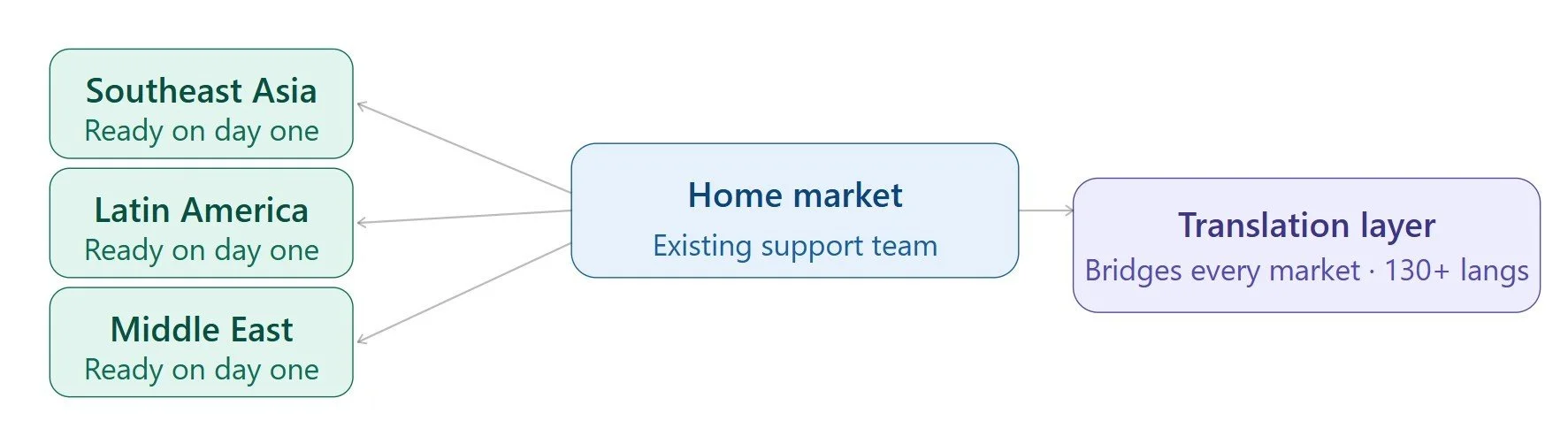
Speaking of new markets, real-time chat translation in Salesforce isn't just about serving existing customers better. It's also about unlocking markets you couldn't previously enter confidently.
Imagine you're a fintech company considering a launch in Southeast Asia. Your product is ready. Your marketing plan is ready. But your support infrastructure only works in English. That's a serious gap, and historically, it's one that required significant investment to close before you could launch.
A multilingual CRM solution built into Salesforce changes that equation. With Salesforce Service Cloud translation handling live chat automatically, you can launch in a new market knowing your support team is ready to handle queries in Thai, Bahasa, or Vietnamese from day one. You’re not hiring a single local agent before you've validated the market.
The ability to move fast in new geographies with lower upfront risk is an ROI that's hard to quantify precisely. But very easy to feel when you're the one making the market entry decision.
ROI Pillar #5: Fewer Escalations and Errors
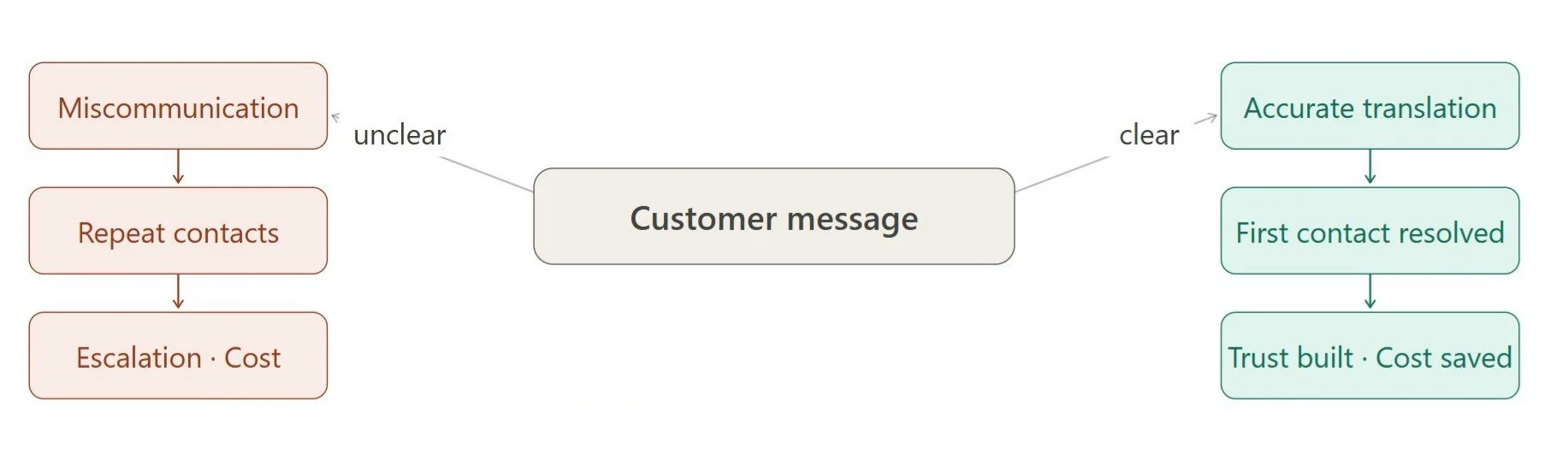
Miscommunication is expensive. In any industry, a support interaction that goes wrong because of a language misunderstanding costs more to fix than it would have cost to get right the first time.
You get escalations. You get complaints. You get repeat contacts from the same customer about the same issue. You get negative reviews. In regulated industries like finance and insurance, you can even get compliance exposure.
Accurate, real-time Salesforce translation cuts through all of this. When agents and customers are communicating clearly, first-contact resolution rates go up. Especially when there is no distortion of manual translation workarounds. Repeat contacts go down. Escalations decrease. And your agents spend their time solving new problems rather than cleaning up miscommunication from old ones.
Each avoided escalation has a cost-saving attached to it. Each reduction in repeat contacts frees up capacity. It's a compounding return. The more accurately your team communicates, the less rework your operation carries.
Where Chatbridge - The Salesforce Chat Translation App Fits In
ChatBridge is a Salesforce chat translation app built natively on the Salesforce platform. This means it delivers all of these ROI benefits directly inside the tools your team already uses.
There's no external dashboard to monitor, no copy-pasting, no new workflow to learn. Agents work in the Salesforce Service Console exactly as they always have. ChatBridge auto-detects customer languages, translates incoming messages, and translates outgoing replies all in real time, across 130+ languages.
A few features directly support the Salesforce translation ROI:
Translation data storage means repeated conversations don't trigger redundant API calls, keeping your translation costs predictable and lean even at high support volumes. Admins can configure the data retention window, and data is automatically deleted once the period expires.
The Agent Transfer feature allows an agent to transfer an active messaging session to another available agent or to a queue. This ensures that conversations can be reassigned to the active agents to maintain availability and full visibility of the previous interaction history.
And because ChatBridge has passed a security review, your customer data stays within the trusted Salesforce environment. It matters particularly for businesses in regulated industries where data residency and security are non-negotiable.
Putting It Together: What's the ROI?
Every business is different, so the exact numbers will vary. But here's the general picture:
Real-time Salesforce translation reduces average handle time per multilingual chat. It increases first-contact resolution rates. It improves CSAT scores among non-English-speaking customers. It reduces the headcount required to serve a multilingual customer base. It enables faster, lower-risk market expansion. And it reduces the compounding cost of miscommunication-driven escalations.
The investment in a Salesforce chat translation app installed directly from AppExchange is a fraction of what most businesses spend on a single additional agent, let alone building out a multilingual support team from scratch.
When you lay those numbers side by side, the ROI of the Salesforce chat translation app isn't hard to see. The harder question is why you'd wait to capture it.
In the Nutshell
Real-time chat translation in Salesforce Service Cloud isn't a nice-to-have feature for global enterprises. It's a practical, high-return investment for any business serving customers who don't all speak the same language, which increasingly is every business.
ChatBridge by Concretio makes that investment as simple as it can possibly be. Native installation, no custom development, a seamless agent experience, and a translation capability that works across 130+ languages from day one. The ROI is there. The tool is ready. The only question is how much longer you want to leave it on the table.
Frequently Asked Questions
-
Multilingual support helps businesses connect with customers in their native language, increasing trust and engagement. With real-time translation in Salesforce Service Cloud, companies can deliver consistent support experiences worldwide without building separate regional teams.
-
Agents can handle conversations in multiple languages without waiting for translators or escalations. This reduces handling time, improves first-contact resolution, and allows support teams to manage higher ticket volumes efficiently.
-
Yes. Customers feel more valued and understood when they receive support in their preferred language. Faster and clearer communication often results in better customer experiences, higher CSAT scores, and stronger brand loyalty.
-
E-commerce, SaaS, travel, healthcare, telecom, and global enterprises benefit significantly from real-time Salesforce translation because they frequently interact with multilingual customer bases across different regions and time zones.
-
Yes, the Salesforce chat translation app, like Chatbridge, supports omnichannel in Salesforce for live chat, case, and conversation translation. This ensures consistent multilingual communication across every customer touchpoint.
Related Reading

Let’s Talk

Drop us a note, we’re happy to take the conversation forward 👇🏻