AI Voice Agents in Healthcare: 8 Production-Ready Use Cases
Key takeaways:
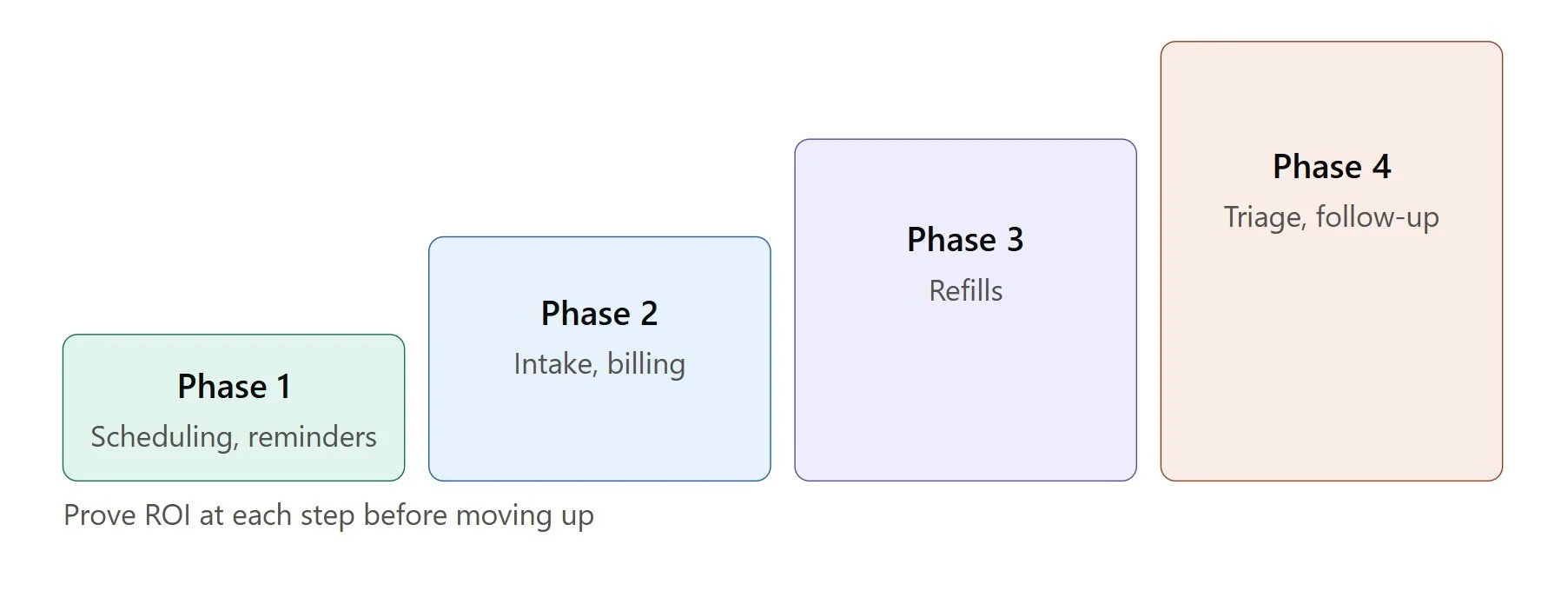
Scheduling, reminders, and intake are the top use cases of AI voice agents, and they prove ROI before you move into triage or follow-up.
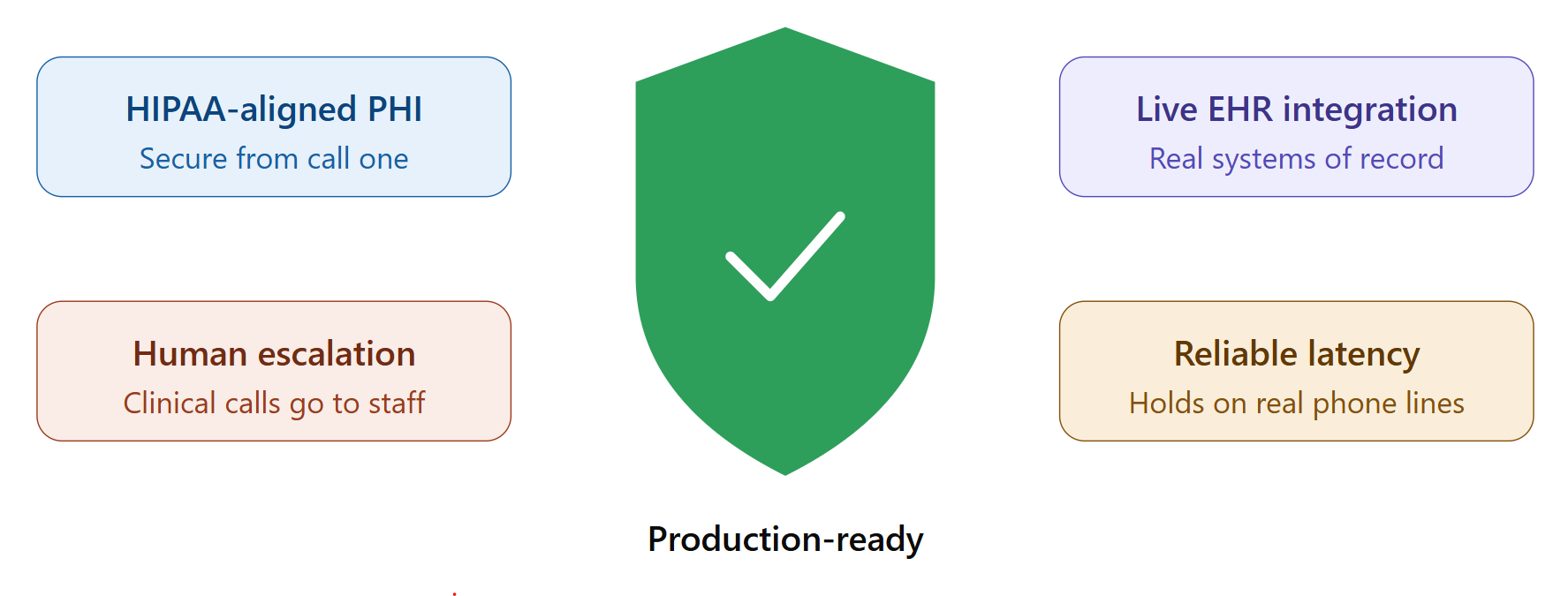
Production-ready voice agents mean HIPAA-aligned PHI handling, live EHR integration, clear human escalation, and reliable latency.
Compliance and tracking come from day one. Track metrics like containment rate, no-shows, CSAT, staff hours, and follow-up compliance.
Healthcare call centers are drowning in repetitive work such as scheduling, reminders, billing questions, and refill requests, while staff shortages make every one of those calls harder to answer fast enough. That gap is exactly why AI voice agents in healthcare have moved from pilot programs to real production deployments faster than almost any other vertical. The global AI voice agents in healthcare market is projected to grow at a compound annual rate near 38% through 2030, according to Grand View Research. This makes healthcare one of the fastest-growing segments in the broader voice AI market.
This isn't about replacing clinicians. It's about healthcare automation for the high-volume, low-complexity calls that eat up front-desk and nurse-line hours. So human staff can spend their time where judgment actually matters. Today, we are going to discuss the eight production-ready use cases of AI voice agents, what makes a deployment "production-ready" in a clinical setting, and how to measure whether it's actually working.
Why Healthcare Is a Natural Fit for Voice AI
Three forces are pushing healthcare organizations toward voice automation faster than almost any other industry:
Call volume is relentless. Scheduling, triage, billing, and follow-up calls never stop, and most of them follow predictable, repeatable patterns. This is exactly the kind of workload voice AI in healthcare is built to absorb.
Clinical staffing shortages. Workforce shortages mean fewer people are available to answer the phone, let alone handle every call with full attention.
Patients still prefer the phone. Older and less tech-comfortable populations in particular trust a phone call far more than a portal login or an app.
Conversational AI in healthcare meets patients where they already are, on the channel they already trust, instead of asking them to adopt a new one.
What Makes a Voice Agent "Production-Ready" in Healthcare
Not every voice bot belongs anywhere near patient data. Before a system takes a single live call, four things need to be locked down:
HIPAA-aligned handling of PHI. Protected health information needs airtight data handling from the first call onward, not a plan to tighten it later.
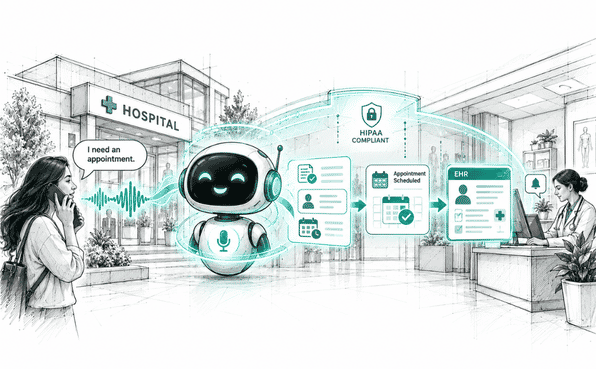
Real EHR or practice-management integration. AI voice agents should read and write against live systems of record, not a bolted-on side database.
Defined escalation paths. Anything resembling clinical judgment needs to route to a human immediately, with no gray area.
Latency and uptime that hold on real phone lines. A system that performs well in a demo but stutters on live noisy calls isn't production-ready yet.
Skip any one of these and a promising pilot tends to turn into a compliance problem down the line, not a success story.
8 Production Use Cases of AI Voice Agents in Healthcare
1. Appointment Scheduling and Rescheduling
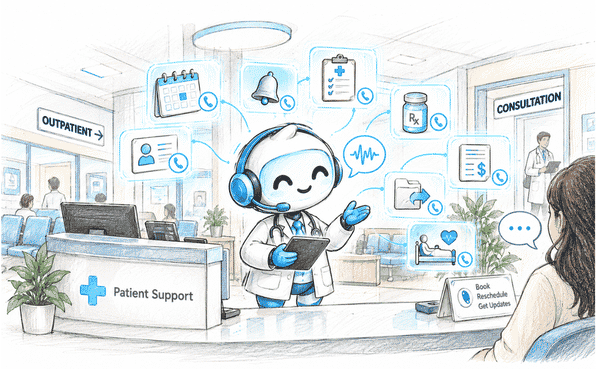
This is the most mature of all voice AI healthcare use cases. A voice agent can check real-time calendar availability, match patients to the right provider or location, confirm insurance on the call, and book or move an appointment without a staff member ever picking up. Because it runs against live scheduling data instead of a static script, it can offer the same flexibility a front-desk employee would.
2. Automated Appointment Reminders and No-Show Reduction
No-shows are one of healthcare's most expensive, most fixable problems. And reminder calls are where the evidence is strongest. A peer-reviewed before-and-after study of the Emirates Health Services primary care network, covering over 135,000 appointments, found that AI-driven reminder calls cut no-show rates nearly in half, from roughly 21% down to about 10%, after the system was introduced (JMIR Formative Research, 2025). The advantage over a plain SMS blast is that the call is two-way: a patient can confirm, reschedule, or cancel in the same conversation instead of just reading a text and forgetting about it.
3. Symptom Triage and Nurse Line Support
AI voice agents in healthcare can gather structured pre-visit information such as symptom onset, severity, relevant history, and route urgent cases to a human nurse immediately. The guardrail here is non-negotiable: the agent collects and organizes information; it does not diagnose or give clinical advice. Every production triage deployment needs a hard-coded boundary between "gathering information" and "making a clinical call," with instant escalation the moment a conversation crosses that line.
4. Prescription Refill Requests
Refill requests are high-volume and mostly procedural. Verify the patient, confirm the medication and pharmacy, and route the request to a provider for approval. AI voice agents can handle the entire intake conversation and hand off a clean, structured request instead of a scribbled phone message, cutting the back-and-forth that usually slows refills down.
5. Billing and Insurance Inquiries
Questions about claim status, copay amounts, or setting up a payment plan are exactly the kind of structured, data-lookup conversation healthcare AI voice agents handle well. Patients get answers without sitting on hold, and billing staff is freed up for the disputes and edge cases that actually need a person.
6. Post-Discharge Follow-Up Calls
Automated check-in calls after discharge can ask about recovery, medication adherence, and warning signs, and flag anything concerning for a clinical team to follow up on directly. Done well, this is a form of patient communication automation that improves outcomes rather than just cutting costs, since it catches readmission risk early instead of waiting for a scheduled follow-up appointment that might be weeks away.
7. Patient Intake and Pre-Registration
Before a visit even happens, healthcare AI voice agents can verify insurance details and collect medical history over the phone, so patients arrive with paperwork already done. This shortens front-desk wait times and gives staff a cleaner starting point for the visit itself.
8. Referral Management and Care Coordination
Referrals are a common place for patients to fall through the cracks. The healthcare voice assistant can call patients to confirm a referral, help them book with the specialist, and collect basic details such as insurance and availability. It can also notify the referring office when the appointment is booked. Because it works from the referral record, nobody has to chase the loop by phone. Anything that needs a clinical decision, such as changing the referral's urgency, goes to a human coordinator.
Measuring Success: KPIs for Healthcare Voice Agents
A deployment only earns its keep if someone is tracking the right numbers from the start, not after a quarter has already slipped by. The KPIs and metrics worth watching closely include:
1. Call containment rate: the share of calls resolved entirely by the agent, with no human pickup required.
2. No-show rate, before and after: tracked against a clean baseline so the improvement is real, not seasonal.
3. Patient satisfaction (CSAT or NPS): a direct signal of whether patients find the experience helpful or frustrating.
4. Staff hours reclaimed: time no longer spent on routine calls, redirected toward higher-value work.
5. Follow-up and care-plan compliance: particularly relevant for post-discharge outreach, where it doubles as an early-warning signal.
Watching these from day one makes it possible to catch a poorly tuned deployment early before it quietly reduces patient trust.
Compliance and Ethical Considerations Specific to Healthcare
Voice AI in a clinical setting carries legal and ethical weight that most other industries don't have to think about. A few things are non-negotiable:
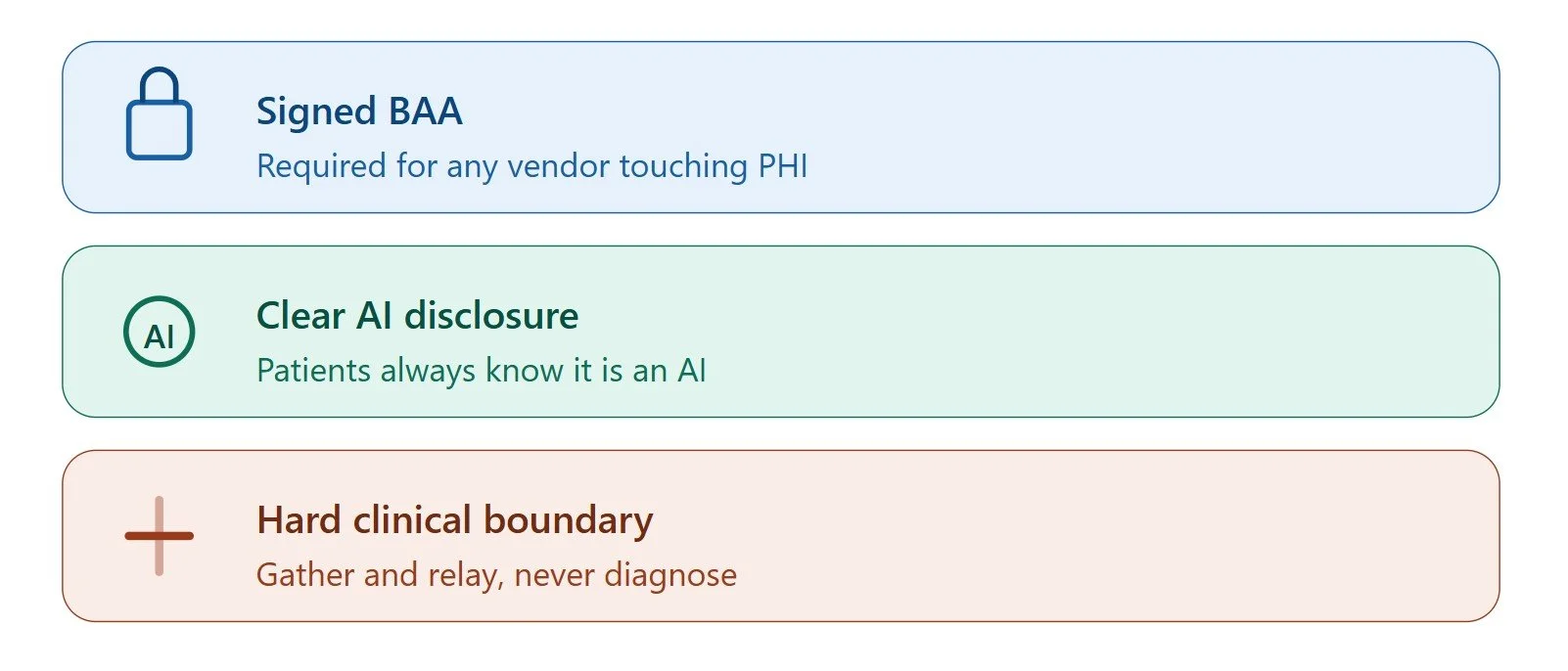
A signed Business Associate Agreement. Any vendor touching protected health information needs a BAA in place. A general data-processing promise isn't enough.
Clear AI disclosure. Patients should always know, without ambiguity, when they're talking to an AI system rather than a person.
A hard boundary on clinical advice. The agent can gather and relay information, but diagnosis and clinical judgment stay strictly with licensed staff.
These aren't optional nice-to-haves, but they're the difference between a deployment that survives a compliance audit and one that doesn't.
Implementation Lessons from Real Deployments
The most common failure mode isn't the AI itself; it's over-scoping too early. A few patterns show up repeatedly across real rollouts:
Start narrow, then expand. Teams that begin with scheduling and reminders, prove the ROI, and only then move into triage or billing tend to succeed. Teams that try to automate clinical judgment on day one tend to stall.
Bring front-desk and clinical staff in early. A voice agent that quietly reroutes someone's daily workflow without explanation creates resistance fast.
Treat integration as the hard part. Most health systems don't build this entirely from scratch. They either buy a healthcare-native platform or bring in AI voice agent development services to do the integration right.
In practice, that usually means organizations need to hire AI developers with real healthcare integration experience. People who understand EHR connections, the compliance layer, and escalation logic well enough that a generic off-the-shelf bot won't get it right on its own.
The Future: What's Next for Voice AI in Healthcare
The next phase looks less reactive and more proactive. Agents that initiate outreach based on risk signals rather than waiting for a scheduled call, multilingual support that scales patient communication across diverse populations without adding headcount, and tighter integration with wearables and remote monitoring data so a voice check-in can reference a patient's actual vitals instead of asking generic questions.
Final Thoughts
AI voice agents in healthcare provide production-proven use cases, each with its own data requirements, compliance boundaries, and success metrics. The organizations getting real value aren't chasing the flashiest automation. They're starting with scheduling and reminders, measuring rigorously, and expanding into triage and follow-up only once the foundation is solid. If you're evaluating tools or planning a build, that's the order to follow, and the compliance and integration work is exactly where experienced AI voice agent development partners earn their keep.
Frequently Asked Questions
-
They are phone-based AI systems that hold natural conversations with patients to handle tasks like scheduling, reminders, intake, billing questions, and follow-up calls. They connect to systems such as the EHR, so they can act on a request instead of only answering it.
-
No. They take over repetitive, low-complexity calls so staff can focus on work that needs human judgment. Anything clinical is routed to a human.
-
Only if they are built and deployed that way. That means HIPAA-aligned handling of protected health information, a signed Business Associate Agreement with the vendor, and clear disclosure to patients that they are speaking with an AI.
-
Most successful deployments begin with appointment scheduling and reminders. A peer-reviewed study of AI reminder calls across more than 135,000 appointments found no-show rates dropped from roughly 21% to about 10%.
-
Track containment rate, no-show rate before and after, patient satisfaction (CSAT or NPS), staff hours saved, and follow-up or care-plan compliance. Start measuring from the first week.
-
One of the biggest challenges of AI in healthcare is protecting patient data and privacy. Other concerns include biased algorithms, inaccurate predictions, high implementation costs, and ensuring that AI systems are reliable and trustworthy.
-
Healthcare uses several types of AI, including machine learning, deep learning, voice agentic AI, natural language processing (NLP), computer vision, and generative AI. These technologies help analyze medical images, predict diseases, support clinical decisions, and automate administrative tasks.
-
One of the most common uses of AI in healthcare is analyzing medical images to help detect diseases. AI also supports clinical decision-making, patient monitoring, medical documentation, and administrative automation, improving efficiency and supporting better patient care.
-
Voice AI will help healthcare professionals document consultations, update electronic health records, schedule appointments, and access patient information through voice commands. It can also support virtual health assistants, reduce administrative workloads, and improve patient communication.
Related Readings
Let’s Talk

Drop us a note, we’re happy to take the conversation forward 👇🏻