
Understanding Agentforce Pricing and Whether the Business Value Is Worth the Cost
Key Takeaways:
Agentforce pricing should be evaluated alongside business value and ROI.
Understanding Flex Credits and implementation costs helps avoid unexpected expenses.
Clear business goals are key to maximising Agentforce ROI and long-term value.
As businesses invest money into AI, it's important to know what it really costs to use it, just like understanding how it works. Agentforce has strong features for automating things like customer service, sales and operations, but figuring out how much it costs can be tricky at first.
The challenge is more than adding up how much you use it. It's about making sure the benefits of using AI agents are worth the cost. From credits and paying based on how much you use it to getting more done and seeing a good return on investment, companies need a clear way to see if it's working.
In this guide, we will break down how Agentforce pricing works, what affects how much you pay and how to decide if Agentforce is an investment, and you will get to know about Flex Credits and usage-based pricing, productivity gains and the ROI
How Agentforce Pricing Works
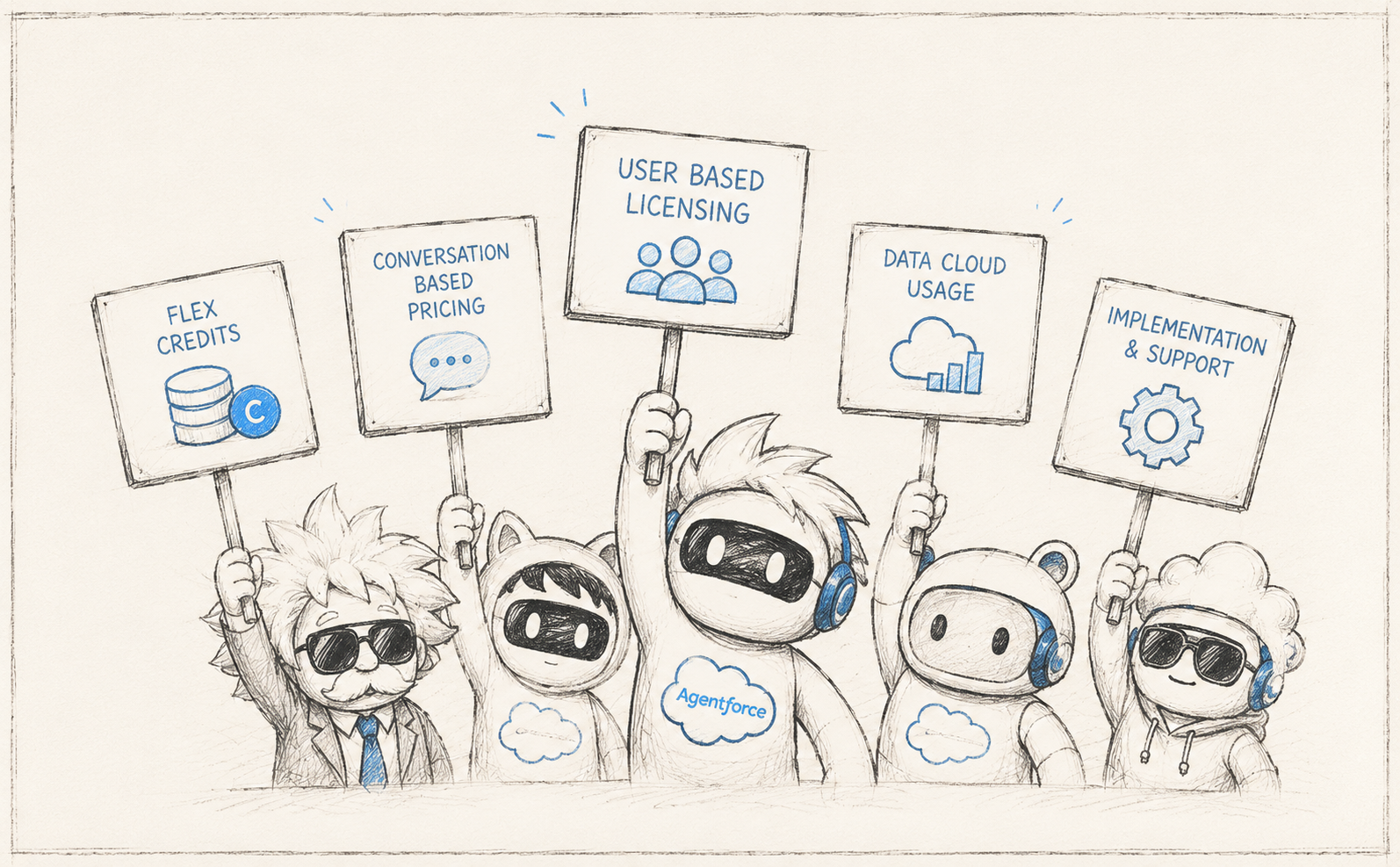
One reason people are talking about Agentforce pricing is that Salesforce is not just using one way to price things anymore.
Now, businesses have multiple options to choose from when it comes to Agentforce pricing. This is because they use Agentforce in ways that require different pricing options.
These include:
Consumption-based pricing through Flex Credits
Conversation-based pricing models
User-based licensing options for employees
This way organisations can pay for what they use, which is Agentforce, rather than paying for things they do not need.
Flex Credits
Salesforce came up with Flex Credits to help businesses pay for things that artificial intelligence does rather than paying for whole conversations.
Under this way of doing things:
Standard actions consume Flex Credits.
More complex actions require additional credits.
Voice interactions typically consume more credits than standard actions.
Costs scale based on how frequently AI agents perform tasks.
The main idea is straightforward: make the cost closely related to what the business gets out of it. Rather than paying a fixed amount of money every time, no matter what, businesses can connect what they spend to what the agents are actually doing.
Conversation-Based Pricing
Conversation-based pricing is for businesses that want what they pay to be directly related to when customers talk to them.
By keeping track of every little thing the artificial intelligence does, businesses pay based on how many conversations the Agentforce handles.
This way of doing things can be easier for customer service teams to predict because they have to deal with a lot of customer questions.
User-Based Licensing
User-based licensing is more like how people pay for software.
Businesses pay based on how many employees use the Agentforce agents rather than how much technology is used.
This way of doing things is often better for things that happen inside the company like helping the sales team or supporting employees because businesses like to know how much they will pay.
Why Salesforce Moved Toward Flexible Pricing
Not every company uses AI in the same way. A team that helps customers might get thousands of requests every day, while a sales team might only use artificial intelligence to find important new customers. If every company paid the same way it would not be fair.
So Salesforce made a pricing system that gives companies more control over how they use artificial intelligence. It also makes it clearer how what the company pays is related to what the artificial intelligence does for the business.
What Does Agentforce Really Cost in a Year?
While Flex Credits and user licensing often receive the most attention, businesses should evaluate the Total Cost of Ownership (TCO) before investing in Agentforce.
The first-year investment typically includes licensing, Data Cloud, implementation services, and ongoing optimisation.
| Cost Component | Mid-Market Organizations | Enterprise Organizations |
|---|---|---|
| Agentforce Licenses | $15K–$50K/year | $50K–$200K/year |
| Data Cloud | $65K–$175K/year | $175K–$500K/year |
| Implementation & Deployment | $50K–$150K | $150K–$500K |
| Annual Tuning & Maintenance | $20K–$50K/year | $50K–$150K/year |
| Estimated Year 1 Total | $150K–$425K | $425K–$1.35M |
Note: Actual costs vary based on business size, data volume, integrations, implementation complexity, and AI usage patterns.
Why First-Year Costs Are Often Higher
Many organisations budget only for licenses and AI consumption. However, the first year typically includes one-time implementation activities such as:
Agent configuration and workflow design.
Salesforce integrations.
Data preparation and migration.
Security and governance setup.
Employee onboarding and training.
As a result, implementation and infrastructure investments can represent a significant portion of the overall project budget.
Looking Beyond the Price Tag
A first-year investment of $150K-$425K may seem substantial for a mid-market business. However, if Agentforce helps reduce support costs, automate repetitive work, improve customer experiences, and increase employee productivity, the return on investment can quickly outweigh the initial spend.
This is why organisations should evaluate Agentforce based on business outcomes generated, not just the upfront cost of deployment.
Consumption Costs vs Business Value: What Really Matters?
When evaluating Agentforce pricing, it's easy to focus on consumption costs. After all, Flex Credits, conversations, and licensing fees are measurable expenses that appear directly on a budget report.
However, consumption tells only half the story. The real question isn't how much Agentforce costs; it's whether the value generated justifies the investment.
Consider the following example:
| Scenario | Monthly Agentforce Cost | Business Outcome |
|---|---|---|
| Company A | $1,000 | Automates basic tasks with limited impact. |
| Company B | $3,000 | Reduces support workload, improves response times, and increases productivity. |
Looking at costs alone, Company A appears to be spending less. But when business outcomes are considered, Company B may be receiving significantly greater value from its investment.
This is where many organisations make a costly mistake. They focus on reducing AI consumption instead of maximising business impact.
The Metrics That Help Validate Agentforce ROI
Rather than focusing solely on Flex Credits or conversations, organisations should measure outcomes such as:
Time saved through automation.
Reduction in support costs.
Faster case resolution times.
Employee productivity improvements.
Customer satisfaction scores.
Revenue influenced by AI-powered interactions.
These metrics provide a clearer picture of whether Agentforce is delivering a positive return on investment.
Cost vs. Value: A Simple Framework
| Scenario | Monthly Agentforce Cost | Business Outcome |
|---|---|---|
| Company A | $1,000 | Automates basic tasks with limited impact. |
| Company B | $3,000 | Reduces support workload, improves response times, and increases productivity. |
The goal is not to achieve the lowest possible consumption. The goal is to ensure every dollar spent on Agentforce contributes to meaningful business outcomes.”
Organisations that evaluate Agentforce based only on consumption costs risk overlooking the bigger picture. The most successful businesses measure how AI impacts productivity, customer experience, and revenue, not just how many credits are consumed.
Ultimately, the question isn't "How much are we spending on Agentforce?"
It's "What value are we getting in return?"
How to Measure Agentforce ROI
Understanding Agentforce costs is only one part of the equation. To determine whether the investment is worthwhile, organisations need a clear framework for measuring return on investment (ROI).
The most successful businesses evaluate Agentforce based on outcomes rather than activity. Instead of tracking only Flex Credits or conversations, they focus on metrics that directly impact operational performance and business growth.
| Metric | Why It Matters |
|---|---|
| Time Saved | Measures how much manual work is eliminated through automation. |
| Cost Reduction | Identifies operational savings created by AI-driven workflows. |
| Customer Satisfaction (CSAT) | Evaluates improvements in customer experiences. |
| Resolution Time | Tracks how quickly issues are resolved. |
| Employee Productivity | Measures efficiency gains across teams. |
| Revenue Impact | Assesses how AI contributes to lead generation, conversions, and sales growth. |
Learn more about how to maximise Agentforce ROI.
Real-World Agentforce Cost Examples
One of the biggest challenges when evaluating Agentforce pricing is understanding what costs might look like in a real business environment. While actual expenses vary based on usage and workflow complexity, Salesforce provides several examples that help illustrate how consumption-based pricing works in practice.
Example 1: Customer Case Management
Imagine a support team with 100 Salesforce users, each managing three customer cases per day over 20 working days per month.
For each case, Agentforce performs three actions:
Identify the customer by email
Retrieve customer cases
Add comments to the case
This workflow consumes 60 Flex Credits per use case, resulting in approximately 360,000 Flex Credits per month and an estimated monthly cost of $1,800. This example demonstrates how Agentforce AI can support customer service teams by automating repetitive case management tasks at scale.
| Metric | Value |
|---|---|
| Actions per Use Case | 3 |
| Flex Credits per Use Case | 60 |
| Monthly Flex Credits | 360,000 |
| Estimated Monthly Cost | $1,800 |
Example 2: Field Service Appointment Scheduling
For field service organisations, Agentforce can help schedule appointments based on customer preferences and technician availability.
In Salesforce's example:
10 field service representatives
3 appointments per day
20 working days per month
The workflow requires five actions, including identifying customers, retrieving work types, and finding available appointment slots.
| Metric | Value |
|---|---|
| Actions per Use Case | 5 |
| Flex Credits per Use Case | 100 |
| Monthly Flex Credits | 60,000 |
| Estimated Monthly Cost | $300 |
Despite requiring more actions than the case management example, the smaller user volume keeps overall costs relatively low.
Conclusion
Understanding Agentforce pricing is important, but the real decision comes down to value. Organisations that focus on measurable outcomes such as productivity gains, improved customer experiences, and operational efficiency are more likely to see a strong return on their investment.
By aligning AI initiatives with clear business goals and leveraging the right expertise through Salesforce Consulting Services, businesses can make smarter decisions and maximise the impact of Agentforce.
Frequently Asked Questions
-
Flex Credits charges businesses based on the actions an AI agent performs, while conversation-based pricing charges per completed conversation. Flex Credits offer greater flexibility across use cases, whereas conversation pricing is often easier to forecast in customer-facing support scenarios.
-
Not every deployment requires Data Cloud, but many organisations use it to provide AI agents with access to customer data, business information, and real-time insights. Data Cloud costs should be factored into the total cost of ownership.
-
Organisations typically measure Agentforce ROI through metrics such as time saved, reduced support costs, faster case resolution, improved employee productivity, customer satisfaction scores, and revenue impact.
-
Yes. Agentforce can be adopted for both customer-facing and internal use cases. Businesses can start with a limited deployment and scale usage as they identify high-value opportunities for automation.
-
The primary cost drivers include the number of AI actions performed, workflow complexity, implementation requirements, Data Cloud usage, integrations, and ongoing optimization efforts.
Related Reading
Let’s Talk

Drop us a note, we’re happy to take the conversation forward 👇🏻