
How Salesforce Data Cloud Powers AI Forecasting with Unstructured Data

Key Summary:
Unlock hidden revenue with Salesforce Data Cloud by converting unstructured data—like emails and PDFs—into actionable AI forecasting signals.
Build an AI-ready foundation that unifies enterprise datasets, fueling smarter predictive analytics via Einstein AI and Agentforce.
Drive predictive accuracy and improved customer intelligence by bridging data silos for better, real-time revenue forecasting.
Enterprise teams lose millions when CRM forecasting ignores the massive volume of customer signals hidden in emails, PDFs, call transcripts, support tickets, and Slack conversations. In fact, industry estimates suggest that up to 80% of enterprise data is unstructured, yet only 18% of it is actively utilized. Traditional models focus primarily on structured data, often missing critical insights related to churn risks, buying intent, and real-time behavioral patterns.
Salesforce Data Cloud helps organizations transform disconnected enterprise data into an AI-ready ecosystem. Combined with Einstein AI and Agentforce AI, businesses can leverage predictive analytics, automation, and advanced AI forecasting tools to build smarter forecasting models.
In this guide, we’ll explore how Salesforce Data Cloud powers AI forecasting and transforms unstructured data into actionable business insights.
What is Unstructured Data & Why It Matters for Forecasting
Unstructured data is information without a predefined format, such as emails, PDFs, call transcripts, support tickets, Slack conversations, and documents that don't fit neatly into database tables like CRM records do. Salesforce Data Cloud helps transform this information into a structured form of data that can be used by enterprises for forecasting and decision-making.
Today, a large percentage of enterprise data is unstructured, making it one of the most valuable yet underutilized business assets.
Traditional forecasting models rely mainly on structured CRM data, often missing critical signals hidden in emails, support tickets, and customer conversations, creating major gaps in forecasting accuracy.
For forecasting, unstructured data provides:
Sentiment signals from customer communications
Behavioral patterns across support interactions
Intent indicators from email threads and documents
Churn precursors in call transcripts and tickets
Data Cloud unlocks this value through Document AI extraction and vector search, enabling Einstein models to analyze complete customer context for dramatically more accurate revenue predictions and opportunity scoring. This helps businesses build a stronger unified customer data foundation for AI forecasting.
How Salesforce Data Cloud Processes Unstructured Data
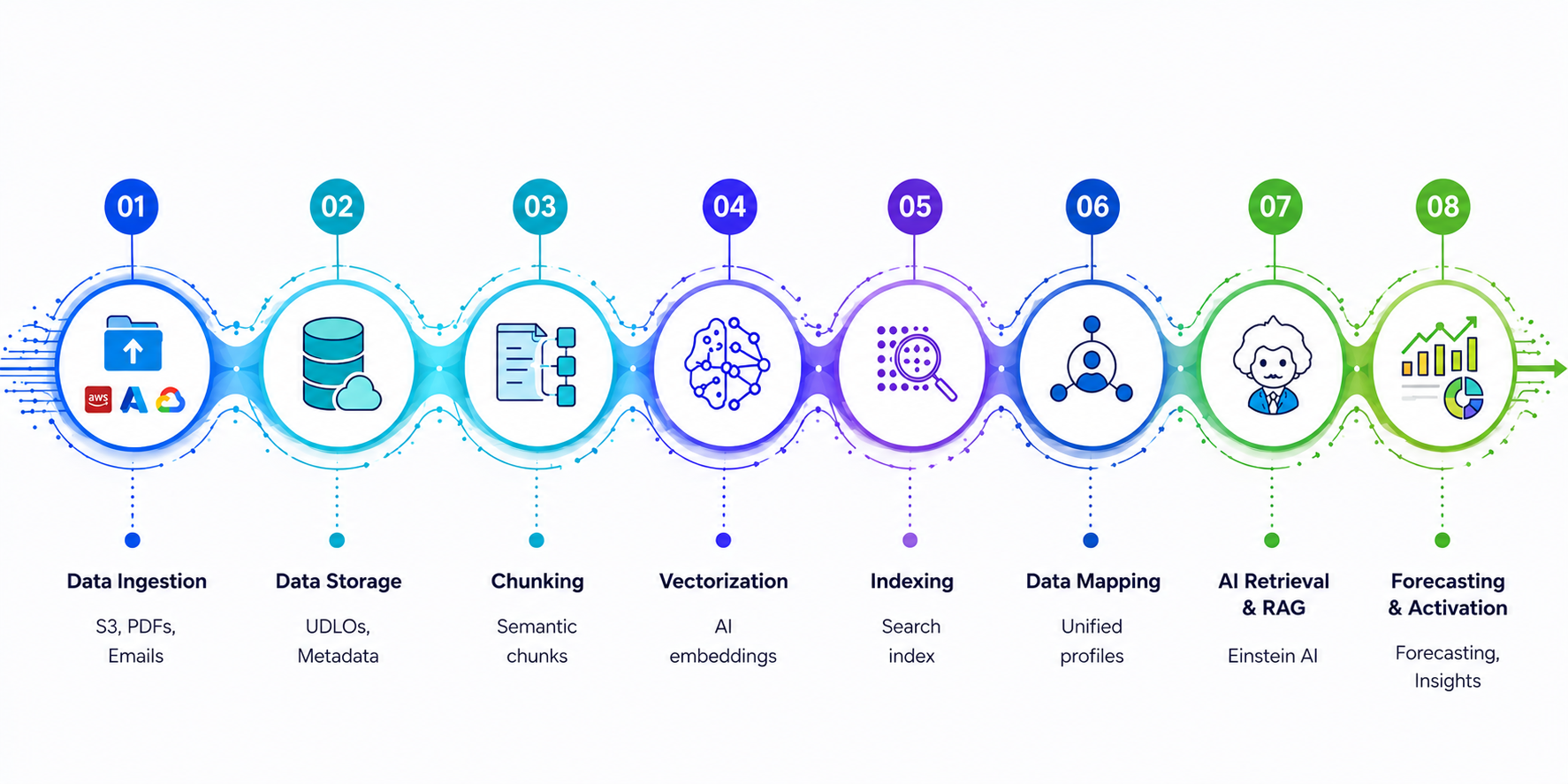
Salesforce Data Cloud helps centralize enterprise data, enabling Agentforce and AI-powered applications to access relevant information for forecasting, analytics, and decision-making.
Data Ingestion: Data Cloud ingests unstructured files from external sources such as Amazon S3, Azure Blob Storage, Google Cloud Storage, emails, PDFs, support systems, and collaboration platforms.
Data Storage: The ingested content and metadata are stored within Unstructured Data Lake Objects (UDLOs) for centralized processing and management.
Chunking: Large documents and files are divided into smaller semantic chunks to improve contextual understanding and retrieval accuracy.
Vectorization: The chunks are converted into vector embeddings, transforming text into numerical representations that AI models can process semantically.
Indexing: Data Cloud creates vector and search indexes on the embeddings to enable efficient semantic search and similarity-based retrieval.
Data Mapping: The processed data is mapped to Unstructured Data Model Objects (UDMOs), connecting unstructured content with unified customer profiles and enterprise records. This allows organizations to generate real-time customer insights across multiple business systems.
AI Retrieval & RAG Processing: The indexed data supports Retrieval-Augmented Generation (RAG) workflows in Einstein AI and Einstein Studio, enabling AI systems to retrieve relevant enterprise knowledge and generate context-aware responses.
Forecasting & Insight Activation: The processed insights are activated across forecasting models, automation workflows, customer intelligence systems, and real-time business analytics. This makes Salesforce a powerful customer data platform for AI-driven forecasting.
Now that we understand how unstructured data is processed, let's take a closer look at the technology that empowers Salesforce forecasting and drives predictive insights.
Predictive Intelligence Technologies Behind Salesforce Forecasting
Salesforce predictive analytics combines AI, automation, and real-time customer intelligence to transform traditional forecasting into a data-driven process.
1. Einstein Forecasting
Einstein AI analyzes historical opportunity data, sales activities, pipeline behavior, and customer interactions to predict future revenue outcomes and improve forecast accuracy.
2. Predictive Deal Scoring
Einstein automatically scores opportunities by identifying patterns from previous wins and losses, helping sales teams prioritize deals with the highest probability of closing.
3. Pipeline Trend Analysis
Salesforce Agentforce continuously monitors pipeline movement, detecting stalled deals, momentum shifts, forecasting risks, and changes in sales performance in real time.
4. Autonomous AI Agents
Agentforce autonomously processes enterprise data and market signals, continuously enhancing forecast accuracy and sales planning.
5. Agentic Workflows
Salesforce AI automation workflows automatically aggregate customer and operational data, enabling forecasting systems to adapt to changing business conditions without manual intervention.
6. Conversation Intelligence
Einstein Conversation Insights analyzes customer calls, meetings, and transcripts to identify sentiment, buying intent, risks, and engagement patterns that impact forecast outcomes.
7. Unified Data Foundation
Salesforce Data Cloud unifies structured and unstructured enterprise data across Customer 360, providing a centralized data cloud platform and AI-ready foundation for predictive modeling. This strengthens Customer 360 Data Cloud capabilities for enterprise forecasting.
8. Scenario Modeling
Sales leaders can simulate “what-if” forecasting scenarios, such as changes in deal size, pipeline growth, or sales cycles, to evaluate potential business outcomes.
9. CRM Analytics & Visualization
Salesforce CRM Analytics delivers AI-powered dashboards, predictive insights, and data visualizations that help organizations identify trends and forecast future customer behavior.
10. Predictive Customer Intelligence
By integrating data across Sales, Service, Marketing, and Commerce Cloud, Salesforce can predict customer lifetime value, churn risks, and future buying behavior to improve revenue forecasting. These capabilities help businesses strengthen their predictive customer intelligence strategy.
Key Challenges Businesses Must Address
1. Large Data Volume
Unstructured enterprise data grows rapidly across emails, documents, support conversations, videos, and collaboration platforms. Managing and storing massive volumes of data becomes challenging, especially when information is distributed across multiple systems and data silos.
2. Data Complexity
Unlike structured CRM records, unstructured data does not follow a predefined format. Processing text, audio, PDFs, images, and conversations requires advanced technologies such as natural language processing (NLP), machine learning, and AI-powered analytics tools.
3. Difficult Data Analysis
Extracting meaningful insights from large volumes of unstructured content is both time-intensive and technically complex. Organizations need intelligent AI systems capable of understanding context, sentiment, intent, and behavioral patterns hidden within the data.
4. Data Governance and Security
As businesses unify enterprise data for AI forecasting and analytics, maintaining governance, privacy, and compliance becomes critical. Organizations must ensure secure access controls, regulatory compliance, data protection, and consistent policy enforcement across all applications and users.
5. Real-Time Data Processing
Modern forecasting systems require real-time analysis of continuously changing enterprise data. Processing high-volume unstructured information at scale without performance delays remains a major technical challenge for many organizations.
Final Thoughts: From Data to Predictive Intelligence
Salesforce Data Cloud helps businesses transform unstructured enterprise data into AI-driven forecasting insights. Combined with Einstein AI and Agentforce AI, organizations can improve forecast accuracy, customer intelligence, and real-time decision-making.
Looking to implement AI-powered forecasting with Salesforce Data Cloud? Connect with an experienced Salesforce consultant to build smarter, scalable forecasting solutions.
Frequently Asked Questions
-
Real-time data ensures that forecasts reflect the latest pipeline changes, customer behavior, market conditions, and sales activities. This helps organizations reduce forecasting errors and make more informed business decisions.
-
Agentforce analyzes real-time business data, identifies trends, detects potential risks, and provides actionable insights that help sales teams make more accurate revenue predictions and respond faster to changing market conditions
-
Together, Salesforce Data Cloud and Agentforce create a unified AI-powered forecasting environment that improves data quality, enhances predictive accuracy, automates analysis, and provides real-time business insights.
-
Unstructured data helps AI forecasting models identify customer intent, sentiment, churn risks, and behavioral patterns that traditional CRM data often misses.
Related Reading
Let’s Talk

Drop us a note, we’re happy to take the conversation forward 👇🏻