
Can Salesforce Marketing Cloud Connect to Other Tools?
Updated on: Jul 16
Before we begin with Salesforce marketing cloud integration with other tools, we must get a little context about modern marketing teams. These modern marketing teams rely on multiple platforms such as CRM systems, e-commerce tools, advertising networks, and social media analytics. While each system generates valuable customer data, that information often remains scattered across disconnected tools. As a result, marketers struggle to build a unified view of their customers or deliver consistent experiences across channels.
Salesforce Marketing Cloud is designed to solve this challenge by bringing customer data, campaigns, and communication channels into a single platform. However, many businesses still rely on other marketing tools alongside it. This raises an important question:
Can Salesforce Marketing Cloud integrate with other marketing platforms?
With the Salesforce Marketing Cloud Jan'21 release notes, we can say that the answer is a definitive yes. Salesforce Marketing Cloud is not like an island; it is designed to be the central nervous system of your entire marketing technology stack. Whether you are connecting a third-party e-commerce platform, a social media analytics tool, or a legacy database, Marketing Cloud integration is the key to unlocking a 360-degree view of your customer. Users should learn about Marketing Cloud Engagement vs Marketing Cloud Account Engagement as well if they really want to master it.
What is the Purpose of the Marketing Cloud Platform?
The purpose of a Marketing Cloud platform is not limited to sending marketing messages. It helps businesses integrate customer data, personalize experiences, and coordinate communication across multiple channels.
These goals are achieved through the following core capabilities:
Data Unification
Instead of having your website data in one place and your store purchases in another, the platform pulls every signal, web visits, mobile app clicks, and support tickets into a single profile. You finally see the person, not just a series of disconnected data points.
1-to-1 Personalization
The goal isn't just to send an email; it's to deliver the right offer to the ideal customer at the exact moment they are most likely to buy. It’s the difference between a random coupon and a timely recommendation for something a customer actually needs.
Cross-Channel Orchestration
This ensures your marketing feels like one continuous conversation across every device. If a customer just bought a pair of shoes after clicking an Instagram ad, the platform "tells" the email system to stop sending them "introductory" discounts five minutes later.
Real-Time Analytics
Using tools like Marketing Cloud Intelligence, companies don't have to wait until the end of the month to see if a campaign worked. AI-driven insights allow marketers to see what’s failing in real-time and shift their budget to the strategies that are actually driving conversions.
The Process of Connecting Salesforce Marketing Cloud
Integrating your marketing stack isn't a "one-click" miracle; it’s a strategic process. When you engage in Salesforce Marketing Cloud implementation services, the workflow typically follows these technical and strategic milestones:
1. Discovery and Mapping
Before writing a single line of code in this marketing cloud connect setup,Salesforce Marketing Cloud expertsmap out your data architecture. What is the "System of Record"? Where does the most accurate customer email live? Mapping these flows prevents data conflicts later.
2. Marketing Cloud Connect (The Salesforce Bridge)
If you use Salesforce Sales or Service Cloud, the first step is usually Marketing Cloud Connect. This native integration allows data to flow back and forth between your CRM and your marketing engine. It enables "Triggered Sends," for example, when a salesperson marks a lead as "Qualified" in the CRM, Marketing Cloud automatically drops them into a specialized nurture journey.
3. API Integration (REST and SOAP)
For non-Salesforce tools such as a custom loyalty app or a specialized POS system, developers typically use APIs to connect with Marketing Cloud.
REST API: Commonly used for modern web applications and triggering real-time events.
SOAP API: Typically used for complex, high-volume data transfers and integrations with legacy systems.
4. Setting up Marketing Cloud Intelligence Salesforce
Integration isn't just about moving data; it’s about understanding it. By connecting all your disparate ad platforms (Google Ads, Meta, TikTok) into Marketing Cloud Intelligence, you create a single source of truth for your ROI. Moreover, users must focus on Salesforce marketing cloud CRM integration review as well.
Note: Know how journey event triggered flows connect journey builder to Marketing Cloud seamlessly with proper guidance.
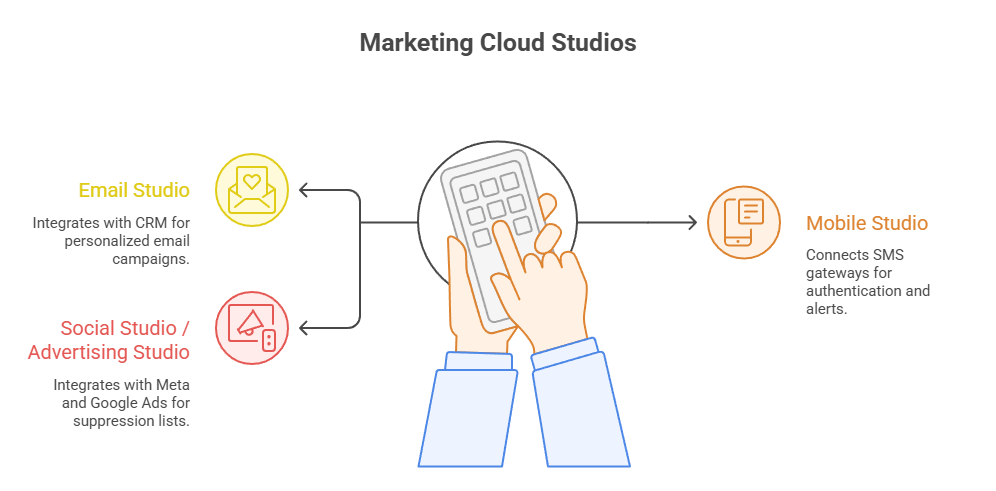
Key Modules of Salesforce Marketing Cloud Integration
Email Studio: Integrates with your CRM to automatically pull real-time customer data, enabling personalized and up-to-date email marketing campaigns.
Mobile Studio: Connecting SMS gateways for two-factor authentication or shipping alerts.
Social Studio / Advertising Studio: Integrating with Meta and Google Ads to sync "Suppression Lists" (so you don't waste ad money on people who already bought).
Real-Life Scenario: The "Smart" Retail Experience
Let’s look at a practical example of how integration changes the game. Imagine a global outdoor gear retailer. They use Salesforce Marketing Cloud, but they also use a third-party weather data API and a separate e-commerce engine.
The Integrated Journey:
The Trigger: The weather API signals a massive snowstorm hitting the Northeast.
The Integration: Marketing Cloud receives this signal and queries the e-commerce database for customers in that zip code who have browsed "winter boots" but haven't purchased.
The Action: An automated SMS and Email are sent with a "Snowstorm Special" discount code.
The Result: The customer buys the boots. The e-commerce system notifies Marketing Cloud to stop the "abandoned cart" journey immediately, so the customer isn't annoyed by redundant ads.
Common Marketing Cloud Integration Challenges (and How to Avoid Them)
Most integration headaches trace back to a handful of predictable issues:
Messy or inconsistent source data. If contact records, IDs, or field formats differ across systems, syncs will fail or create duplicates. Run a data-cleansing pass and standardize key fields before connecting anything.
API/governor limits. Salesforce enforces call limits to protect platform stability. High-volume syncs (large contact lists, frequent updates) can hit these limits if not batched properly. Design integrations around batch processing and rate limits from the start, not after they fail.
Field mapping errors. Mismatched or missing field mappings between Marketing Cloud and connected systems cause data to sync incorrectly or silently drop. Map every field explicitly and test with sample records before going live.
Real-time vs. batch sync confusion. Not every integration needs real-time updates. Over-engineering for real-time sync, where batch would suffice, adds cost and complexity without added value. Match the sync method to the actual business need.
Skipping a staging/sandbox test. Connecting systems directly in production without testing in a sandbox first is a common way that small mapping or logic errors turn into customer-facing data problems.
Choose the Right Salesforce Marketing Cloud Consultant
The platform is incredibly powerful, which also means it is complex. Many businesses fail not because the tool is bad, but because the implementation was flawed. This is why choosing the right Salesforce Marketing Cloud consulting partner is vital.
What to look for in Salesforce Marketing Cloud experts:
Proven Track Record: Look for partners with a portfolio of complex integrations, not just basic email templates.
Strategic Depth: A good consultant will not just ask, "What do you want to build?" They will ask, "What business problem are we solving?"
Technical Versatility: They should be comfortable with AmpScript, SSJS, and SQL, which are the languages that power deep integrations.
Post-Go-Live Support: Implementation is just the beginning; you need a partner who provides training to ensure your internal team can drive the Ferrari you just bought.
The Future: AI and Autonomous Marketing
In 2026, integration has evolved. We are no longer just connecting databases; we are connecting AI Agents. With Salesforce’s latest advancements, your integrated stack can now use "Agentforce" to autonomously resolve customer issues or adjust marketing spend across platforms without a human needing to click "send."
Summary Table: Integration Benefits
| Feature | Without Integration | With Marketing Cloud Integration |
|---|---|---|
| Customer View | Fragmented/Siloed | Unified 360-degree Profile |
| Data Speed | Manual uploads/Delayed | Real-time synchronization |
| Personalization | Generic / "Hi [First_Name]" | Hyper-personalized based on behavior |
| Reporting | Spreadsheets & Guesswork | Marketing Cloud Intelligence Dashboards |
Final Thoughts
So, can Salesforce Marketing Cloud be integrated with other marketing tools?
Yes, and it is the only way to stay competitive. By breaking down the walls between your CRM, your website, and your advertising platforms, you move from "marketing to people" to "building relationships with people."
If you are ready to stop managing platforms and start managing experiences, it’s time to look into professional Salesforce Marketing Cloud consulting. The right integration today is the foundation for your growth tomorrow.
Ready to Transform Your Digital Strategy?
Don't let data silos hold your business back. Concretio’s team of Salesforce Marketing Cloud experts is ready to help you bridge the gap between your tools and your customers.
Connect with Salesforce Consultants at Concret.io today for a comprehensive integration audit and discover how a unified Marketing Cloud ecosystem can drive 10x engagement for your brand.
Frequently Asked Questions
-
Marketing Cloud Intelligence, Salesforce acts as the reporting hub. It integrates data from all your marketing tools, not just salesfoce to provide a unified view of your ROI .it allows you to see how your social media spend, web traffic, and email conversion all work together in one dashboard.
-
Integration costs vary depending on complexity. A “quickStart” package for basic web tracking might range from $5000 to $7000. More advanced integrations, real time behaviroial triggers, and e-commerce sync from $15,000 to $50,000+.
-
Marketing Cloud Connect is a low -code package designed specifically to sync Salesforce CRM (Sales/Service Cloud ) with Marketing Cloud. It handles the synchronisation of subscriber and tracking data automatically. A Custom API Integration (using REST or SOAP) is required when you need to connect non-Salesforce tools, such as a custom mobile app or external data warehouse, where a pre-built connector doesn’t exist.
-
The most frequent hurdles include:
Data Quality: “Garbage in, Garbage out.” if you souce data is messy, the automation will be flawed.
API Limits: salesforece ghas “governor limit” tone sure platform stability.
Mapping Errors: incorrectly linking a Customer ID from an external tool to a “Subscriber key “ in Marketing Cloud.
-
By 2026, integrate sha smove beyond just “moving data.” With Agentforec, your integrated system can now use AI to autonomously handel task across platforms. For example, if a customer asks a question via a WhatsApp integration, the agents can check your inventory system, provide an answer, and update the customer’s “interest “field in marketing without any human intervention.
-
Salesforce Marketing Cloud is a digital marketing platform that helps businesses create personalized customer journeys across email, SMS, social media, mobile, and advertising channels. It enables marketers to automate campaigns, segment audiences, and measure performance from a single platform.
-
Salesforce Marketing Cloud improves email campaigns through AI-powered personalization, audience segmentation, automated customer journeys, and performance analytics. These capabilities increase engagement, nurture leads more effectively, and help convert prospects into customers with timely, relevant communication.
-
Salesforce consultants help design, implement, and optimize Marketing Cloud by building automated customer journeys, integrating CRM, configuring data models, and creating personalized campaigns. Their expertise ensures faster deployment, better ROI, and scalable marketing automation.
Let’s Talk

Drop us a note, we’re happy to take the conversation forward 👇🏻