
Agentforce Pricing in 2026: Every Option, What It Actually Costs, and Why It Keeps Changing
Updated on: Aug 4, 2026
The price list moved again, and someone has to explain the new number to finance. Agentforce pricing has changed repeatedly since late 2024, and each change added a new way to buy rather than settling on one.
That matters for anyone who signed a contract, built a forecast, or wrote an internal budget memo against an earlier version of this rate card.
Salesforce's current pricing pages include Salesforce Foundations, Flex Credits, Conversations, per-user add-ons, and Help Agent resolutions simultaneously. They are not all usable together: Flex Credits and Conversations cannot run in the same org.
Some of what circulates about this rate card is also stale. Conversations is still live, and what Salesforce Foundations gives away free has grown since launch.
What are the Agentforce pricing options in 2026?
Salesforce lists eight public Agentforce pricing options in July 2026: $0 Foundations, $500 per 100,000 Flex Credits, $2 Conversations, $125 or $150 add-ons, Agentforce 1 Editions from $550, a $5 User License plus credits, and $2 Help Agent resolutions. A negotiated enterprise agreement has no public rate.
The table lists purchase options, not nine distinct meters. The Agentforce pricing history later tracks five major constructs and buying-model changes: Conversations, Flex Credits, PayGo and Pre-Commit, the Agentic Enterprise License Agreement, and Help Agent resolutions.
| Option | List Price | Buying Model | What It Covers |
|---|---|---|---|
| Salesforce Foundations | $0 | N/A | Agentforce Builder, Prompt Builder, Agent Script, Agentforce Coworker, and Agentforce Vibes. |
| Flex Credits | $500 per 100,000 credits | Pre-Purchase, Pre-Commit, PayGo | Pay-per-action across Actions, Prompts, Translations, and Voice Actions. |
| Conversations | $2 per conversation | Pre-Purchase only | Flat-rate pricing for customer-facing agents. |
| Agentforce add-ons (Sales, Service, Field Service) | $125 per user/month | Pre-Purchase | Unmetered employee-facing usage. |
| Agentforce Industries add-ons | $150 per user/month | Pre-Purchase | Unmetered usage plus industry-specific AI capabilities. |
| Agentforce 1 Editions | From $550 per user/month | Pre-Purchase | Add-on included, plus 2.5M Flex Credits per org per year. |
| Agentforce User License | $5 per user/month | Pre-Purchase (requires separate Flex Credits purchase) | Limited CRM object access with metered usage. |
| Help Agent Resolutions | $2 per resolution | Pay per resolution | Available only with the Help Agent SKU. |
| Agentic Enterprise License Agreement | Negotiated (no public rate) | Flat-fee, multi-year | "Unlimited" Agentforce, Data 360, MuleSoft, and Slack. |
Source: Agentforce pricing page; Agentic Enterprise License Agreement details from an industry pricing analysis.
Flex Credits
Flex Credits price at $500 USD per 100,000 credits, working out to $0.005 per credit, per the official Rate Card. With this pricing option, a standard Agentforce action costs $0.10 in production and $0.08 in sandbox, confirmed by the same Rate Card.
Flex Credits are the only construct sold across all three buying models: Pre-Purchase, Pre-Commit, and PayGo.
Pre-Purchase means paying upfront and drawing down a fixed balance. Pre-Commit exchanges a minimum usage commitment for a lower rate and bills monthly. PayGo removes the upfront commitment and bills monthly for credits consumed, per Salesforce's payment-options announcement.
Conversations
Agentforce pricing based on Conversations is still live. The official Salesforce pricing page lists it today at $2 USD per conversation, Pre-Purchase only.
A common claim holds that Flex Credits replaced per-conversation pricing in May 2025. Salesforce's own announcement says the opposite: "Thousands of organizations have successfully leveraged Salesforce's existing conversational pricing at $2 per conversation," introducing Flex Credits as an addition, not a replacement.
Salesforce's own FAQ also says Flex Credits and Conversations cannot be supported in the same org.
Salesforce also publishes what the conversation unit means. For ASA Messaging, the window begins when a user messages after the previous window ends, or when the agent sends a configured welcome message.
An unauthenticated web user ends the window by closing it. For authenticated users and named messaging channels, the window ends 24 hours after it starts.
Sales Coach and SDR use separate billable events, per Salesforce's conversation-usage documentation. The practical renewal question is not only the $2 rate. It is which published conversation definition the order form applies.
Per-user add-ons and Agentforce 1 Editions
Agentforce add-ons for Sales, Service, and Field Service cost $125 per user per month; Industries add-ons cost $150, per the official Agentforce pricing page.
Agentforce 1 Editions start from $550 per user per month, bundling the add-on with 2.5 million Flex Credits per org per year.
A separate $5-per-user-per-month Agentforce User License requires a standalone Flex Credits purchase and grants only limited, metered CRM object access.
Pay-per-resolution on the Help Agent
Salesforce announced Help Agent pay-per-resolution pricing on June 25, 2026, with general availability in July 2026, in its official launch announcement.
The current Rate Card lists a Help Agent Resolution at 400 Flex Credits, which equals $2 at the published $0.005 credit rate.
Pay-per-resolution launched on the Help Agent SKU, announced by Salesforce on June 25, 2026, and generally available in July 2026. It is priced at $2 per resolution as per the official pricing page and reconciles to 400 credits on the June 2026 Rate Card.
When a session resolves successfully, any Agentforce actions or Data 360 queries run during that interaction are included in the $2 charge, per Salesforce's billable-usage documentation, and not billed separately.
What Salesforce Foundations includes at $0
Salesforce Foundations is the free entry point into Agentforce.
Foundations originally shipped with 100,000 Flex Credits included for any customer on Enterprise Edition or above, per Salesforce's May 2025 announcement.
That figure has since doubled. The Salesforce Foundations page now states Foundations "grants you 200K Agentforce Flex credits," with a combined 450k allowance across Agentforce and Data 360.
Foundations also grants a separate Headless 360 allowance: 600 annual logins with 30,000 credits, per the same Foundations page. Unlike Agentforce and Data 360 credits, the per-unit consumption rate for Headless 360 usage isn't yet published, the June 2026 Rate Card lists both Customer 360 Platform usage types, Salesforce Record Operation and Process Invocation, as "TBA."
How much does a single Agentforce action cost?
A standard Agentforce action costs $0.10 in production and $0.08 in sandbox, priced at $0.005 per Flex Credit. Under the current Agentforce Pricing model, costs scale directly with usage type: a basic prompt runs $0.01, a voice action $0.15, a fifteen-times spread on the same rate card, per the official Rate Card.
For a planning example, 5,000 standard production actions × 20 Flex Credits per action = 100,000 credits. At $0.005 per credit, that is $500 at rate-card price. Use this math only for standard production actions, not prompts, voice, Help Agent resolutions, Data 360, implementation, or other costs.
Every unit on the current Flex Credits multiplier table converts directly to a dollar figure at $0.005 per credit.
| Usage Type | Production Credits | Cost | Sandbox Credits | Sandbox Cost |
|---|---|---|---|---|
| Basic Prompt | 2 | $0.01 | n/a | n/a |
| Bring-your-own-LLM Starter Prompt | 2 | $0.01 | n/a | n/a |
| Standard Prompt | 4 | $0.02 | n/a | n/a |
| Advanced Prompt | 16 | $0.08 | n/a | n/a |
| Standard or Custom Action | 20 | $0.10 | 16 | $0.08 |
| Standard or Custom Voice Action | 30 | $0.15 | 24 | $0.12 |
| Help Agent Resolution | 400 | $2.00 | n/a | n/a |
The June 17 rate card added Help Agent Resolutions at 400 credits, which reconciles exactly to the listed $2.00 resolution price. Salesforce Help also states Advanced Prompts began metering on July 21, 2026, at 16 credits, four times the Standard Prompt multiplier, in its current billable-usage documentation.
Speech and translation meter on their own units rather than per action:
| Usage Type | Unit | Credits | Cost |
|---|---|---|---|
| Speech to Text | Per hour of transcription | 150 | $0.75 |
| Translation | Per 1 million characters | 4,000 | $20.00 |
| Text to Speech | Per 1 million characters | 6,000 | $30.00 |
The spread is the thing to notice. A basic prompt and a voice action differ by fifteen times on the same rate card, so an agent's design, not just its traffic, sets its running cost.
Buying model does not change the published usage multiplier. A standard action consumes 20 credits under Pre-Purchase, Pre-Commit, or PayGo.
Salesforce's pricing page shows the same arithmetic at volume: 40 credits used 20 times a day for 30 days costs $120 monthly, while a 120-credit voice flow run 300 times costs $180.
Salesforce attaches its own caveat to those figures: "This example does not include other costs like Data 360 credits or other consumption services," stated directly on the pricing page.
This piece stops at the rate card too. What sits beyond it, Data 360 consumption, implementation spend, and how overage actually bills, is the next article in this series.
How has Agentforce pricing changed from 2024 to 2026?
Agentforce pricing changed through five major constructs and buying-model moves between October 2024 and July 2026: Conversations, Flex Credits, PayGo and Pre-Commit, a negotiated enterprise agreement, and Help Agent resolutions. These stacked rather than replacing the earlier commercial choices, so buyers still face multiple units at renewal.
The pattern is easier to see laid end to end than argued in prose.
| Date | The Move | Unit | List Rate |
|---|---|---|---|
| Oct 29, 2024 | Per-conversation pricing reaches general availability. | Conversation | $2 per conversation |
| May 15, 2025 | Flex Credits launch as a second, parallel pricing unit. | Action (20 Flex Credits) | $500 per 100,000 credits ($0.10 per action) |
| Aug 19, 2025 | PayGo and Pre-Commit expand the ways to buy Flex Credits. | Buying model | PayGo without upfront commitment; Pre-Commit offers lower rates in exchange for a commitment. |
| Oct 13–16, 2025 | Agentic Enterprise License Agreement announced at Dreamforce. | Flat fee, multi-year | Negotiated; no public per-unit rate. |
| Jun 25, 2026 (GA Jul 2026) | Pay-per-resolution launches on the Help Agent SKU. | Resolution | $2 per resolution |
Flex Credits arrived seven months after Conversations as an additive, second unit. Salesforce then added PayGo and Pre-Commit without removing Pre-Purchase or Conversations.
An industry pricing analysis reports that the Agentic Enterprise License Agreement followed at Dreamforce in October 2025. Salesforce's October 2024 launch announcement documents the original conversation price, while its June 2026 Help Agent announcement documents the fifth move and July availability.
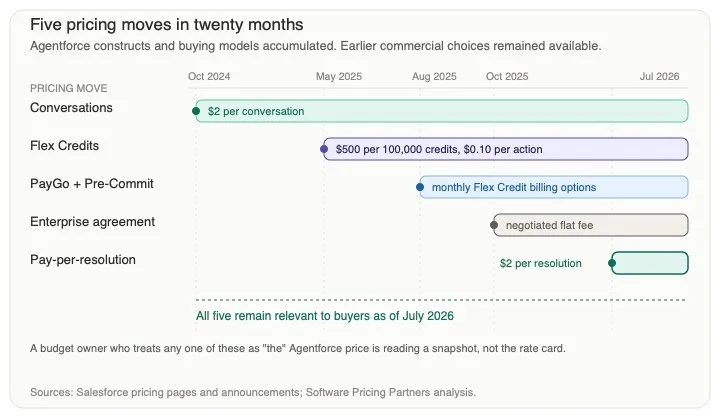
Five Agentforce pricing constructs and buying-model changes in twenty months. Sources: Salesforce pricing pages and announcements; Software Pricing Partners construct analysis.
The load-bearing point is not any single row. Nothing on this timeline switched off. Credits, conversations, buying models, flat-fee agreements, and resolution pricing all remain relevant to the commercial decision.
A budget owner who treats Flex Credits as "the new pricing model" that superseded Conversations will be caught flat-footed when an AE quotes Conversations pricing for a specific use case, because it never left the rate card.
The safer planning assumption is another pricing change, not a settled rate card.
What does the pricing churn mean for your budget?
Salesforce completed its m3ter acquisition on July 1, 2026, making consumption billing strategic infrastructure. Analyst-compiled deal figures suggest paid adoption lagged deal growth. Together, these signals tell budget owners to treat Agentforce Pricing, metering, and contract governance as durable planning concerns, not assume the commercial model will soon simplify.
Why the meter keeps moving
The clearest signal that consumption pricing is not a passing phase arrived off the pricing page entirely. Salesforce signed a definitive agreement to acquire m3ter on June 8, 2026, with the deal completing July 1, 2026.
Salesforce describes m3ter as a metering and rating platform built for consumption-based monetization. The acquisition brings high-volume mediation, metering, and rating into what Salesforce now calls Agentforce Revenue Management.
Salesforce says m3ter will support native consumption billing alongside its existing models. That supports a strategic direction toward consumption pricing. It does not prove today's Agentforce meter or multiplier structure will remain unchanged.
CIO.com's analyst coverage sharpens what that means for the buyer. Pareekh Jain, principal analyst at Pareekh Consulting, points to billable-event definitions, AI interaction charges, usage visibility, spending caps, anomaly detection, and forecasting.
Jain also sees the foundation for CRM FinOps capabilities such as consumption dashboards, quotas, spending alerts, chargebacks, cost forecasting, and agent ROI tracking. That is the tooling a moving meter requires.
The paid-attach gap
Adoption and monetization are not the same curve. An industry pricing analysis compiled from Salesforce disclosures puts February 2025 at roughly 5,000 Agentforce deals with about 3,000 paid, and December 2025 at 18,500 deals with roughly 9,500 paid.
Deal volume rose 3.7 times while the reported paid share fell from roughly 60 percent to roughly 51 percent. The figures show a monetization gap. They do not establish why buyers remained unpaid.
KeyBanc Capital Markets downgraded Salesforce from Overweight to Sector Weight, in a report from managing director Jackson Ader and three co-authors, citing KeyBanc's own CIO survey and customer checks.
The report says its customer checks and feedback on Agentforce were weak. It also says the disclosed numbers and KeyBanc's latest CIO survey did not show building momentum.
Salesforce disputes the read. A company spokesperson told The Register that Agentforce is the fastest-growing product in Salesforce history and said customers are going live in weeks rather than months.
Both signals can coexist: a fast-growing product and incomplete paid conversion. A budget owner should carry that uncertainty, rather than either headline alone, into a renewal conversation.
How do you budget when the rate can change?
Salesforce contracts Flex Credits at $0.005, while its published Rate Card says usage types, tiers, and multipliers may change. That creates effective-price exposure in your Agentforce Pricing model, but whether revised multipliers apply during an existing term depends on contract. Ask which version governs, what notice applies, and what is protected.
Forecasting Agentforce spend means underwriting both the published multiplier and the contract terms that govern it.
The sharpest fact in the entire rate card sits in a footnote most buyers never read. The official Flex Credits rate card states: "Usage types, tiers, and associated multipliers may be updated from time to time. Changes to tiers will be treated as multiplier changes."
That sentence creates a route for the published effective price of an action to rise while the headline rate remains $500 per 100,000 credits. It does not say whether a revised multiplier automatically applies mid-term. The order form and incorporated rate-card version decide the buyer's exposure.
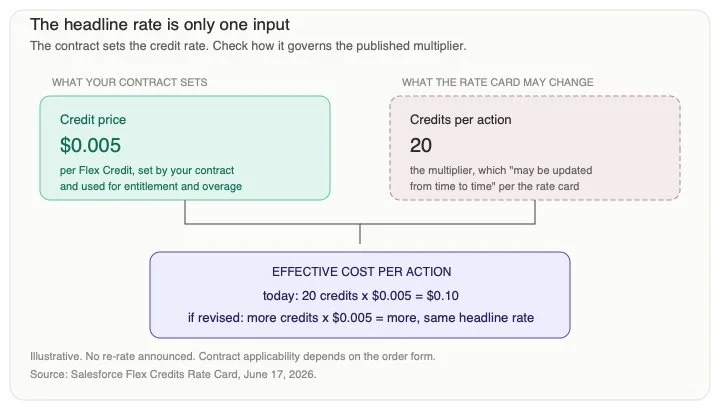
The rate card can move. The contract determines the exposure.
Unused Flex Credits carry no rollover: the official FAQ states plainly that "Unused Flex Credits do not roll over into subsequent subscription terms." The rate card independently confirms the same rule.
Overage carries no penalty premium, but it inherits whatever rate is already on the contract. The same FAQ says usage beyond entitlement is billed monthly in arrears at the contracted rate.
That is why the base rate, not a hypothetical overage markup, is the number worth protecting in negotiation.
The one tool built to keep this visible is the Digital Wallet, free to any customer on a Digital-Wallet-enabled product. It gives near-real-time usage data, proactive alerts, and trend analysis, the minimum instrumentation for a variable consumption bill.
None of this adds up to a monthly bill here. Building that number, blending credits with per-user licensing, is a separate exercise this article does not attempt.
What should you ask before your next renewal?
Before renewing, ask which rate-card version governs, whether multiplier changes can apply during the term, and what notice and price protection you receive. Also confirm the $0.005
contracted rate covers overage with no penalty and pre-agree the cost of switching from Conversations to Flex Credits.
The facts above are only useful if they change what gets asked at the negotiating table.
| Fact | Why It Matters | What to Ask |
|---|---|---|
| Published multipliers may change | The effective price can change if a revised multiplier governs the order, even while the credit rate remains $0.005. | Which rate-card version is incorporated? Can revisions apply during the term, and what notice and protection do I receive? |
| Unused credits do not roll over | Over-committing on a pre-purchase is a permanent loss, paid once in unused credits and again in the next term's commitment. | Can unused credits carry into the renewal term or convert under the Flex Agreement? |
| Overage inherits the contracted rate | The contracted rate governs both entitlement and every unit beyond it, with no penalty premium. | What is my contracted rate, and is it protected across the full term, including overage? |
| Construct is per-org and exclusive | Choosing Conversations prevents using Flex Credits in the same org until a SKU swap. | What does switching cost, and can a switch clause be pre-agreed now? |
| Construct constrains buying model | Choosing Conversations rules out PayGo and Pre-Commit, combining pricing and payment flexibility into one decision. | Which buying models stay available to me under each construct? |
| Conversation is a defined billing unit | ASA Messaging can close after 24 hours for authenticated users and named channels, while Sales Coach and SDR use different events. | Which Salesforce conversation subtype and window definition does the order form apply? |
There is also a governance question independent of unit economics. The Register reported a January 2026 Gartner warning that a capped enterprise agreement for Salesforce's AI and data platforms "may not be available when they come to renew these deals, potentially meaning customers could struggle to predict costs and understand value."
Salesforce disputes this. Bill Patterson, EVP of Corporate Strategy, said: "The claim that we are moving away from capped agreements is inaccurate." Ask for that commitment in writing before you sign.
Sources
Salesforce Agentforce Pricing, Salesforce, accessed July 2026
Flex Credits Rate Card, Salesforce, June 17, 2026
Salesforce's Agentforce Is Here, Salesforce, October 29, 2024
Salesforce Introduces New Flexible Agentforce Pricing, Salesforce, May 15, 2025
New Ways to Pay Make It Easier than Ever to Get Started with Agentforce, Salesforce, August 19, 2025
Salesforce Foundations, Salesforce, accessed July 2026
Flex Credits Billable Usage Types, Salesforce Help, accessed July 2026
Agentforce Conversations Billable Usage Types, Salesforce Help, accessed July 2026
Salesforce Launches Agentforce Help Agent, Salesforce, June 25, 2026
Salesforce Signs Definitive Agreement to Acquire m3ter, Salesforce, June 8, 2026
Agentforce Developer Pricing, Salesforce, accessed July 2026
Salesforce to acquire usage-based billing specialist m3ter, CIO.com
Salesforce's Agentforce isn't winning over clients, KeyBanc analysts claim, The Register, July 15, 2026
Deciding whether to switch constructs, and how to structure that choice, is worth a second set of eyes before locking into a multi-year term.
Concret.io's Agentforce consulting services can walk through that renewal math with you before you return to the negotiating table.
Frequently Asked Questions
-
A Standard or Custom Action consumes 20 Flex Credits in production (16 in sandbox), which works out to $0.10 per action at the $0.005-per-credit rate ($0.08 in sandbox). Other action types consume differently: a Standard or Custom Voice Action consumes 30 credits ($0.15), Basic Prompts consume 2 credits ($0.01), and Advanced Prompts consume 16 credits ($0.08). The multiplier depends on the specific action type, not a flat per-action rate.
-
Pre-Purchase: pay upfront for a fixed credit balance and draw it down over the term.
Pre-Commit: commit to a minimum usage level in exchange for a lower rate, billed monthly.
PayGo: no upfront commitment at all; billed monthly for whatever credits you actually consume.
Flex Credits is the only construct sold across all three models; Conversations, for example, is Pre-Purchase only.
Note also that buying model doesn't change the usage multiplier itself (a standard action is still 20 credits regardless of which model you're on); it only changes how and when you pay.
-
No. Salesforce's official rate card states plainly that unused Flex Credits do not roll over into subsequent subscription terms; they expire at the end of the term. This makes over-committing on a Pre-Purchase a real risk: you lose the unused balance once, then commit again for the next term.
-
Identify which action types you'll use and their credit multipliers (20 credits for a standard action, 30 for voice, etc.).
Multiply by expected monthly volume.
Example A: A data transform using 40 credits, run 20 times a day for 30 days = 24,000 credits. At $0.005/credit, this equals $120/month.
Example B: A multi-step voice action flow totaling 120 credits, triggered 300 times a month = 36,000 credits. At $0.005/credit, this equals $180/month.
Convert total credits to dollars at $0.005/credit.
Add license costs separately, per-user add-ons ($125–$150/user/month) or Agentforce 1 Editions (from $550/user/month, includes 2.5M credits/year).
-
No. The official pricing FAQ says Flex Credits and Conversations are not supported in the same org. Conversations is Pre-Purchase only. Switching to Flex Credits requires swapping all existing Agentforce Conversation SKUs, after which Flex Credits can use Pre-Purchase, Pre-Commit, or PayGo.
Let’s Talk

Drop a note below to move forward with the conversation 👇🏻