Stop Overpaying for Tokens and Implement an SLM-First Strategy
Key Summary:
AI overspending happens when expensive LLMs are used for simple tasks.
SLMs are cheaper, faster, and reduce inference costs.
Fine-tuned SLMs improve accuracy, control, and reliability over general LLMs.
Most companies didn't realize they had an AI spending problem until the invoice landed. LLM adoption is accelerating, but the cost model behind it is still evolving. Not because AI is inherently expensive, but because most organizations are using the most powerful and most expensive models for tasks that simply don't need them.
Implementing an SLM-first strategy is the fix. It's one of the most practical enterprise AI cost optimization strategies available today. The SLM model doesn't require you to scale back your AI ambitions. It just requires you to be smarter about how you deploy them.
The High Cost of Large AI Models is a Real Problem
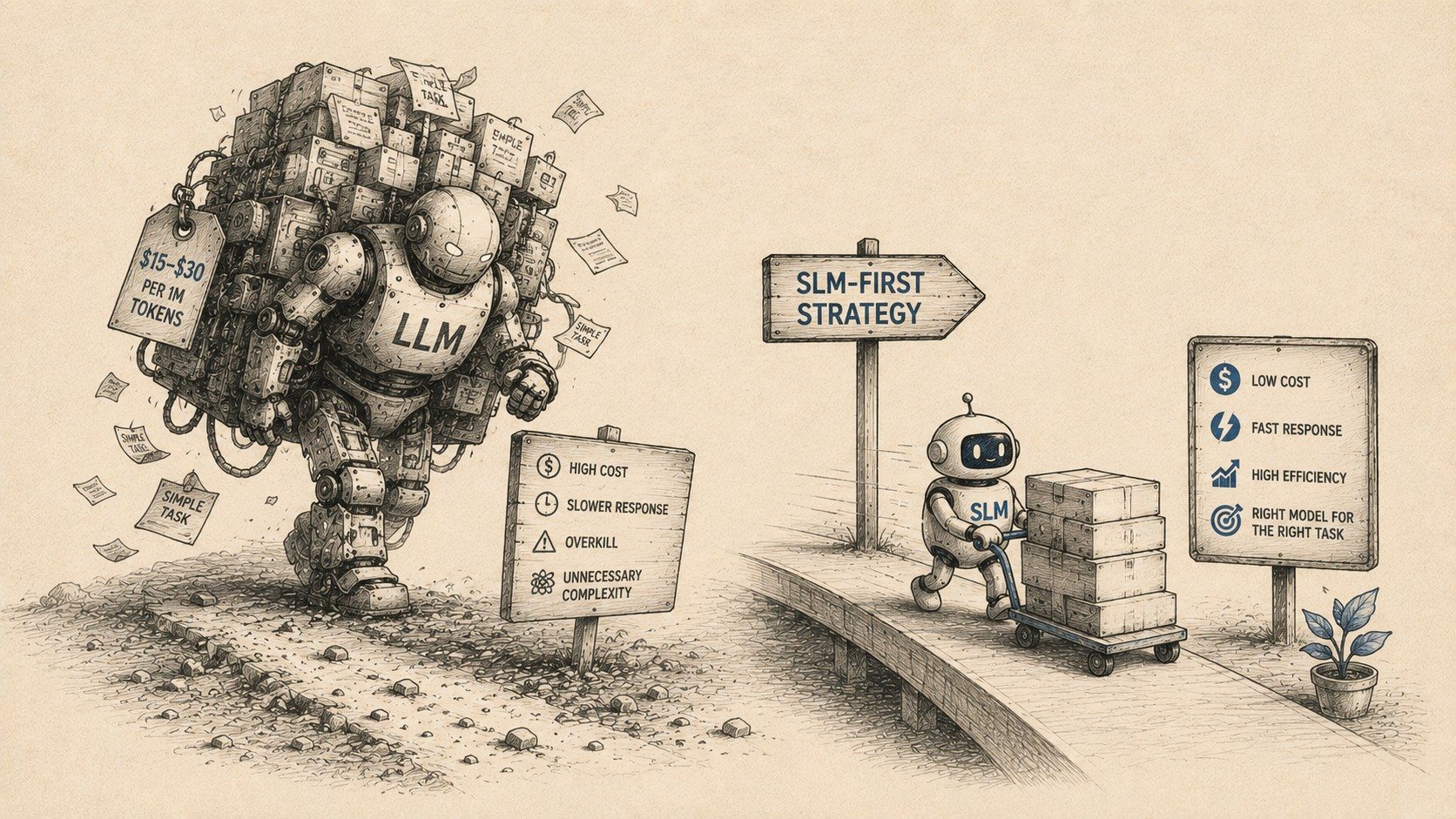
Think about your team paying a high price for a top-tier large language model. Your team might be using it for every single task in your workflow. Be it summarizing emails, classifying support tickets, or generating one-line responses to customer queries.
While these tasks are simple, the cost is often hefty. You’re paying premium token rates every single time. The top LLM models can cost anywhere from $10 to $30 per million tokens. When you're running thousands of API calls a day across a sales team, a support desk, or a document pipeline, those costs add up fast.
You're not just burning budget. You're also dealing with latency. That means the slow response times that frustrate users and hurt adoption. This is the core issue. Enterprises are treating LLMs like a Swiss Army knife when they only need a butter knife for most jobs.
What Does It Mean By SLM-first Strategy?
SLM narrows down to industry-specific training, and therefore, learning what matters. SLMs trade broad general knowledge for deep, domain-specific expertise.
An SLM-first strategy is a simple idea: before you reach for a large, expensive model, ask whether a smaller one can do the job just as well. It's an architectural decision. Instead of routing every AI task through a frontier model like GPT-5 or Claude Opus, you build a tiered system.
Small Language Models handle the bulk of your workload, the repetitive, high-volume, well-defined tasks. Larger models stay on standby for the genuinely complex stuff that actually needs them.
Think of it like staffing a team. You don't hire a senior consultant to answer routine customer emails. You put the right person on the right task. An SLM-focused strategy applies that same logic to your AI infrastructure.
For most enterprises, this shift to SLM models is one of the most impactful AI cost optimization strategies they can implement right now.
Key Pillars of an SLM-Focused Strategy
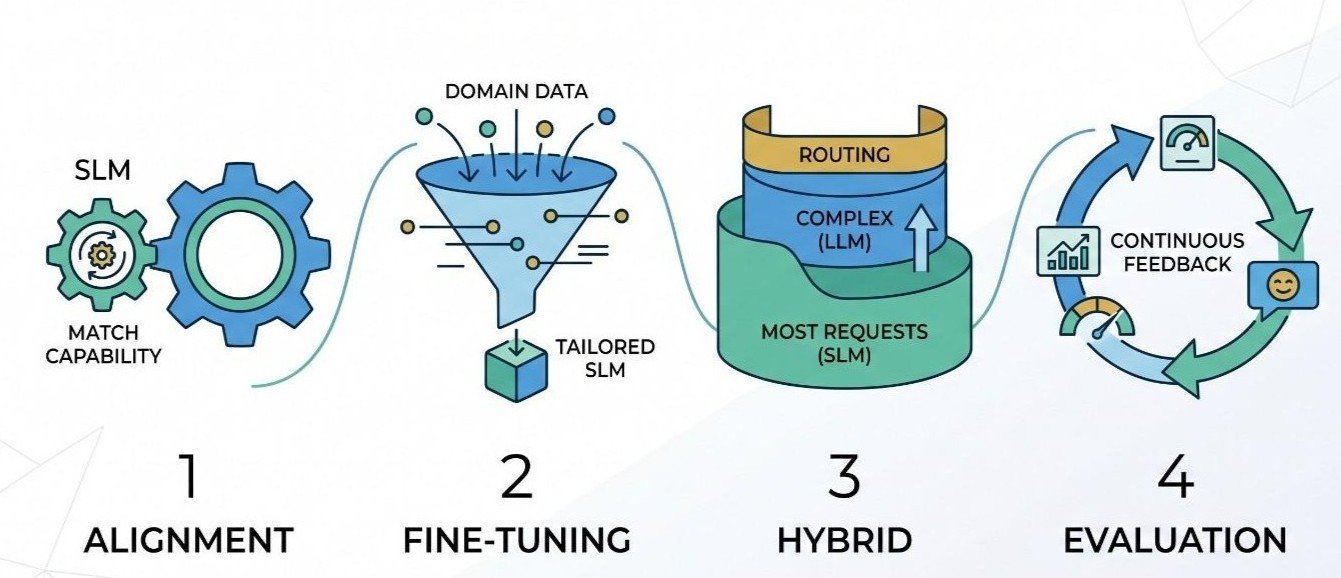
An SLM-first strategy centers on using compact, efficient models as the default choice for AI-powered features. So, this reserves larger models only when truly necessary. Here are some key pillars for the SLM-focused AI model strategy.
1. Task-Model Alignment
Not every task requires a large, general-purpose model. The foundation of an SLM-first strategy is about matching tasks to model capability. Standard operations such as extraction, classification, or concise summarization are often handled more efficiently by smaller, fine-tuned models. By defining a strict scope for each task, you’re not overpaying in latency and avoiding unnecessary compute costs for problems that don't need large models.
2. Fine-Tuning and Knowledge Distillation
SLMs perform best when tailored. Fine-tuning on domain-specific data allows smaller models to achieve what's expected, often challenges larger models in narrow contexts. Investing in high-quality datasets and iterative training pipelines is critical to achieving reliable performance.
3. Hybrid Model Architecture
An SLM-first approach doesn’t mean SLM-only. Instead, it uses a layered system: SLMs handle the majority of requests, while larger models act as fallback or escalation paths for complex or high-stakes queries. Routing logic based on task complexity is the key here.
4. Continuous Evaluation and Feedback Loops
To maintain quality, SLM models require accurate evaluation pipelines. This includes benchmarking against larger models, tracking real-world performance, and including user feedback. Over time, this feedback loop helps refine both the models and the routing decisions.
SLMs vs LLMs: Comparison Based on the Business Case
Why SLMs matter is the real question that every decision maker asks. Why do you even bother before changing anything? Therefore, you need to view it through the lens of SLM vs LLM to get a clear answer. Here's the business case, broken down.
1. Cost Savings
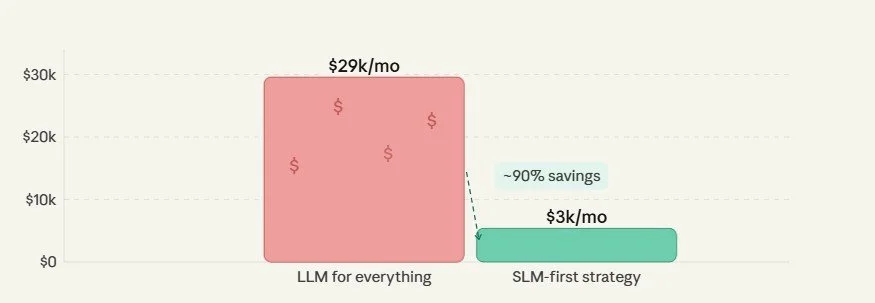
Saving cost is the most immediate win. Top-tier LLMs can cost $15 to $30 per million tokens. A capable SLM runs at a fraction of that, sometimes less than $0.20 per million tokens. When your team is making tens of thousands of API calls a day for routine tasks, the difference isn't marginal. It's transformational. Most enterprises that implement a proper tiering approach see AI inference costs drop by 60-80% within the first quarter. That's how to reduce AI inference costs, not by using less AI but by using cheaper models where the output quality holds up.
2. Speed and Scalability
SLMs are fast. Response times that take 3-5 seconds on a large model often drop to under 500 milliseconds on a well-optimized small model. For user-facing applications - chatbots, CRM assistants, live support tools - that difference is felt immediately. Adoption rates go up. And because SLMs are lighter, they scale more easily. You can run more parallel inferences on the same systems, handle traffic spikes without blowing your budget, and expand to new use cases without redesigning your infrastructure.
3. Faster Performance
Speed and performance aren't the same thing. Speed is about response time. Performance is about output quality on the task at hand. A fine-tuned SLM focused on a specific job will often outperform a frontier model on that exact task. Frontier models are generalists. They're built to handle anything. That breadth comes at the cost of depth. A smaller model trained specifically on your task and your data doesn't have to guess. It knows.
4. Accuracy Within Domain
This is where fine-tuning SLMs for CRM, legal, healthcare, or any specialized domain pays off most clearly. The LLMs work from broad training data. They don't know your product names, your internal taxonomy, your customer segments, or your deal flow. A fine-tuned SLM does. When you train a model on domain-specific data, it learns the language and logic of your business. The result is more precise outputs, fewer hallucinations on domain-specific queries, and less time spent on prompt engineering to get the right answer out of a general-purpose model.
5. Increased Control
Running SLMs, especially self-hosted or on-premises, gives you something frontier model APIs can't: full control. Control over where your data goes. Control over model behavior. Moreover, the control over versioning, updates, and rollback. For industries like finance, healthcare, or government, this is more than just a nice-to-have. But even outside regulated sectors, data governance is becoming a boardroom topic. An SLM-first strategy that keeps sensitive customer and operational data within your own infrastructure is a much easier story to tell your legal and compliance teams than "we send everything to a third-party API."
SLM vs LLM for Enterprise: What's the Difference?
Large language models (LLMs) are the big names - GPT-5, Claude Opus, Gemini Ultra. They’re trained on large datasets, well capable, and can handle complex, open-ended reasoning well. Also, they’re expensive and slow by comparison.
Small Language Models (SLMs) are leaner, faster, and purpose-built. The best part is, they’re designed to do specific tasks well. Not everything, but the domain-specific things.
Here's the key stat when thinking about SLM vs LLM for enterprise use: SLMs can be 100x cheaper and 10x faster for specific, well-defined tasks. That's not a rounding error. That's a fundamental shift in what's possible with your AI budget. And when those tasks make up 80% of your daily AI workload? The ROI becomes clear for a business.
What an SLM-First Strategy Actually Looks Like
An SLM-first strategy doesn't mean abandoning LLMs; it means being deliberate about when you use them. Here's a simple framework:
Tier 1: SLMs for routine tasks: Email summarization, ticket classification, intent detection, sentiment analysis, short-form content generation, data extraction from forms or CRM fields. These are repetitive, high-volume, and well-defined. A fine-tuned SLM handles them faster and cheaper than any frontier model.
Tier 2: Mid-size models for moderate complexity: Document analysis, multi-step reasoning within a defined domain, generating structured reports from data. These tasks need more capability than a tiny model, but don't require the full power of a large model.
Tier 3: LLMs for genuinely complex tasks: Multi-document synthesis, nuanced creative work, complex code generation, tasks that require broad world knowledge and reasoning. This is where frontier models earn their price tag.
Fine-Tuning SLMs for CRM: A Real-World Example
One of the highest ROI use cases of fine-tuning SLMs for CRM is in sales and support workflows. Consider a sales team using an AI assistant to summarize call notes, extract action items, update deal stages, and draft follow-up emails. Every one of these tasks is structured, repetitive, and tied to specific CRM fields.
A fine-tuned SLM trained on your company's CRM data, deal terminology, and email templates will outperform a generic LLM on these tasks and do it in milliseconds instead of seconds. You're also not sending sensitive customer data to a third-party API with the same frequency, which helps with data governance.
The result? Faster responses for sales reps. Lower latency in the user experience. Also, the cost per interaction would be a fraction of what you were paying before.
In a Nutshell: The Smartest AI Strategy Isn't the Biggest One
The enterprises winning with AI right now aren't the ones spending the most. They're the ones spending the most intelligently.
An SLM-first strategy gives you that edge. You cut inference costs, speed up your user-facing applications, and give your teams AI tools that are tuned to how your business actually works, not how a general-purpose model guesses it might.
Start with one high-volume task, test a smaller model against it, and let the numbers make the case. Because in the end, overpaying for tokens isn't an AI problem. It's a strategy problem. And now you have the strategy to fix it.
Need help to strategize AI and build an agentic AI for your business? Concretio has a team of AI agent developers to help you out. Let's discuss which AI solution aligns best with your goals.
Frequently Asked Questions
-
Enterprises that implement a proper tiering approach often see AI inference costs drop by 60-80% within the first quarter. Capable SLMs run at a fraction of the cost of top-tier LLMs.
-
SLMs are ideal for high-volume, routine operations like email summarization, intent detection, ticket classification, and data extraction from forms. These tasks are repetitive and well-defined.
-
SLMs are significantly faster for specific jobs. Response times that take 3-5 seconds on a large model often drop to under 500 milliseconds on an optimized SLM. This reduced latency improves adoption for user-facing tools like chatbots and CRM assistants.