
Know How to Choose the Right Integration Pattern for Agentforce
Key Summary:
Three integration types: Synchronous API, asynchronous event-driven, and agent-native.
Choose based on: Response speed, system reliability, and transaction volume.
Keep it simple: Use the simplest pattern that meets your requirements reliably.
If you're building AI agents on Salesforce's Agentforce platform, one question comes up almost immediately: how do you connect your agents to the world outside Salesforce? Your customer data might sit in an ERP, your fulfillment logic might live in a third-party platform, and your backend systems probably weren't designed with AI agents in mind. Choosing the wrong Agentforce integration pattern from the start can mean performance bottlenecks, security gaps, or hours of rework down the line.
The good news is that Salesforce gives you a range of well-defined options. The challenge is knowing which one fits your situation. This guide breaks down the main integration patterns for Agentforce, when each one makes sense, and what questions you should be asking before you commit to an approach.
Why Integration Pattern Choice Matters More Than You Think
Agentforce AI agents are not just chatbots. They analyze, plan, and take action, which means the systems they connect to need to respond reliably, securely, and at the right speed. A poorly chosen Salesforce integration pattern can cause your agent to time out mid-conversation, expose sensitive data through an unsecured endpoint, or fail silently under load.
Integration patterns for Agentforce are critical to how well the system works with your data and existing tools. Even the most advanced AI reasoning engine will struggle if the connections between systems are poorly designed. Getting the architecture right early is what separates a smooth Agentforce implementation service from one that constantly runs into issues and requires ongoing fixes.
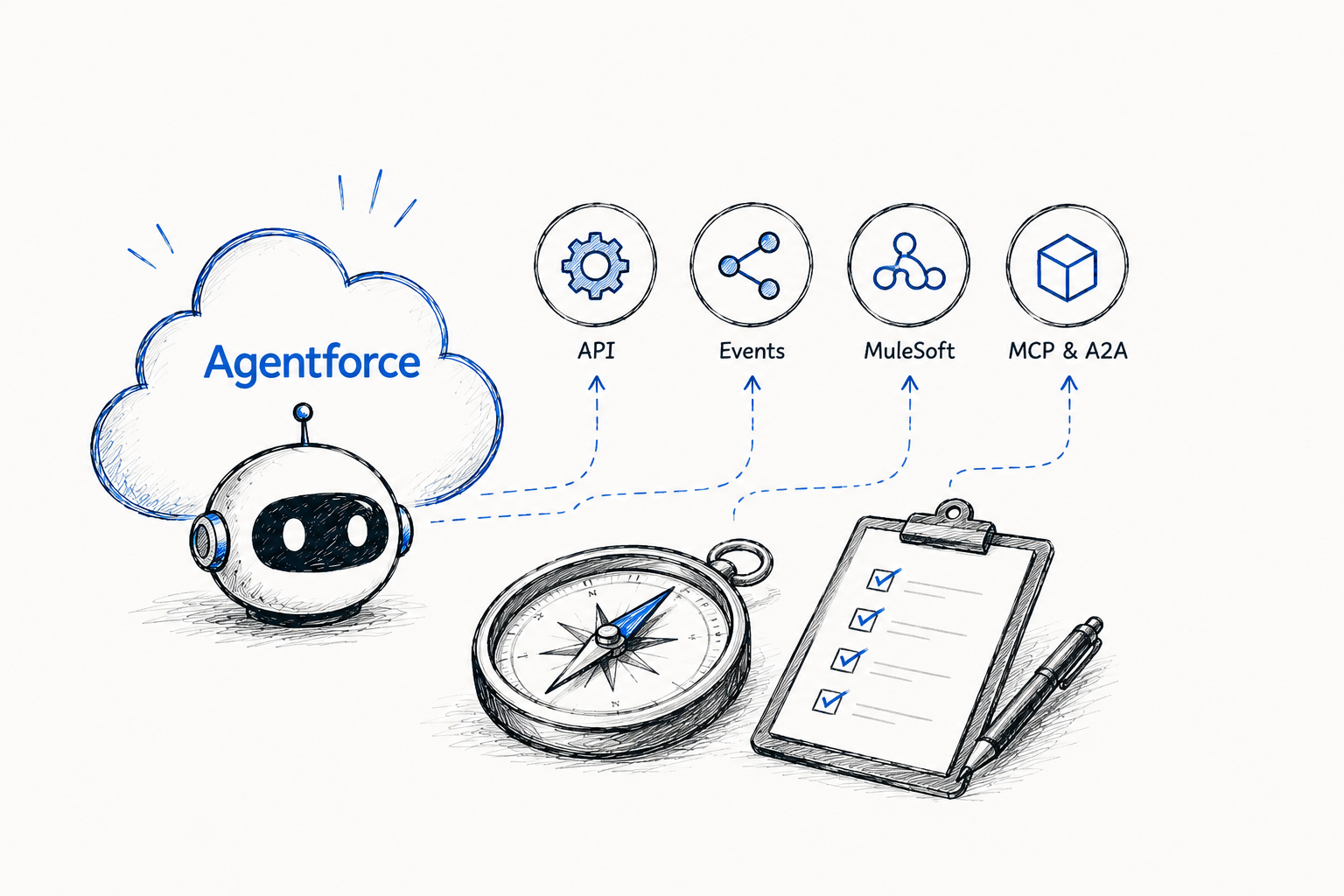
There are three main categories of Agentforce integration patterns to understand: traditional API-based integration, event-driven integration, and the newer agent-native approaches using Model Context Protocol (MCP) and Agent-to-Agent (A2A) communication.
Pattern 1: Traditional API Integration (The Proven Foundation)
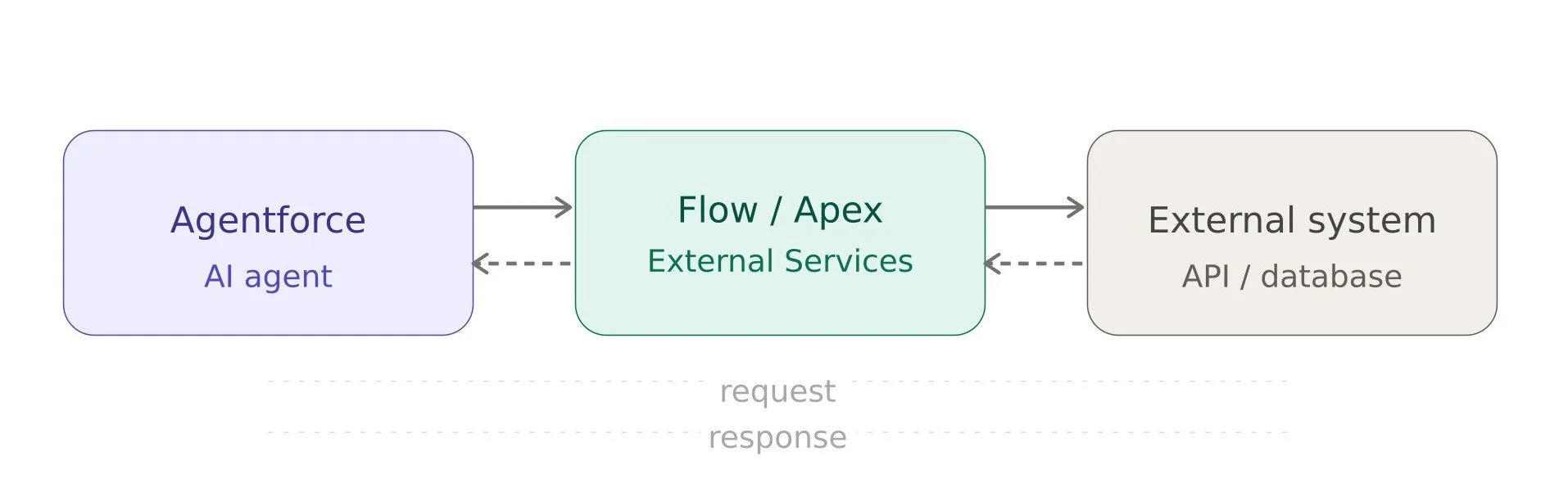
Traditional API integration is the most established Salesforce integration pattern, and for good reason. It uses familiar tools like Apex callouts, External Services, Salesforce Flow, and Named Credentials to connect Agentforce to external systems in a synchronous, request-reply style.
Here's how it works in practice: your agent identifies that it needs data from an external system, triggers a flow or Apex method, which then calls the external API and returns the result back to the agent in real time. The whole interaction is synchronous. The agent waits for the response before continuing.
When to use this Agentforce integration pattern:
This approach is ideal when your use case requires an immediate response. If a customer asks, "What's the current status of my order?", the agent needs that answer now, not in a few seconds after an event queue has been processed. It’s also the right choice when you’re working with APIs that are already configured in your Salesforce org, or when you have existing Apex logic and flows that can be extended to serve the agent.
It's also the right choice when you're working with APIs that are already configured in your Salesforce org, or when you have existing Apex logic and flows that can be extended to serve the agent.
External Services is particularly useful here. Rather than writing custom Apex code to call every external endpoint, you can import an OpenAPI specification and Salesforce automatically generates the invocable actions your agent needs. This is a significant time-saver and reduces the chance of brittle, hard-to-maintain code.
Watch out for: External Services synchronous operations time out after 120 seconds. If your external system is slow or unpredictable, this pattern will frustrate your users. It also requires both systems to be available at the same time, which creates a tighter coupling between your Agentforce setup and your external services.
Pattern 2: Event-Driven Integration (Built for Scale)
When your use case involves high transaction volumes or when the external system you're integrating with isn't always available, event-driven integration is the stronger choice among Agentforce integration patterns.
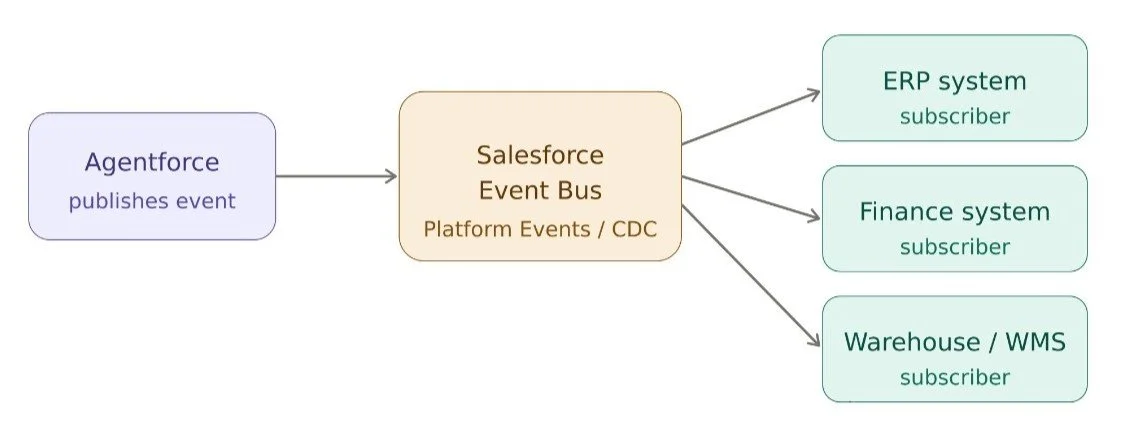
Instead of the agent waiting for an immediate response, it publishes an event to the Salesforce Event Bus (using Platform Events or Change Data Capture). External systems subscribe to those events, process them, and optionally push data back. The agent doesn't block. It moves on, and the external system handles its part independently.
This asynchronous approach is genuinely powerful when you're dealing with tens or hundreds of transactions. The Salesforce Event Bus is built for scale, with high reliability and built-in replay capabilities (events can be replayed using a unique replay ID, which is useful for error recovery). MuleSoft integrates naturally here. It can listen to Platform Events and Change Data Capture events through the Salesforce Connector and route them to downstream systems.
When to use this Agentforce integration pattern:
Choose event-driven when your external system is sometimes unreliable or slow. A REST-based synchronous call to an unstable system will fail loudly and disrupt the user experience. An event-driven architecture queues the work and retries gracefully until the system recovers. It's also the better pattern when you need to fan out, like sending the same event to multiple subscribers, or when the agent's action doesn't require an immediate confirmation to continue the conversation.
A real-world example: an Agentforce sales agent logs a deal closure. That event triggers fulfillment in the ERP, a notification in the finance system, and an alert in the warehouse management tool, all from a single published event, without the agent waiting for any of them to complete.
Watch out for: Event-driven architectures add complexity. You need to design for eventual consistency. Your agent and your external systems may temporarily see different states of the data.
Pattern 3: MuleSoft-Mediated Integration (The Governed Middle Layer)
MuleSoft deserves its own mention because it straddles both synchronous and event-driven approaches and adds something neither can easily do on its own: governance, discoverability, and centralized management of APIs at scale.
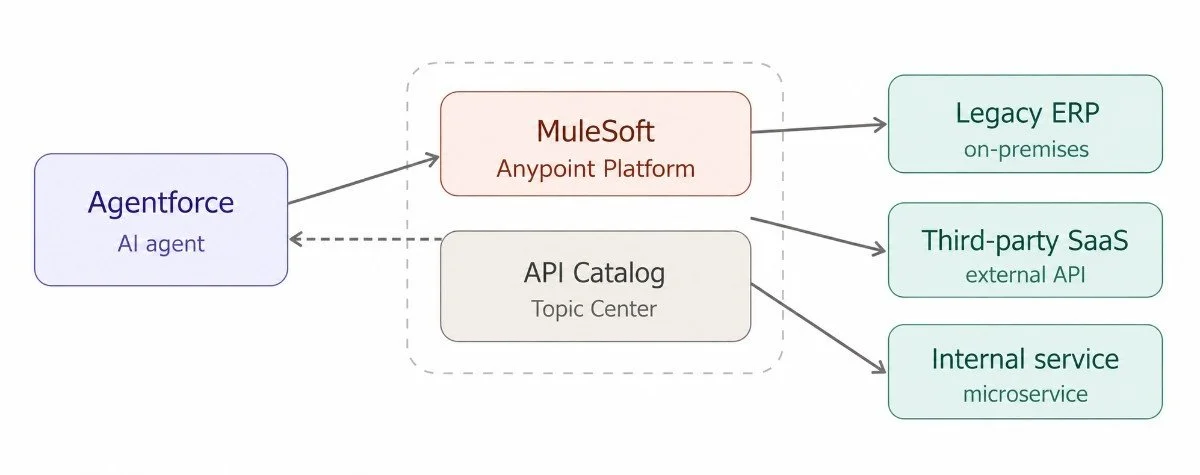
With MuleSoft for Agentforce, you design your APIs in Anypoint Code Builder and use the Topic Center to define what topics and actions your agent can perform. When you publish those APIs, they sync to Salesforce's API Catalog, which automatically creates Named Credentials and External Services in the background. Your agent can then discover and call those APIs as actions without any additional boilerplate.
This pattern is the right Agentforce integration solution when you have a large API estate that spans multiple internal and external systems, and you want agents to access that data without each integration being a bespoke, independently-maintained connection. MuleSoft essentially becomes the data-access layer for your agents that unlocks the information from hard-to-reach, on-premises, or legacy systems that would otherwise be inaccessible.
It's also the most future-proof choice if your organization is moving toward an agentic enterprise where multiple AI agents, workflows, and users all need governed access to the same underlying data.
Pattern 4: MCP and A2A (The Emerging Agent-Native Approaches)
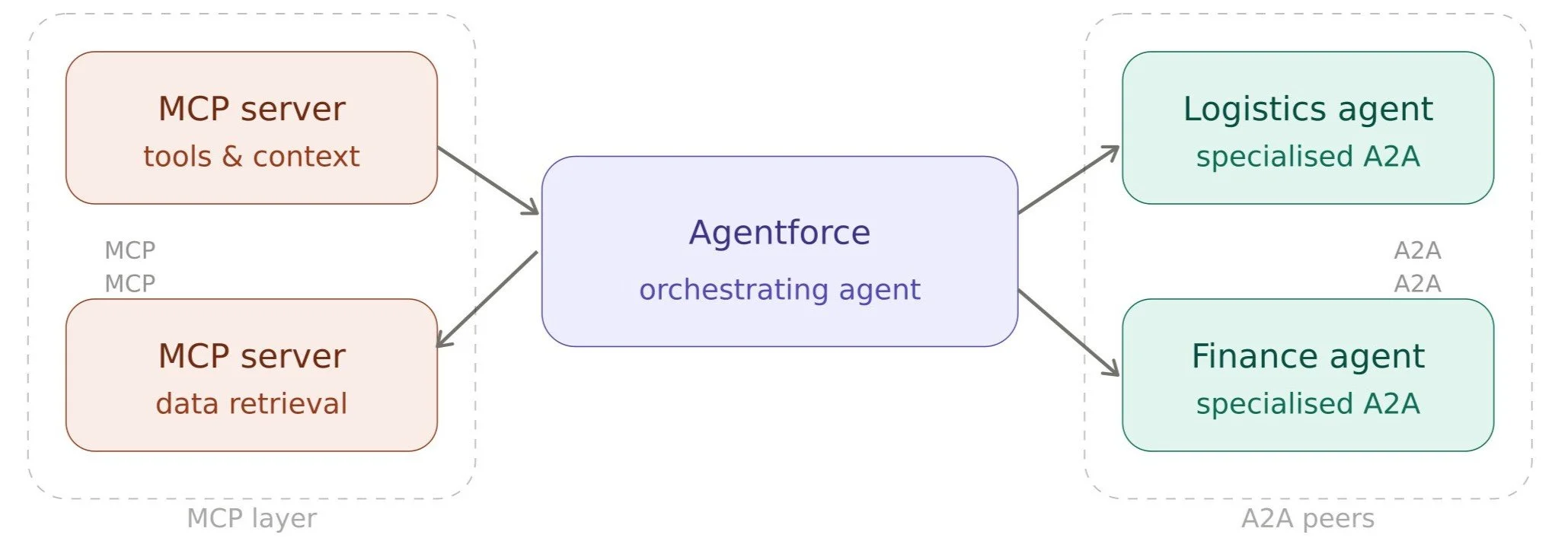
The two newest Salesforce integration patterns for Agentforce - Model Context Protocol (MCP) and Agent-to-Agent (A2A) - are specifically designed for the age of autonomous agents.
MCP (Model Context Protocol) allows your Agentforce agent to connect to an MCP server, which exposes tools, data sources, and capabilities in a format agents naturally understand. Rather than calling an API and parsing a raw JSON response, an agent using MCP gets structured, context-rich information it can reason over directly. MuleSoft can act as an MCP server through its MCP Bridge, combining access to many systems in one place.
A2A (Agent-to-Agent) takes this further by letting your Agentforce agent hand off tasks to specialized agents on other platforms. Rather than one generalist agent trying to handle everything, A2A enables a network of specialized agents to work together, each contributing expertise within its domain.
When to choose MCP and A2A patterns:
MCP makes sense when the external system already has an MCP server, when you're building something where high reusability of the integration layer is a priority, or when you want your agent to handle complex, multi-step retrieval with rich context. A2A is the right call when specialization is needed. When one agent handling a narrow domain would deliver better results than overloading a single generalist agent.
Note that both MCP and A2A are still in beta as of early 2026. They're powerful and worth planning for, but for mission-critical production workloads, traditional API-based or event-driven patterns remain more mature and better-documented.
How to Make the Decision When Choosing an Integration Pattern
When working with Agentforce implementation experts to plan your integration architecture, here are the five questions that will narrow down the right pattern quickly:
1. Does the agent need an answer in real time? If yes, start with the traditional API or MCP. If the task can be completed in the background, event-driven is on the table.
2. How reliable is the external system? Unreliable or occasionally offline systems are a strong signal to go event-driven, where queuing and retries absorb the instability.
3. What is the expected transaction volume? High-volume scenarios favor event-driven architectures. You can think of thousands of events per minute for high-volume scenarios. Lower-volume, real-time conversational use cases favor synchronous API calls.
4. Do you have existing API investments? If your org already has External Services configured, Apex callouts built, or MuleSoft APIs published, building on top of those is faster and lower-risk than starting fresh with MCP or A2A.
5. Does your external system already support agent-native protocols? If an MCP server already exists for the system you're integrating, using it is almost always the right call. It reduces custom development and gives your agent a richer integration experience out of the box.
Common Mistakes to Avoid
Many organizations jump straight to the newest, most exciting option, and right now, that means MCP and A2A. These are genuinely compelling Agentforce integration patterns, but must be chosen carefully for a specific use case.
On the other side, teams sometimes default entirely to synchronous API calls because they're familiar, then wonder why their agent feels sluggish or breaks when an external system goes down. Understanding the tradeoffs, not just what each pattern can do, but what it costs you in complexity, latency, and resilience, is what good architecture is really about.
The best integration pattern for Agentforce is always the simplest one that reliably meets your requirements. Complexity has a carrying cost. Every additional layer of indirection is a layer that can fail, slow down, or need maintenance six months from now.
Get the Right Integration with the Right Support
Choosing between Agentforce integration patterns isn't purely a technical decision but it's a business one. The right pattern depends on your use case, your existing tech stack, your transaction volumes, your tolerance for consistency, and your team's ability to maintain the chosen architecture over time.
That's why organizations building on Agentforce seriously benefit from working with experienced Salesforce consultants who understand not just the capabilities of each pattern, but how they play out in real-world production environments. A good Agentforce integration solution is designed to scale, stay secure, and evolve as your agent use cases grow.
Whether you're just starting your Agentforce journey or looking to expand an existing deployment, getting the integration architecture right is one of the highest-leverage decisions you'll make. Take the time to map your requirements against the patterns here, and don't hesitate to bring in Agentforce experts when the tradeoffs get complex.
Frequently Asked Questions
-
Start by asking one question: does your agent need an answer immediately, or can it wait? If it's real-time, go with API-based integration. If the task can run in the background, event-driven is likely the better fit. If you want to connect MCP servers and other agents across platforms, go with agent-native integrations like MCP and A2A.
-
Yes. That's precisely what integration patterns for Agentforce are designed for - linking your agents to ERPs, third-party SaaS tools, internal databases, and legacy systems that live outside the Salesforce ecosystem.
-
For basic setups using Flow and External Services, technical expertise is helpful, but the barrier is relatively low. More complex Salesforce integration patterns, especially event-driven or MuleSoft-mediated architectures, will benefit from experienced Salesforce consultants who understand both the platform and your business requirements.
-
Quite possibly, yes. Many organisations start with simple API-based integrations and evolve toward event-driven or MuleSoft-mediated patterns as agent usage scales. Building with growth in mind from the start, with support from a reliable Agentforce integration solution, saves significant rework down the line.
Related Reading

Let’s Talk

Drop us a note, we’re happy to take the conversation forward 👇🏻