
How Agentic Enterprise is Reshaping Manufacturing
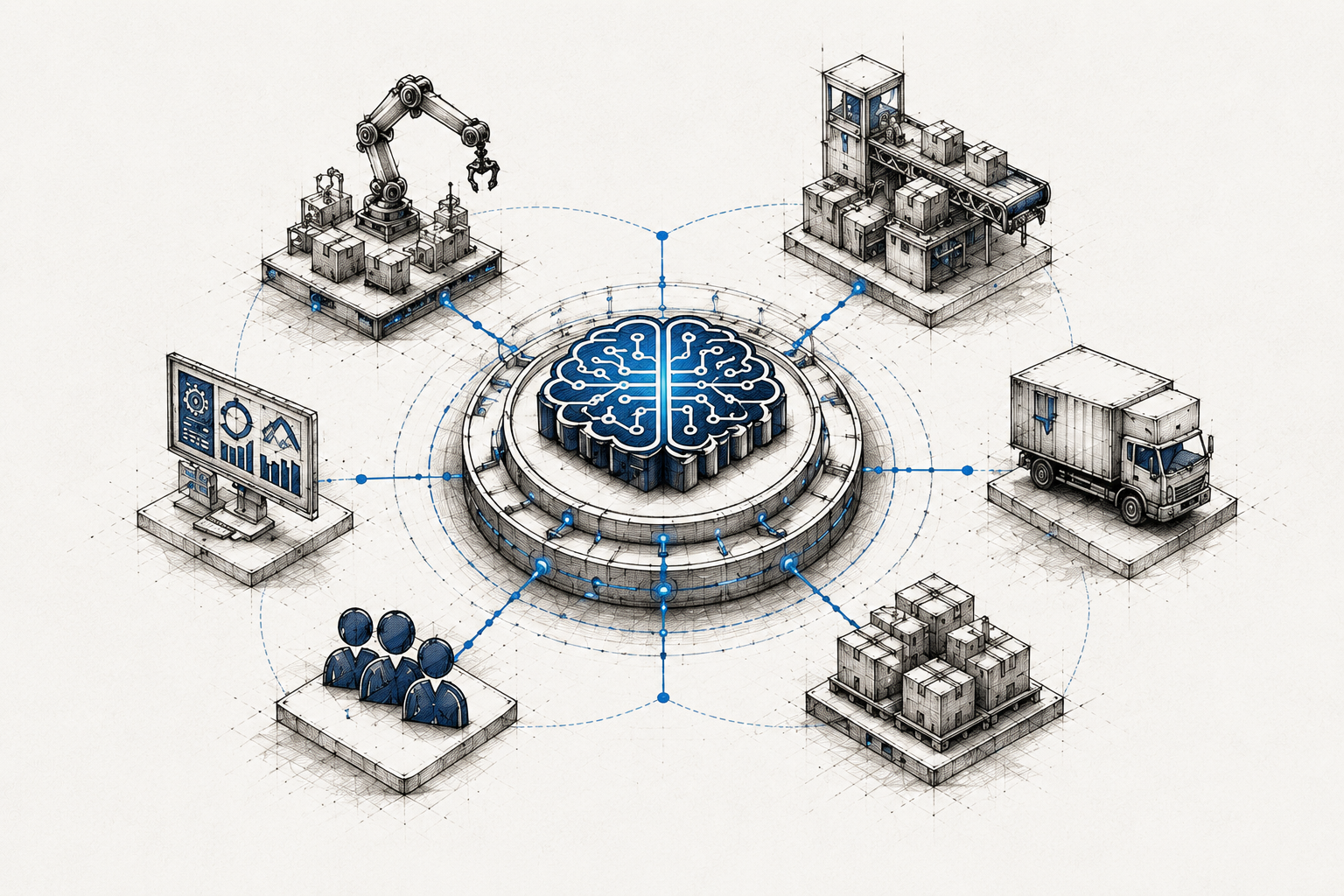
Key Summary:
Agentic AI helps manufacturers automate real-time decision-making and operations.
Enterprise AI automation improves efficiency, reduces downtime, and optimizes supply chains.
AI Agent Development Services help businesses build intelligent and scalable manufacturing workflows.
The shift toward autonomous workflows is no longer theoretical. Recent industry data show that AI agent adoption is accelerating, with deployments growing by 119% in the first half of 2025. At the same time, nearly 80% of HR leaders expect a hybrid workforce in which humans and digital agents work side by side.
This transformation is driving the rise of the Agentic Enterprise in manufacturing, where intelligent systems actively make decisions instead of just providing insights. While early adoption was seen in consumer industries, manufacturing is quickly emerging as the next frontier, driven by increasing operational complexity.
Here’s a breakdown of an agentic enterprise, the limitations of traditional systems, and real-world use cases.
What is an Agentic Enterprise?
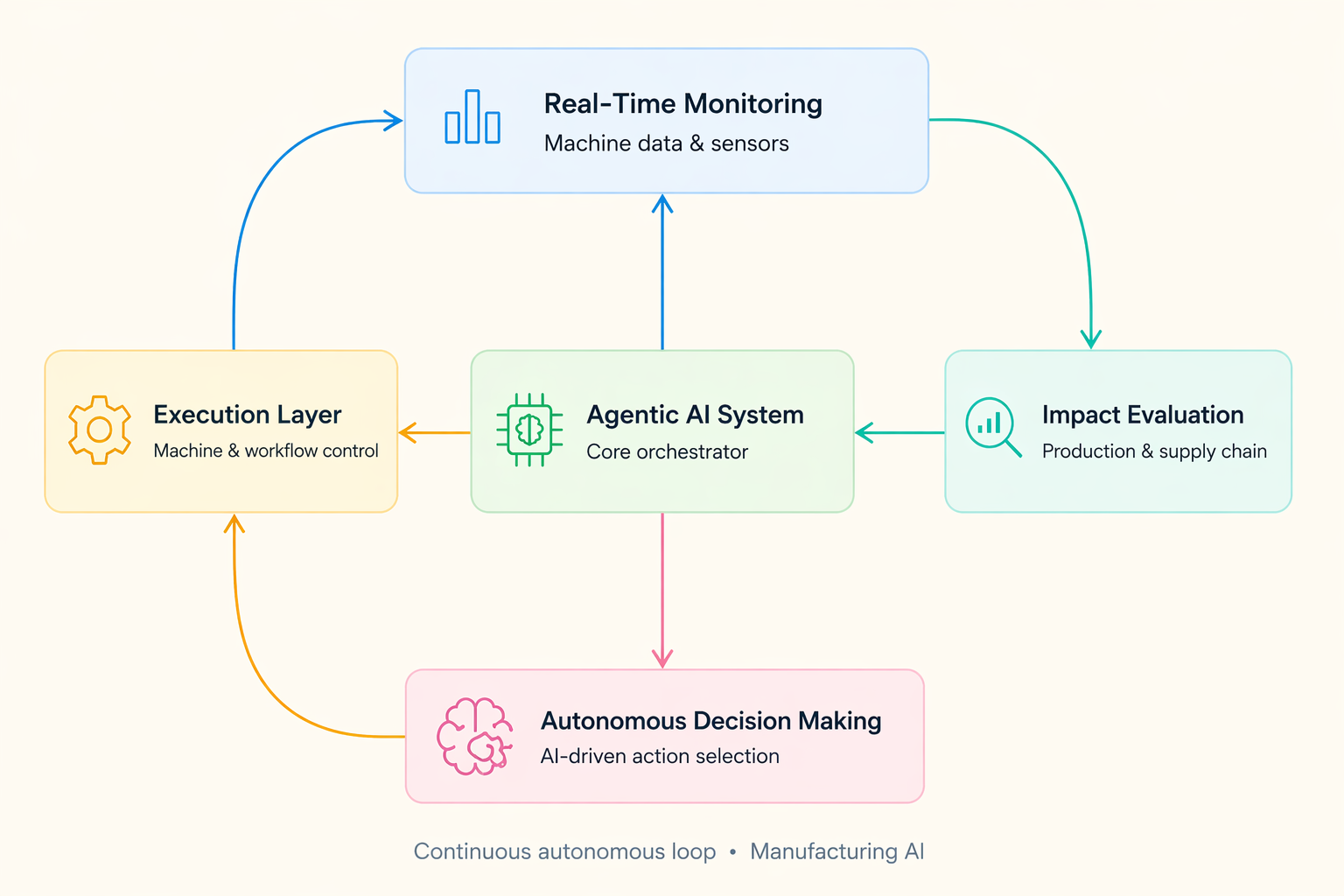
Agentic AI in manufacturing refers to intelligent, autonomous systems that go beyond analysis to make decisions and execute complex, multi-step workflows. These systems form the foundation of an Agentic Enterprise in manufacturing, where AI agents optimize production, reduce downtime, and manage supply chains proactively.
These AI agents continuously:
Monitor real-time conditions
Evaluate impact across production and supply chain
Make decisions and execute them without waiting
And they don’t work alone. Multiple agents operate together across workflows, keeping everything aligned, even when things change unexpectedly.
In short, agentic Ai turns manufacturing into a system that is:
Action-driven, not alert-driven
Adaptive, not rigid
Continuously optimizing, not constantly reacting
Why Traditional Manufacturing Systems Are Failing
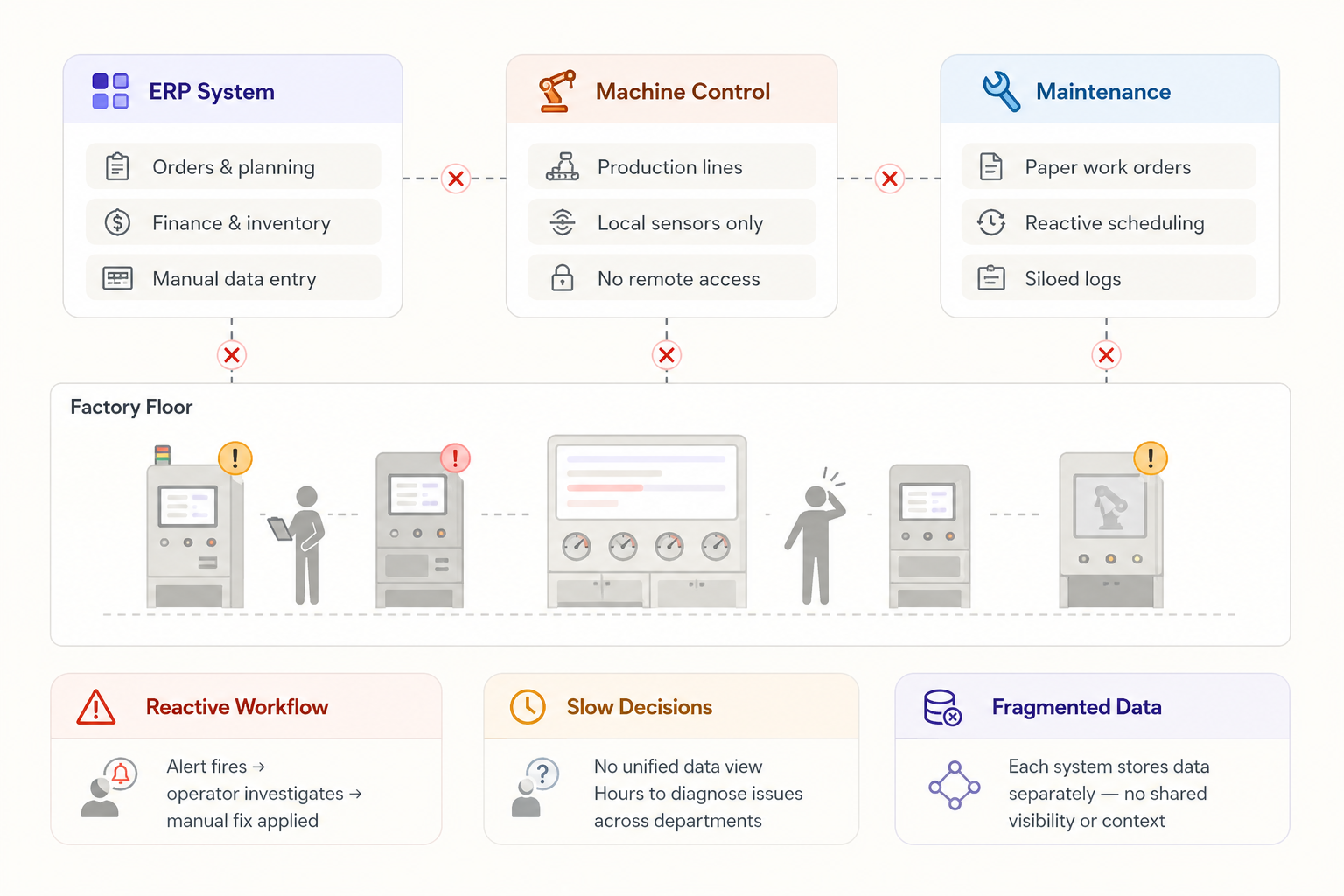
For decades, manufacturing technology has relied on a foundational loop: gather data, generate an alert, and wait for a human operator to diagnose and fix the problem. Traditional ERPs, legacy CRMs, and static shop-floor dashboards are inherently reactive. They operate on rigid, rules-based logic that reports what has already happened, but they offer little in the way of immediate, autonomous resolution.
To understand where these systems fall short, let’s break it down:
| Challenge | What Happens in Traditional Systems | Impact on Operations |
|---|---|---|
| Flexibility | Systems are built for fixed, high-volume production | Hard to adapt to design or demand changes |
| Maintenance | Repairs happen only after breakdowns | High downtime and production loss |
| Material Usage | Subtractive processes generate excess waste | Increased cost and inefficiency |
| Data Usage | Data is siloed or used only for reports, Slow | delayed decision-making |
| Response Time | Adjustments take time and manual effort | Delays in handling disruptions |
Key Capabilities of an Agentic Manufacturing Enterprise
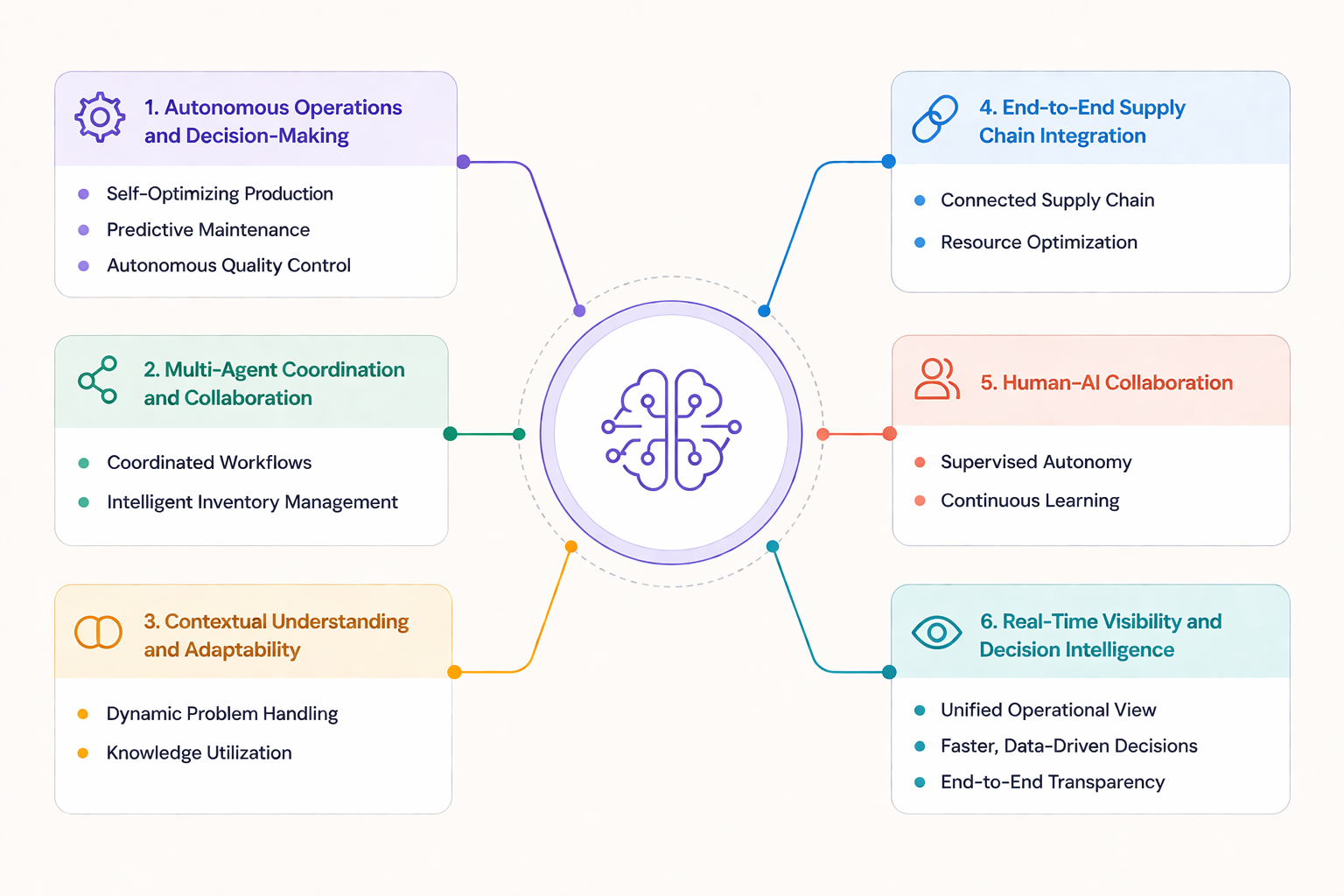
An agentic AI in manufacturing is defined by the shift from passive, reactive systems to autonomous, goal-driven AI agents that can plan, decide, and act across production and supply chain workflows.
This evolution represents a move toward a fully AI agent enterprise model, where multiple intelligent systems collaborate seamlessly across functions.
1. Autonomous Operations and Decision-Making
Self-Optimizing Production
AI agents continuously analyze real-time data to adjust production schedules and machine parameters for maximum efficiencyPredictive Maintenance
Systems detect early signs of failure, schedule maintenance, and initiate actions before breakdowns occurAutonomous Quality Control
AI-powered systems detect defects, identify root causes, and instantly correct production issues
2. Multi-Agent Coordination and Collaboration
Coordinated Workflows
Multiple AI agents (e.g., scheduling, logistics, quality) work together to keep operations alignedIntelligent Inventory Management
Systems track materials in real time, automatically adjusting orders and production based on demand and supply conditions
3. Contextual Understanding and Adaptability
Dynamic Problem Handling
Systems don’t stop at disruptions; they analyze and replan workflows instantlyKnowledge Utilization
AI captures and uses operational knowledge (logs, reports, past fixes) to improve decision-making
4. End-to-End Supply Chain Integration
Connected Supply Chain
AI agents synchronize suppliers, inventory, and logistics to prevent delays and bottlenecksResource Optimization
Systems optimize energy usage and production timing to reduce cost and waste
5. Human + AI Collaboration
Supervised Autonomy
Humans set goals and monitor systems, while AI handles executionContinuous Learning
Systems improve over time using feedback and real-time data
6. Real-Time Visibility and Decision Intelligence
Unified Operational View
AI agents bring together data from machines, production systems, and supply chains to create a real-time view of operationsFaster, Data-Driven Decisions
Instead of relying on reports, decisions are made instantly using live data and contextual insightsEnd-to-End Transparency
From raw materials to final delivery, every stage is continuously monitored and optimized
Real-World Examples of Agentic Manufacturing
Siemens Smart Factory (Amberg)
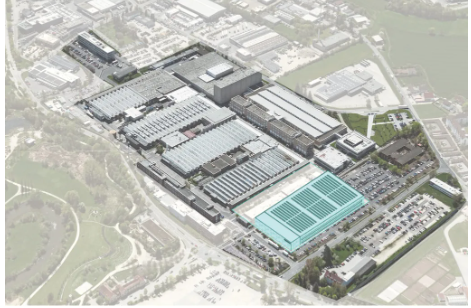
Source: Sieman
Problem:
Traditional manufacturing systems struggle to handle complex production planning, supply chain coordination, and real-time adjustments, leading to delays, inefficiencies, and limited flexibility.
Solution:
Siemens is building an AI-driven smart factory that uses digital twins, real-time data, and automated systems to optimize production, coordinate logistics, and adapt operations dynamically. This enables faster decision-making, higher efficiency, and more flexible manufacturing with minimal human intervention.
2. BMW Group Humanoid Robots in Production
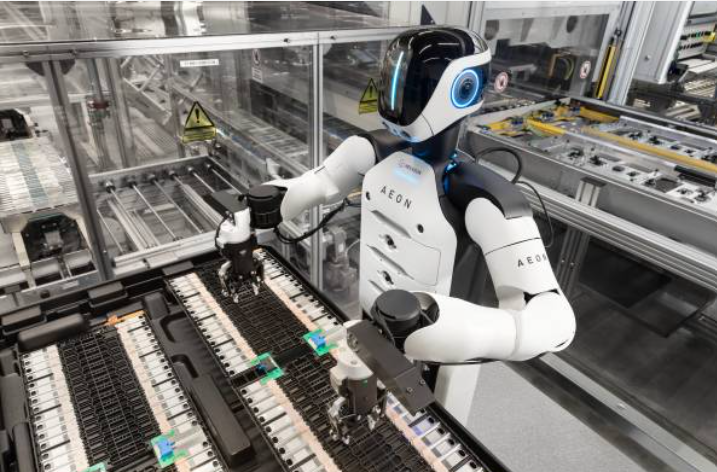
Source: BMW
Problem:
Manufacturing involves repetitive, physically demanding, and precision-heavy tasks that are difficult to scale efficiently using traditional automation alone. At the same time, siloed data and limited system intelligence make it harder to adapt quickly to changing production needs.
Solution:
BMW is deploying AI-powered humanoid robots and “Physical AI” in its production systems, supported by a unified data platform. These intelligent systems can perform complex tasks, learn continuously, and work alongside humans, improving efficiency, flexibility, and working conditions while enabling more autonomous, data-driven operations.
How Salesforce Enables Agentic Manufacturing
Salesforce enables agentic manufacturing by transforming traditional CRM systems into proactive systems of action. With solutions like Agentforce AI Agents, it brings together sales, service, and supply chain data, allowing businesses to fully leverage Salesforce for manufacturing use cases.
These AI-powered systems help organizations transition into an AI agent enterprise, where workflows are automated, decisions are real-time, and operations are continuously optimized.
Core Enabling Technologies
Atlas Reasoning Engine Acts as the “brain” of AI agents, enabling them to reason, plan, and execute multi-step actions autonomously
Data Cloud Unifies data from multiple sources (ERP, IoT, customer data) into a single, connected view, providing the context needed for accurate decision-making
Einstein Trust Layer Ensures secure and reliable AI usage, maintaining data privacy while keeping humans involved in critical decisions
High-Impact Use Cases
Proactive Asset Maintenance AI agents monitor machine data in real time, predict failures, and automatically schedule service, order parts, and assign technicians
Inventory & Supply Chain Management Systems track stock levels and supplier performance, automatically adjusting inventory and responding to disruptions
Commercial Operations & Sales AI aligns production with real-time demand, helping teams adjust plans and improve revenue performance
Customer & Partner Support AI agents handle routine queries, provide 24/7 support, and streamline partner onboarding and operations.
Conclusion
The rise of Enterprise AI automation is transforming manufacturing from reactive operations to intelligent, autonomous workflows. With AI agents handling real-time decisions, predictive maintenance, and supply chain optimization, businesses can improve efficiency, reduce downtime, and scale faster.
Ready to build smarter manufacturing operations? Explore our AI Agent Development Services and accelerate your journey toward an agentic enterprise
Frequently Asked Questions
-
Salesforce enables agentic manufacturing by connecting customer data, operations, and Agentforce AI Agents on a unified platform, helping businesses transition into an intelligent, automated enterprise.
-
No, AI agents are designed to work alongside humans, handling repetitive and operational tasks while humans focus on strategy, innovation, and oversight.
-
Agentic systems rely on real-time data from machines (IoT), production systems (MES/ERP), supply chain, and customer demand to make accurate decisions.
-
Common challenges include data integration, system compatibility, initial investment, and the need for skilled talent to manage AI-driven systems.
Related Reading
Let’s Talk

Drop us a note, we’re happy to take the conversation forward 👇🏻