
How Zayd Enam built Cresta, the company Salesforce agreed to buy for a reported $2.7B.
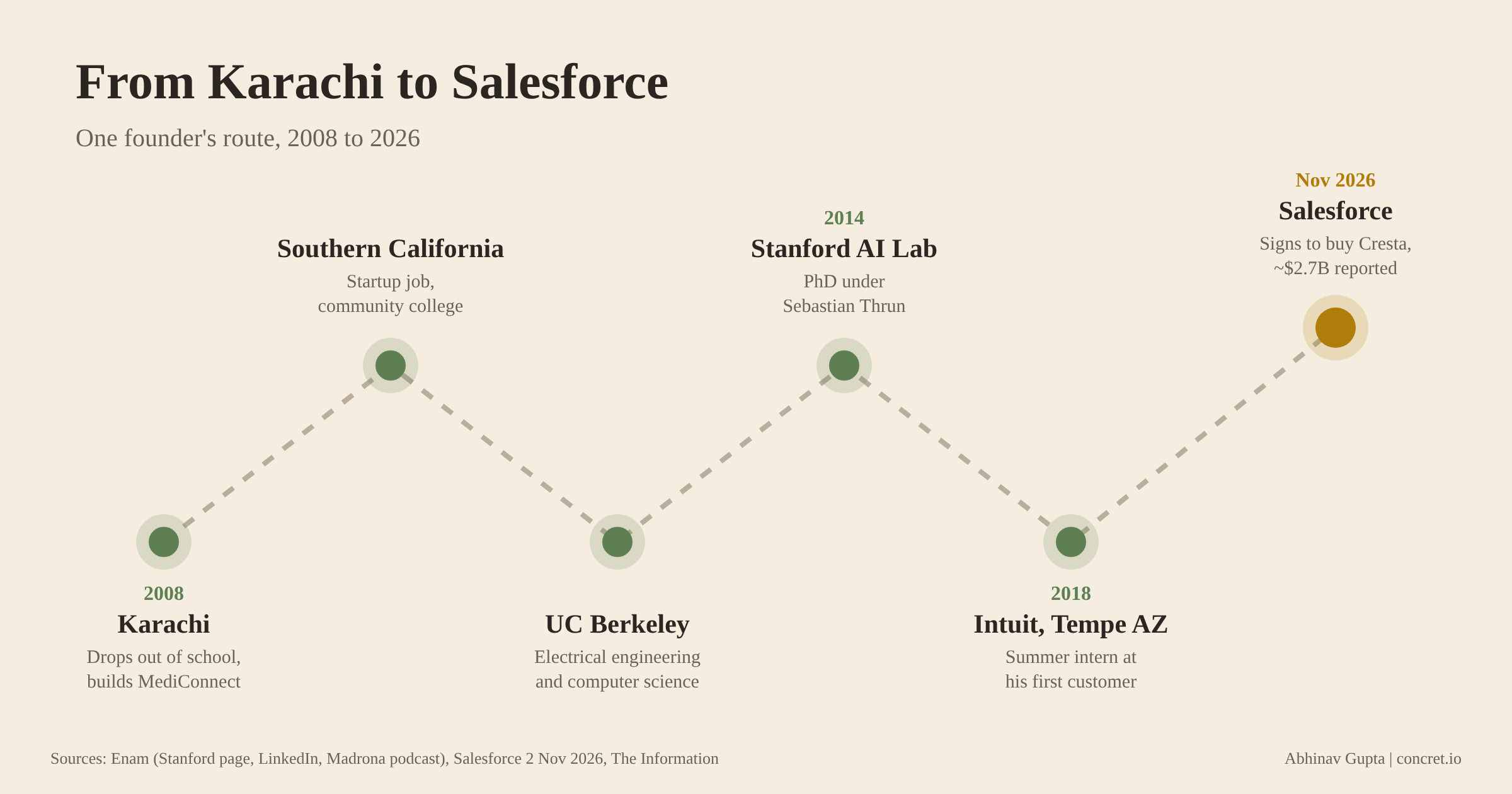
On 2 November 2026, Salesforce signed a deal to buy Cresta, a contact center AI company whose voice agents, Salesforce says, answer calls for Marriott, Comcast and Alaska Airlines. Salesforce did not disclose the price. The Information reported it at about $2.7B. The deal is expected to close between February and April 2027, subject to regulatory approval.
The interesting part is not the price. It is how Cresta got its first customer.
Its founder could not get a meeting that ended in a contract. So he took a summer internship at the company he wanted to sell to, proved the revenue from the inside, and then signed the deal twice: once as CEO, once as the intern being let go.
A startup before college
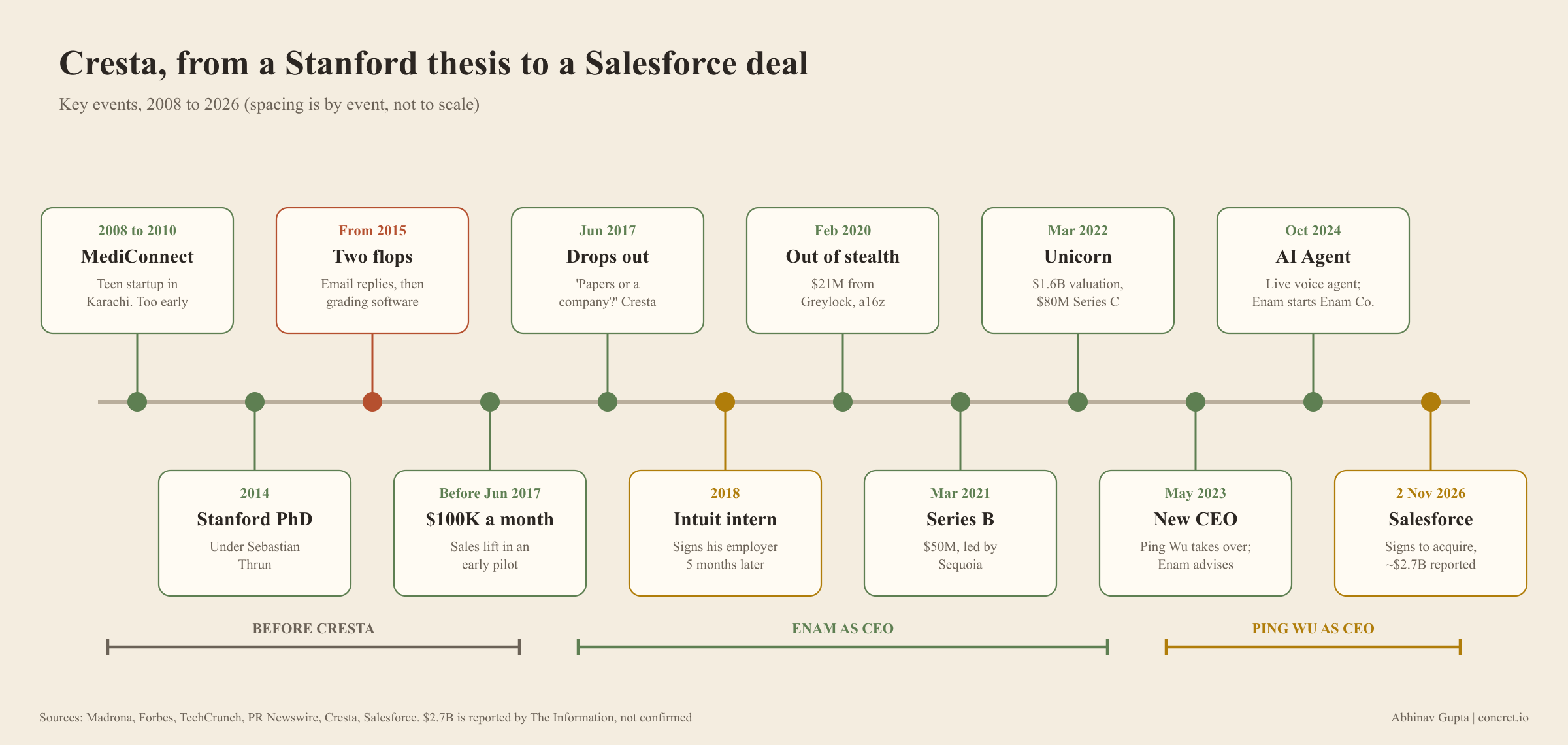
Zayd Enam grew up in Karachi. As a teenager he dropped out of high school to build MediConnect, an online platform for booking doctor appointments in Pakistan. By his own account, it signed some of Karachi's largest hospitals and won a 2009 APICTA award.
In October 2009, a 17-year-old Enam pitched it on stage at a Pakistani tech awards event. One person in the room wrote that he "spoke at the speed of light because he wanted nothing left unsaid."
MediConnect did not survive. In Enam's own words, it was "too early in 2009."
He then moved to Southern California, worked at another startup, took community college classes, and transferred to UC Berkeley to study electrical engineering and computer science.
Two products that failed
In 2014 Enam started a PhD at the Stanford AI Lab under Sebastian Thrun, the founder of Google X and Udacity. His research had a plain goal he called "Experts on Day One": use AI so that a new worker performs like an expert from the first day.
His first two attempts to turn that into a product both died.
| Attempt | What killed it |
|---|---|
| AI that suggests email replies | Six months in, Google launched Smart Reply. “The day Google released the project, like 20 people messaged me that link.” Google had billions of emails. He did not. |
| AI that helps teaching assistants grade | It worked, but schools buy software too slowly to build a business on. |
My read of the lesson: pick a market that has its own data, real budgets, and fast feedback.
The $100,000 signal
So he went looking for that market the hard way. He would sit beside people at Bay Area offices, watch where their work slowed down, and build small tools to help.
Sales and support teams fit. Their conversations repeat, the best reps outperform the rest by a wide margin, and results show up in revenue.
At one company, a support pilot was about to be cancelled, so he asked to move it to sales. With two reps using his real-time reply suggestions, the pilot added $100,000 in sales a month within a few weeks. That is more than $1M a year, from a grad student's side project.
He also saw why nobody else was there. Contact centers looked dull and full of messy integrations.
He compared it to Paul Graham's essay on "schlep blindness": smart people avoid problems that look tedious, even when the prize is large. "Every company in the world has some way to interact with their customers," he said, "and the experiences right now are terrible."
"Papers or a company?"
In June 2017, Enam presented these results at a lab meeting. Thrun pulled him aside afterward:
"These are amazing results. Do you want to keep writing papers on this or do you want to start a company?"
A week later, Enam and fellow PhD student Tim Shi, who also did early research work at OpenAI in 2017, dropped out. Thrun came too: he became a co-founder and chaired Cresta's board.
Enam incorporated in Delaware under a placeholder name: Grey Parrot Inc, after the African Grey Parrot, which he calls "the most linguistically intelligent animal in the world."
The first investor, Sun Microsystems co-founder Andy Bechtolsheim, agreed to invest after a short meeting at Stanford, then refused to wire the money until they found a better name.
They settled on Cresta, which Enam says comes from the Latin for growth. The money arrived.
A one-person company that nobody would buy from
Enam then broke a rule most startup advisers teach: start small. He went straight for large enterprises.
His reasoning was technical, not ambitious. The AI learns from repeated patterns, and only big teams of more than 250 reps produce enough of them. Small businesses do not.
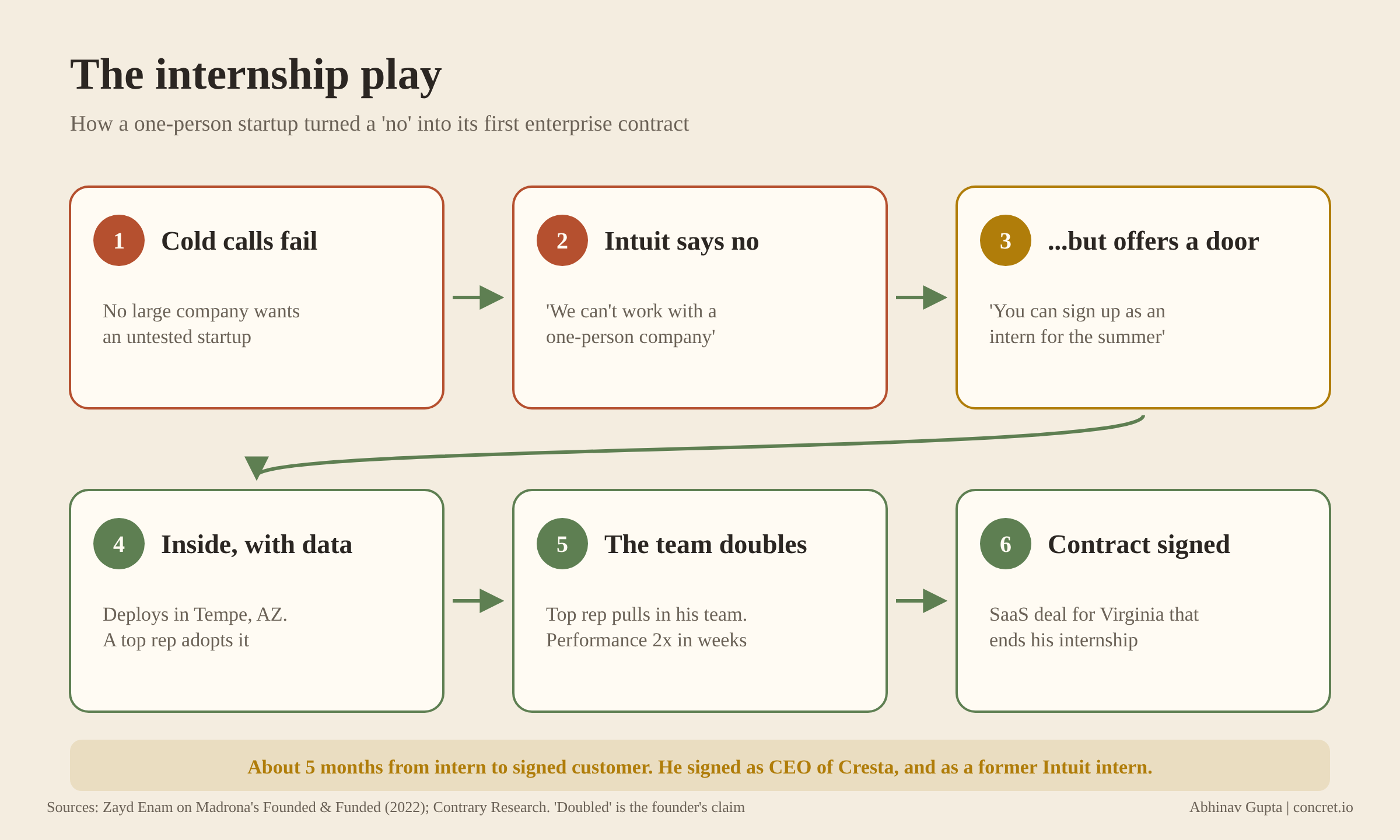
The cost was rejection. Cold calls and prospecting "wasn't getting much traction." No large company wanted to bet on an untested product from a startup with no customers.
The internship
The break came through Scott Cook, the co-founder of Intuit. Enam cold-emailed him after a presentation and got a meeting with Intuit's CIO.
He pitched Cresta and asked Intuit to be his first client. In Enam's telling, the CIO said:
"This is a really great project, but we can't work with you because you're a one-person company, and we're Intuit... But if you want to sign up as an intern to my group, you can sign up as an intern for the summer."
Enam took the internship.
As an intern he got what no outside vendor could have had quickly: access to Intuit's data systems. He deployed the first version to Intuit's sales team in Tempe, Arizona, where reps sold TurboTax and QuickBooks over chat.
Cresta trained a small model on Intuit's own chat logs. It suggested the next reply as a rep typed. Think Gmail Smart Reply, trained on one company's best salespeople.
The first person to use it was one of Intuit's top salespeople. He liked it enough to get the rest of his team on it. According to Enam, the whole team's performance doubled in a few weeks.
That is the detail that matters. Intuit did not adopt Cresta because of a pitch. One of its own top reps pulled his team onto it.
Signing as CEO and former intern
Intuit then wanted to roll it out to a larger team in Virginia. Enam told them a project this serious needed a proper enterprise contract.
"We came to a standard SaaS agreement, the only addendum being that this clause hereby terminates Zayd Enam's internship. Then I had to sign as the CEO of Cresta and then as a former intern at Intuit."
Contrary Research puts the gap at five months, from intern to signed customer.
One loose end was the code. Because of the IP assignment that came with the internship, Tim Shi has recalled, Cresta handed Intuit a snapshot of the source code on a USB drive, theirs to keep, and built forward on its own from there.
3-4 Years before ChatGPT
Cresta's first model went live at Intuit in 2018, more than four years before OpenAI launched ChatGPT on 30 November 2022. There were no prompts.
There was no general model to ask. Cresta built "sequence models trained from each customer's conversation, from scratch," one per client. Tim Shi later called them "just small deep neural nets from our PhD work."
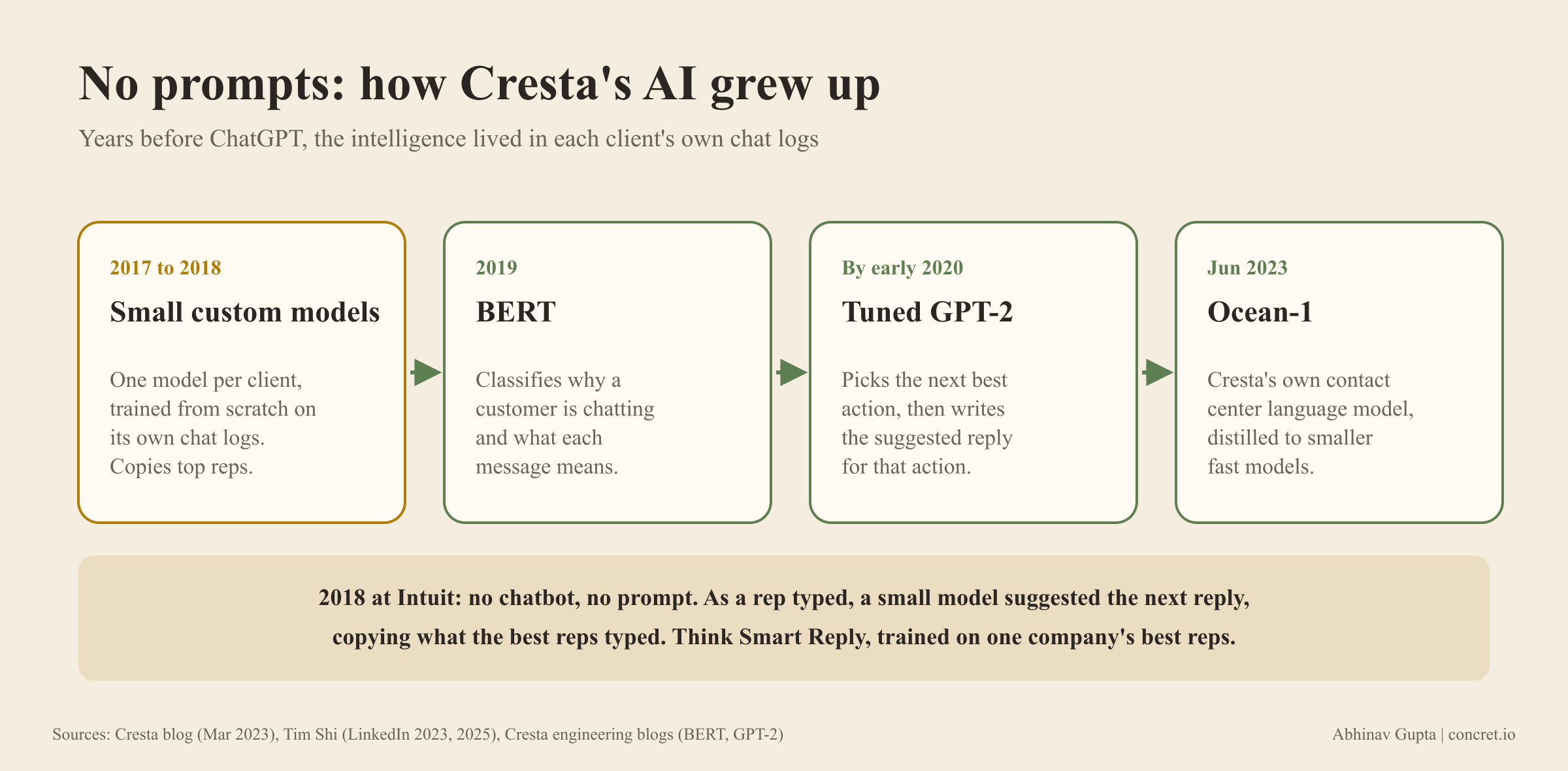
Each step added a layer. BERT, in 2019, tagged why a customer was chatting. By early 2020, a GPT-2 model tuned on real chats wrote the suggested reply. In June 2023 came Ocean-1, Cresta's own contact center language model.
My read: by the time ChatGPT arrived, Cresta had spent years learning from the one thing a general model never sees, each client's own conversations.
From 1 logo to a unicorn: Cresta's funding and valuation
Intuit was the first customer, and the product matured inside it. Enam says he personally sold the first $1M of annual recurring revenue.
Then the single logo did its job. According to Cresta's sales chief, Intuit's reference and the security groundwork Cresta had already done there helped win Cox Communications as customer number two.
| Year | Milestone |
|---|---|
| Feb 2020 | Leaves stealth with $21M from Greylock and a16z |
| 2020 | COVID moves selling online. Revenue quadruples (company figure) |
| Mar 2021 | $50M Series B led by Sequoia |
| Mar 2022 | $80M Series C led by Tiger Global, at a $1.6B valuation. Genesys, Five9 and Zoom invest |
| Jun 2023 | Launches Ocean-1, its own contact center language model |
| Oct 2024 | Launches its own AI agent for live voice calls |
| Nov 2024 | $125M Series D led by World Innovation Lab and QIA |
| Apr 2026 | Cresta says it passed $100M in annual recurring revenue (company claim) |
| 2 Nov 2026 | Salesforce signs to acquire Cresta, about $2.7B reported. Close expected Feb to Apr 2027 |
The part most founder stories skip
Enam was not the CEO who sold Cresta.
In early 2023, after a record quarter, he went to his own board and suggested bringing in a more experienced operator to run the next phase. Ping Wu became interim CEO, then permanent CEO in May 2023. Wu had co-founded Google's Contact Center AI, and Enam had recruited him in 2021.
Enam moved to an advisory role.
Under Wu, Cresta added autonomous voice agents, the product Salesforce's announcement leads with. Sequoia's note on the deal credits both: Enam "supplied the conviction and persistence to get Cresta started," and Wu "built on that foundation."
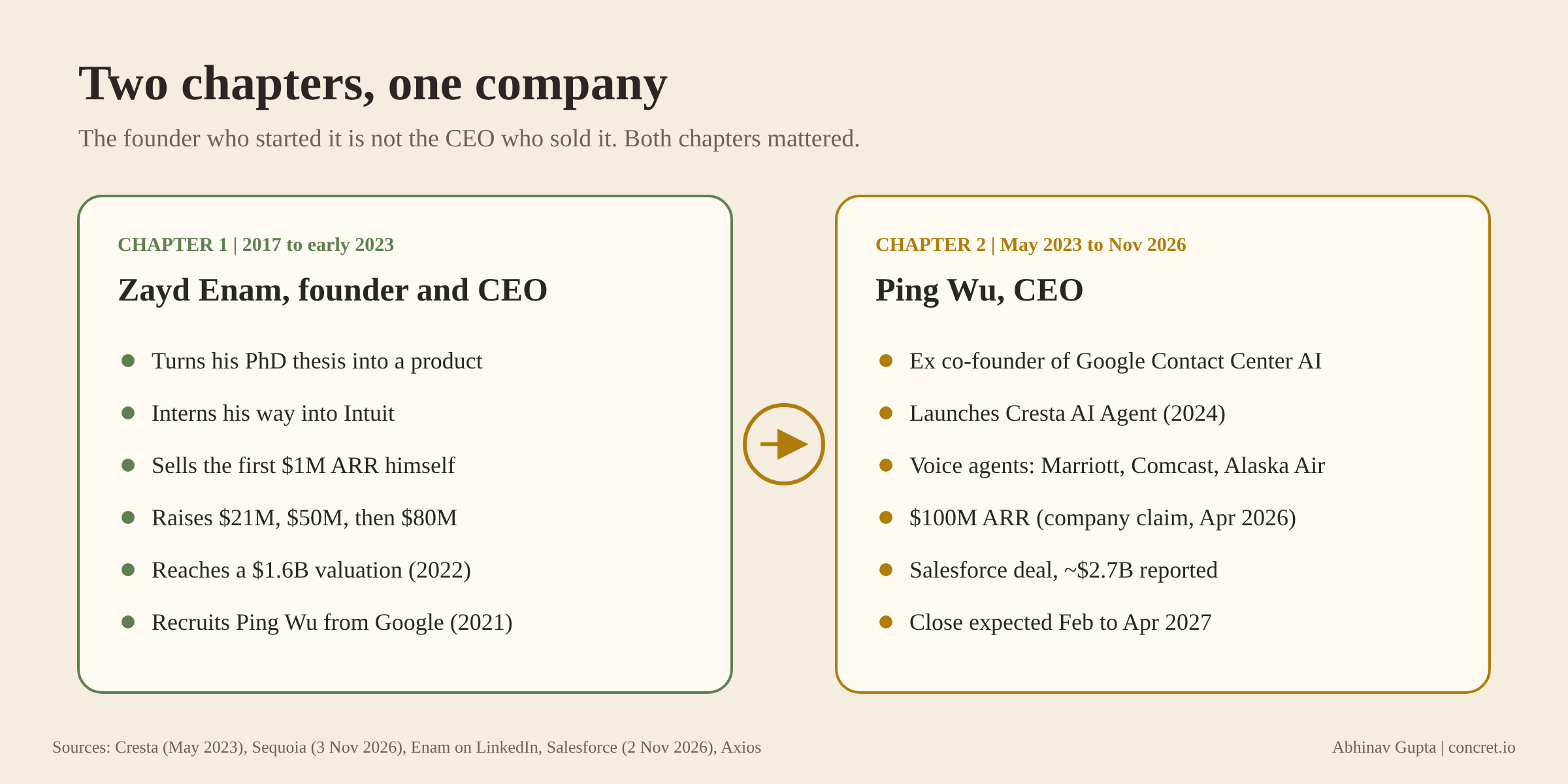
Enam's own summary is blunter: he "handed baton to management team I recruited." In 2024 he started again with Enam Co., which buys services businesses and rebuilds them with AI. Bechtolsheim wrote the first check, again.
That is a success story too. Knowing which chapter you are built for is a founder skill.
What leaders can take from it
My assessment: four moves from this story transfer to any enterprise sale.
| Lesson | What Enam did |
|---|---|
| Get inside before you sell | Took an internship to get data access and sit next to real users |
| Let the best user sell it | A top rep pulled his own team in. No executive pitch could do that |
| Prove revenue, not features | Doubled team performance before asking for a contract |
| Know your chapter | Built it from zero to unicorn, then handed it to an operator he hired |
A teenager from Karachi with a failed health startup, two failed AI products and a one-person company built something Salesforce has agreed to buy for a reported $2.7B. He did it by refusing to stay outside the room.
If you are weighing what the Cresta deal means for your Salesforce contact center roadmap, talk to us at Concret.io.
Sources
I checked every claim above against at least one primary source: the founder's own words, a company statement, or contemporary press. Claims that rest on one person's account are listed under "Treat with care".
Founder's own account: Madrona, Founded & Funded podcast (2022), Enam's Stanford page, Enam on LinkedIn, Unite.AI interview, Sep 2020
Thrun quote: Forbes, Mar 2021
Five months, intern to customer: Contrary Research
2009 pitch in Pakistan: In the Line of Wire, Oct 2009
Grey Parrot, Bechtolsheim and the name: Enam on LinkedIn, Jul 2024, SEC Form D, "Previous Names: Grey Parrot, Inc."
USB drive and the Tempe chat team: Tim Shi, Stanford Hidden Layer podcast
Cox and the sales chief's version: Alex Cramer, Topline podcast
Funding: TechCrunch, Feb 2020, PR Newswire, Mar 2022, QIA, Series D, Nov 2024, Cresta, $100M ARR, Apr 2026
The pre-LLM tech: Cresta, "Seven predictions", Mar 2023 ("sequence models trained from each customer's conversation, from scratch"), Tim Shi on LinkedIn, Apr 2025, Cresta engineering: multi-headed BERT, Cresta: action-directed GPT-2, Tim Shi on Ocean-1, Jun 2023, OpenAI, "Introducing ChatGPT", 30 Nov 2022, Cresta About page, "2018: first customer Intuit", Cresta Series B release, revenue quadrupled, Mar 2021
AI agent launch: Cresta, Oct 2024
CEO change and after: Cresta press release, May 2023, Cresta leadership update, Enam Co.
The deal: Salesforce, 2 Nov 2026, The Information, Sequoia, 3 Nov 2026
Unsure, treat with care
$2.7B comes from one outlet citing one unnamed source. Salesforce has not confirmed it, and the deal has not closed.
$100M ARR is Cresta's own claim and has not been independently verified.
"Doubled in a few weeks", the USB drive, and MediConnect's hospitals and award are each from one founder's account.
GPT-2 dates differ across Cresta's own sources (2018, 2019, early 2020). I use only what all of them support.
Three versions of the Intuit introduction exist. Enam cold-emailed Scott Cook after a presentation. Tim Shi recalls Enam taking Cook's class at Stanford's business school. Cresta's sales chief says Cook, an early investor, suggested the internship. I use Enam's account because he was in the room.
Let's Talk

Drop us a note, we’re happy to take the conversation forward 👇🏻