
When to Replace SFMC, & When to Fix Implementation? - Salesforce Marketing Cloud alternatives
Updated on: Jul 8

Enterprise marketing teams evaluating Salesforce Marketing Cloud alternatives face a critical question most vendor comparisons skip: Is the platform actually the problem?
After supporting dozens of Salesforce implementations, one pattern stands out: teams often blame the platform for implementation failures. The result: expensive migrations that recreate the same problems on a new stack. Before evaluating Salesforce Marketing Cloud alternatives, this framework helps determine whether the situation calls for a platform switch or an implementation fix.
The quick assessment: The right path depends on three factors: integration depth with Salesforce, team capacity to operate the platform, and whether current problems stem from the platform itself or how it was configured.
What Should You Ask Before Blaming the Platform?
Before comparing Salesforce Marketing Cloud alternatives, audit the current integration state. Deep Salesforce dependencies multiply migration complexity exponentially.
| Integration Indicator | If Present | Migration Impact |
|---|---|---|
| Apex triggers firing transactional sends | Deep integration | 3-6 month migration window |
| Salesforce Custom Objects driving Journeys | Data architecture dependency | Data model redesign required |
| Service Cloud case triggers | Cross-cloud dependency | Workflow reconstruction needed |
| Data Cloud segments in journeys | CDP layer involved | Significant data pipeline work |
| Flow-triggered emails | Automation dependency | Re-architecture of automation layer |
| SFCC transactional messaging integration | Commerce ecosystem lock-in | Catalog, cart, order pipelines require rebuild |
If three or more indicators apply (and they often do), migration complexity justifies a serious implementation audit before platform evaluation.
Decision Criteria by Team Profile
| Team Type | Priority | Platform Direction |
|---|---|---|
| Marketing-led, no dedicated admin | Ease of use | HubSpot, Klaviyo |
| IT-supported, technical capacity | Power + flexibility | Braze, Iterable |
| Agency-managed | Partner expertise alignment | Depends on agency stack |
| Enterprise with Salesforce investment | Ecosystem continuity | Improve SFMC or Adobe |
Who to Blame? SFMC Platform or the Implementation?
Before committing to migration, distinguish between implementation gaps and genuine platform misalignment. The symptoms often look similar; the solutions are vastly different. In this case, users must also look at the differences between HubSpot Vs Salesforce Marketing Cloud Vs Pardot to have a better picture in their mind.
Signs The Implementation Is The Problem:
Journey Builder capabilities exist but aren't configured
AMPscript/SSJS (SFMC's personalization scripting languages) unused despite personalization requirements
Data extensions poorly structured with no relational data model
No dedicated SFMC administrator or ongoing training investment
SI partner disengaged after initial deployment
Basic batch campaigns running on enterprise-tier licensing

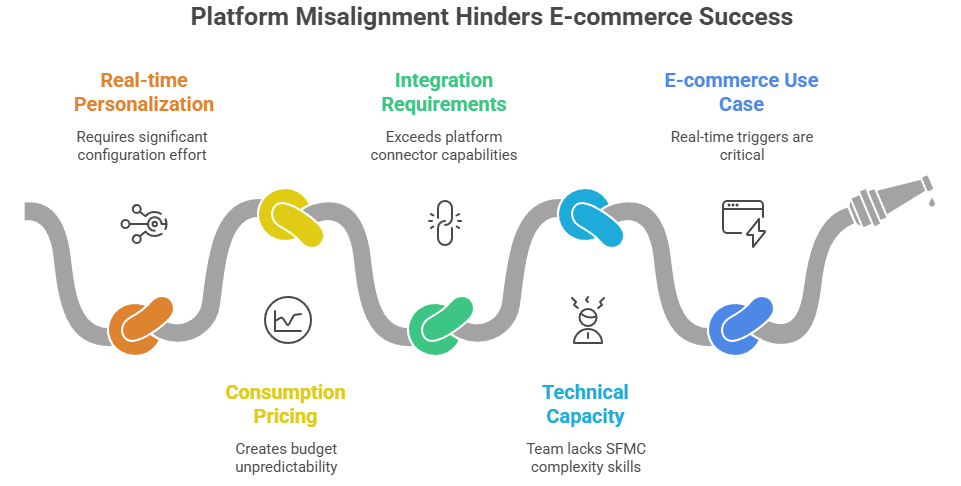
Signs The Platform Is Genuinely Misaligned:
Real-time personalization requires significant configuration effort; out-of-the-box defaults favor batch operations
Consumption pricing creates persistent budget unpredictability at the current scale
Integration requirements exceed platform connector capabilities
Team will realistically never have the technical capacity for SFMC complexity (and that's okay)
Use case is e-commerce/DTC, where real-time product triggers are critical
| Symptom | Likely Root Cause | Recommended Action |
|---|---|---|
| Low journey engagement rates | Implementation gap | Configuration audit + retraining |
| Abandoned cart triggers delayed >1hr | Configuration or architecture | Audit entry source setup; consider real-time platforms if unfixable |
| Budget overruns every quarter | Consumption model fit | Evaluate fixed-price alternatives |
| Marketing team avoids the platform | Complexity mismatch | Simplification or platform change |
| Only using batch email sends | Underutilization | Enablement before migration |
If implementation gaps are primary, migration often recreates the same problems on a new platform. Investment in proper SFMC enablement may deliver better ROI than switching costs. Understanding common implementation challenges helps distinguish between platform limitations and configuration issues.
Which Alternative Fits Your Enterprise Profile?
Based on the assessment above, go through this enterprise Marketing Automation comparison. Here's how alternatives map to enterprise scenarios:
| Your Profile | Primary Option | Alternative | Key Trade-off |
|---|---|---|---|
| E-commerce (Shopify, BigCommerce) | Klaviyo | Braze | Less enterprise customization |
| E-commerce on SFCC | Audit SFMC first | Klaviyo (with rebuild) | High integration complexity |
| Deep Salesforce, must stay in ecosystem | Improve SFMC implementation | Adobe Marketing Cloud | Similar complexity profile |
| Mid-market, marketing-led team | HubSpot Marketing Hub | Mailchimp (simpler) | Feature ceiling at enterprise scale |
| Mid-market with Salesforce CRM | Marketing Cloud Growth | HubSpot (with integration) | Growth edition still maturing |
| Technical team, mobile-first | Braze | Iterable | Higher implementation investment |
| B2B complex nurture journeys | HubSpot or improved SFMC | Marketo | Different ecosystem dependencies |
The Hidden Friction: Data Schema Reconciliation
When analyzing alternatives, enterprise technology teams frequently overlook the fundamental data layer. Salesforce Marketing Cloud’s architecture is built heavily around relational Data Extensions. Relational databases do not map cleanly over to event-driven architectures (like Braze or Iterable) or relatively flat, contact-centric databases (like HubSpot or Mailchimp).
Migrating out of SFMC requires an upfront data normalization and schema mapping cycle. If your active campaigns rely heavily on complex custom SQL queries and relational lookups across multiple data tables, your target replacement platform must be audited for relational query depth before signing a contract.
E-commerce & DTC Path
Klaviyo dominates this segment for good reason: native e-commerce integrations, real-time behavioral triggers, and predictable pricing. For Shopify-based operations, the migration path is well established. With 183,000+ customers and $1.2 billion in ARR, Klaviyo's scale is proven.
Trade-off: less enterprise customization and a different data model than Salesforce structures.
SFCC consideration: For organizations on Salesforce Commerce Cloud, the integration work is substantial. Commerce events and product data flows (catalog, inventory, carts, orders) require rebuilding. If abandoned cart and back-in-stock logic depends on SFCC jobs, custom code, or OCAPI/SCAPI (Commerce Cloud's REST APIs), budget real engineering time for migration.
Enterprise Salesforce Path
For organizations with deep Salesforce integration (custom objects in journeys, Apex triggers, Service Cloud workflows), the calculus changes. Organizations running SFCC + SFMC face the most complex migration scenario: the integration layer ties together data sync jobs (catalog, customer, order feeds), transactional email hooks, and the data extensions that power Journey Builder segmentation. Rebuilding these integrations on a new platform requires significant custom development. This is often the "audit implementation first" situation.
Why the integration complexity exists: Both SFCC and SFMC are acquired products running on separate architectures. SFMC originated as ExactTarget (acquired 2013 for $2.5B), which itself had acquired Pardot in 2012. SFCC was Demandware (acquired 2016 for $2.8B). The connector bridges two platforms that were never designed as one system.
Salesforce's consolidation play:Marketing Cloud Growth (launched 2024) is the first native marketing product built on the core Salesforce platform with Data Cloud. The company estimates 3-5 years to fully unify marketing products onto one platform. For organizations deep in the ecosystem, waiting for consolidation may be more practical than migrating away.
Adobe Marketing Cloud offers enterprise-grade capabilities with similar complexity profiles. Adobe's commerce stack may appeal to organizations wanting unified commerce + marketing from a single vendor.
However, if integration debt is high, evaluate whether better SFMC implementation addresses root issues before committing to 3-6 month migration projects.
Salesforce declined to participate in Forrester's Wave Q3 2024 evaluation, which is notable, but it doesn't mean the alternatives are easier to run.
Mid-Market Path
HubSpot Marketing Hub leads for marketing-led teams prioritizing ease of adoption. Strong native CRM, intuitive interface, teams can operate without dedicated technical support. For a detailed comparison between SFMC and HubSpot, the trade-offs depend heavily on technical capacity and journey complexity requirements.
Braze offers modern architecture and real-time capabilities. A Gartner Magic Quadrant Leader for three consecutive years, Braze counts McDonald's and five Walt Disney divisions among its enterprise customers. Trade-off: higher implementation investment, typically $60K-$200K/year for mid-market, and a steeper learning curve.
For mid-market already on Salesforce CRM: Consider Marketing Cloud Growth Edition before adding another vendor. At $1,500/org/month (vs HubSpot Enterprise at $3,600/month), Growth offers native Data Cloud integration and AI capabilities (Agentforce, Einstein) without maintaining a separate system. The product is built on the core Salesforce platform, not the acquired ExactTarget architecture, so it shares data natively with Sales and Service Cloud.
Also Read: Salesforce Marketing Cloud Data Relationships Feature in Depth
Operational Migration Timelines & TCO Planning
Transitioning off an enterprise stack cannot happen overnight. Based on complexity tiers, organizations should budget for the following implementation milestones:
Simple Deployment (2 to 4 Weeks): Involves flat contact list migrations, basic email/SMS static campaigns, and standard native plug-and-play integrations.
Moderate Deployment (1 to 2 Months): Includes rebuilding multi-tiered customer lifecycle journeys, mapping standard behavioral webhooks, and establishing bidirectional CRM syncing.
Complex Deployment (3 to 6 Months): Involves extensive relational data configurations, handling massive database sub-units, multi-brand partitions, and reconciling cross-cloud third-party dependencies.
The Parallel Cost Factor: Standard migration compliance mandates running both SFMC and your chosen alternative concurrently for 2 to 4 months. This parallel execution window guarantees message delivery stability, allows your engineering team to validate tracking data integrity, and offsets the inevitable 2-month productivity dip as your marketing staff adjusts to a new interface.
What Does Migration Actually Cost?
Platform license represents 60-70% of Year 1 investment for most enterprise deployments. The remainder, often underestimated in vendor conversations, includes:
| Cost Category | % of Year 1 | Enterprise Range (USD) |
|---|---|---|
| Platform license | 60-70% | $50,000 - $200,000+ |
| SI partner / implementation | 15-25% | $20,000 - $100,000+ |
| Data migration & cleanup | 5-10% | $10,000 - $40,000 |
| Training & enablement | 3-5% | $5,000 - $20,000 |
| Parallel operation period | 5-10% | 2-4 months dual licensing |
The Elephant in the Room: Segmented Total Cost of Ownership (TCO)
When evaluating SFMC alternatives, looking at the sticker price of the license is a trap. In 2026, the true cost of a MarTech platform is split into three "hidden" buckets:
Implementation & Partner Costs: SFMC often requires specialized (and expensive) implementation partners for even basic setups. High-agility alternatives like Braze or HubSpot can often be managed with a smaller, in-house technical team.
Technical Debt & Maintenance: If your team spends 40 hours a month just managing data extensions, SQL queries, and sync errors, your "free" internal labor is actually a massive hidden cost.
Seat & API Tax: Watch out for platforms that charge based on user seats or volume-heavy API calls. If your growth plan involves 50+ users or real-time data streaming, these variable costs can quickly outpace the base license fee.
Planning Guidance:
Request Year 1 TCO estimates, including implementation from every vendor under consideration. Resistance to providing estimates signals potential issues. For context on Salesforce implementation cost factors, enterprise deployments typically range from $50,000 to $180,000.
Factor SI partner selection as carefully as platform selection. Implementation quality often determines outcomes more than platform capabilities.
Budget for parallel operation. Running both platforms during migration is standard practice for enterprise deployments. Plan for 2-4 months of dual costs.
Account for productivity dip. Team learning curves affect campaign velocity for 2-3 months post-migration.
The Talent Cost Factor Most Comparisons Ignore
Platform licensing is visible; talent costs are where TCO calculations fall apart. SFMC typically requires dedicated technical staff who understand data extensions, AMPscript, Journey Builder architecture, and SQL for segmentation. These roles are specialized and command premium compensation.
| Platform | Typical Admin Role | US Salary Range | Staffing Model |
|---|---|---|---|
| SFMC | Marketing Cloud Administrator | $90K-$140K | Dedicated FTE required |
| HubSpot | HubSpot Admin | $35K-$60K | Often absorbed into Marketing Ops |
| Klaviyo | Email Marketing Specialist | $50K-$75K | Marketing generalist can manage |
| Braze | Marketing Automation Specialist | $70K-$120K | Technical capacity needed |
Talent sourcing options: Offshore partners (India) deliver 40-60% cost savings with deep Salesforce talent pools, strong English proficiency, and proven delivery models for end-to-end implementations. Though, choose a partner, who is not just a team of executors, but who knows how to implement enterprise projects.
Nearshore (Latin America) offers 30-70% savings with timezone overlap. Onshore commands full rates but simplifies coordination.
Pricing Comparison for Planning:
SFMC: Starter Suite at $25/user/month, Growth at $1,500/org/month, Advanced at $3,250/org/month. Full Marketing Cloud Engagement starts at $1,250/org/month and scales with consumption.
HubSpot Marketing Hub: Professional at $890/month, Enterprise at $3,600/month.
Klaviyo: Free up to 250 profiles, scaling to ~$1,200/month at 100K profiles.
Braze/Iterable: Enterprise pricing typically $60K-$200K/year.
Actual pricing varies by region and agreement terms. Contact your respective Account Executive for current rates.
Comparison method: Pick three scenarios (50K, 250K, 1M contacts) with the same channel mix. Request pricing for all three from every vendor under consideration. This reveals how steeply each platform scales with growth.
Before Switching Platforms:
SFMC's lower tiers are more accessible than many realize. Organizations on higher-tier contracts with low utilization should evaluate downgrading within Salesforce before committing to migration costs.
The comparison that matters is the complete Year 1 TCO, not list price vs list price.
How Long Does Migration Really Take?
Migration timelines vary dramatically based on integration complexity and organizational readiness. Also, it depends on the Salesforce Marketing Cloud alternatives you are choosing. However, the estimate is:
Timeline ranges
Simple (contact lists, basic campaigns, minimal integrations): 2-4 weeks
Moderate (journey reconstruction, standard integrations): 1-2 months
Complex (custom objects, cross-cloud dependencies, multiple business units): 3-6 months
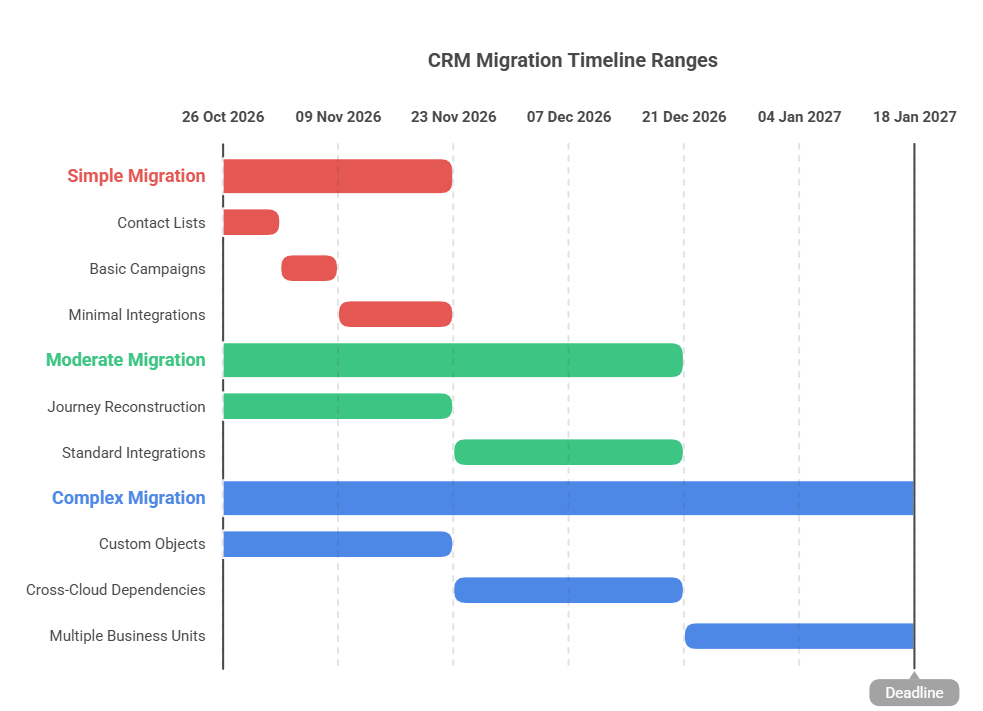
Industry benchmark:47% of CRM migration projects miss initial timeline and budget targets. Enterprise marketing platform migrations follow similar patterns.
Hidden Timeline Factors
Data architecture reconciliation: Salesforce data models don't map cleanly to other platforms. Plan for schema design and data transformation work.
Journey reconstruction: Automations can't be exported and imported. Each journey requires manual rebuilding and testing.
Stakeholder alignment: Multiple business units typically require separate migration phases.
Parallel validation: Running both platforms simultaneously to validate data integrity and campaign performance.
One reference point: Meriton Suites migrated 1M+ contacts from SFMC to Klaviyo and reported improved engagement post-migration, but that required proper planning and integration work with their booking platform.
For enterprise migrations, the realistic planning multiplier is 2x initial timeline estimates and 1.5x initial budget projections.
Mitigating Risk: Implementation Quality over Platform Features
Selecting a platform alternative is only half the battle; the quality of your System Integrator (SI) or deployment partner is what determines the final return on investment (ROI). Enterprise deployments routinely experience timeline friction due to poor configuration rather than underlying software flaws.
When sourcing proposals from software vendors, mandate comprehensive Year 1 Total Cost of Ownership (TCO) estimates that explicitly wrap in implementation labor, data migration consulting hours, and API overage buffers. Hesitation from a software vendor or agency partner to supply transparent configuration cost breakdowns signals hidden integration friction down the line.
The Bottom Line
E-commerce with real-time needs: Klaviyo provides the clearest migration path and strongest platform fit for product-triggered journeys and predictable pricing.
Enterprise with deep Salesforce integration: Audit implementation quality before committing to platform migration. The problem may be solvable without switching costs. Sometimes the answer is better configuration and enablement, not a new platform.
Mid-market seeking simplicity: HubSpot. Seeking technical power with modern architecture: Braze.
Migration reality: Plan for 2x the timeline and 1.5x the budget versus initial estimates. Factor SI partner costs as heavily as platform costs.
For organizations evaluating SFMC alternatives or assessing current implementation quality, contact us to discuss your specific situation.
FAQs
Q-1. Why do enterprises migrate away from Salesforce Marketing Cloud?
Ans: The most frequent drivers include steep licensing costs, high implementation and third-party developer dependencies (such as needing certified specialists for AMPscript and SQL), a slow time-to-value cycle for basic campaigns, and contract structures that scale aggressively based on contact consumption credits.
Q-2. Can automated customer journeys be exported directly out of SFMC?
Ans: No. Journey logic, multi-step automation dependencies, and behavioral trigger workflows cannot be exported as transportable code packages. Every campaign flow must be manually mapped out, rebuilt from scratch, and re-tested inside the new software’s visual builder engine.
Q-3. What alternative is best for an organization heavily invested in Salesforce CRM?
Ans: If keeping your data footprint native to the Salesforce core is mandatory, exploring Marketing Cloud Growth Edition or optimizing your existing implementation via specialized consulting are your cleanest routes. If ease of use is your primary goal, HubSpot Marketing Hub offers robust, deep-sync bidirectional connectors for Salesforce CRM data pipelines.
Q-4. How long should we run marketing platforms in parallel during a migration?
Ans: Enterprises should plan for a 2 to 4-month parallel operations window. This duplicate duration allows you to cleanly transition IP warming pools, validate data sync accuracy, and ensure your creative teams can build out fresh assets without halting active pipeline generation.
Still Unsure About Fix or Switch to Salesforce Marketing Cloud alternatives?
Lets talk.
References
Primary Sources
Salesforce Marketing Cloud: Complexity, Licensing, and Negotiation Pitfalls - UpperEdge
5 Interesting Learnings From Klaviyo at $1.2 Billion in ARR - SaaStr
Forrester Wave Email Marketing Service Providers Q3 2024 - Forrester
Pricing Sources
Salesforce Marketing Cloud Pricing - Salesforce Official
HubSpot Marketing Hub Pricing - HubSpot Official
Klaviyo Pricing Plans - Klaviyo Official
Braze Pricing Guide - Vendr
Iterable Pricing - ITQlick
Salesforce Acquisition & Platform History
Salesforce Completes Acquisition of ExactTarget - Salesforce Official (2013)
Salesforce Buys Demandware for $2.8B - TechCrunch (2016)
Marketing Cloud Growth Announcement - Salesforce Official (2024)
The Future of Salesforce Marketing Cloud - Salesforce Ben
Marketing Cloud Growth vs. Advanced Editions - Salesforce Ben
Supporting Sources
Braze 2025 Year in Review - Braze Official
Forge 2025: McDonald's, Disney, and Enterprise Engagement - Braze Official
Talent & Staffing Sources
Salesforce Marketing Cloud Salary Guide 2025 - Salesforce Ben
SFMC Administrator Salary - Glassdoor
HubSpot Admin Salary - ZipRecruiter
Marketing Automation Specialist Salary - Glassdoor
Klaviyo Salary Data - ZipRecruiter