
DiffSpot Latest Release: Enhancements to Our HubSpot Portal Audit Tool

Key Summary:
DiffSpot now provides deeper insights into HubSpot portals with improved workflow and CRM visibility
Workflow diagrams make it easier to understand automation logic at a glance
The PDF report is more structured and ready for direct sharing with stakeholders
If you’ve been using DiffSpot to audit your HubSpot portal, you already know how quickly you can scan your environment and understand what exists inside it.
But scanning alone isn’t always enough.
As portals grow, the need shifts from just visibility to clear insights, better analysis, and faster decision-making. This release is focused exactly on that.
With the April 2026 update, our HubSpot portal audit tool introduces deeper data visibility, better workflow understanding, and more actionable reporting, helping you move from audit to action with confidence.
Let’s take a closer look at what’s new
A Complete View of Your CRM Properties
One of the biggest gaps in portal analysis has always been the lack of complete data visibility.
Until now, most scans focused heavily on custom configurations. With this update, DiffSpot now includes both standard and custom CRM properties, giving you a more accurate representation of your data model.
This means:
You no longer see just part of your system
You can validate property mappings more effectively
You get a true understanding of how your CRM is structured

For teams working on migrations or cleanup, this change removes a major blind spot.
Deeper Insights Into Workflows
Workflows are often the most complex part of any HubSpot portal, and one of the hardest to understand during audits.
To address this, the new update enables DiffSpot to surface enhanced workflow data, giving you a clearer view of how your automation is structured and how it behaves in practice.
You can now clearly see:
Enrollment triggers (manual vs condition-based)
Step-by-step action sequences
Breakdown of branches, delays, emails, and logic
A simplified description of what each workflow does
This makes it easier to evaluate whether workflows are:
Still relevant
Properly structured
Aligned with current processes
Visualize Automation with Workflow Diagrams
Even with detailed workflow data, understanding complex automation step by step can still take time, as users need to trace multiple actions, conditions, and branches to understand how a workflow behaves.
To simplify this, DiffSpot now introduces workflow diagrams that visually represent how your automation flows. Instead of going through individual actions, you can see how triggers, conditions, and steps connect in a single, structured layout.
These diagrams clearly map branching logic and dependencies, making it easier to follow how workflows behave across different paths.
This is especially useful when reviewing complex automations, validating logic before migrations, or quickly identifying unnecessary steps.
While detailed data helps you analyze workflows, diagrams help you understand them instantly.
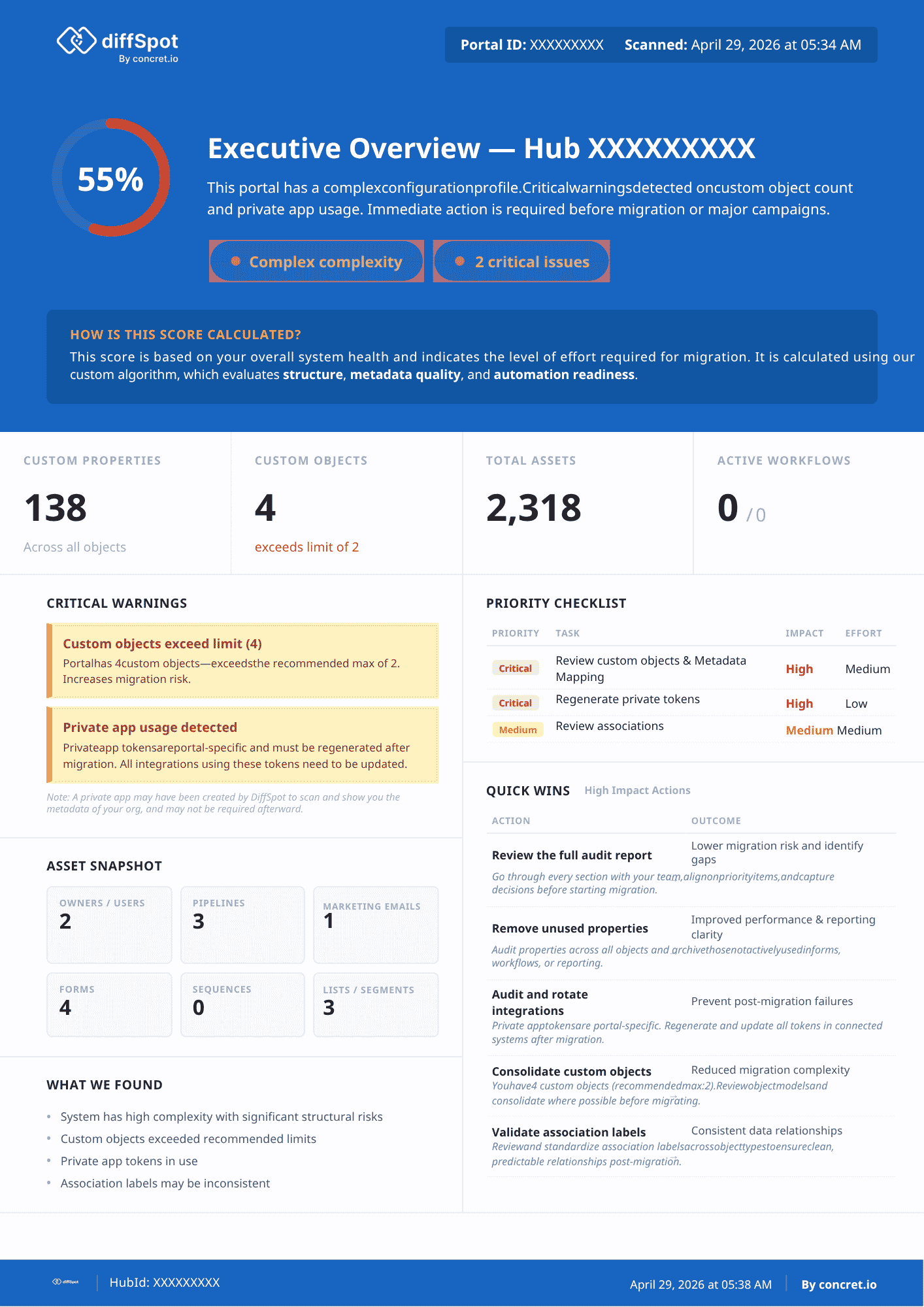
Turn Your Audit Into a Shareable Report
Exporting audit reports isn’t new in DiffSpot, but this update significantly improves how those reports are presented and used.
Previously, while PDF export was available, reports often required additional formatting or cleanup before they could be shared externally. With this release, the PDF output has been enhanced into a more structured, professional report that’s ready to use right away.
The improved report now includes:
A clear summary of portal health and overall complexity
Organized insights across workflows, properties, pipelines, and more
Actionable recommendations with priority focus areas
This makes it easier to share findings with clients, stakeholders, or internal teams without making any manual changes.
Better Visibility Across CRM Structure
During audits, CRM data is often difficult to interpret due to incomplete information or unclear mappings, especially when labels, groups, or stages lack context.
This update improves several core data sections in DiffSpot, making the information more complete, accurate, and easier to work with:
Association Labels: Now display proper names instead of internal IDs, making object relationships easier to understand
Property Groups: Expanded coverage with additional categories like employees, customers, invoices, orders, and more
Marketing Emails: Added details such as subject, type, status, and creation date for better visibility
Pipelines & Stages: Now include win probability and internal stage IDs, useful for mapping and integrations
With clearer and more structured data, it becomes easier to analyze your CRM setup, validate configurations, and plan changes with confidence.
Broader Asset Coverage for Complexity Mapping
The accuracy of your portal complexity depends on how much of your system is actually included in the analysis. When only core CRM objects are considered, the overall picture can feel incomplete.
This release expands DiffSpot’s complexity mapping by including additional asset types that were previously not part of the calculation, resulting in a more complete and accurate view of your portal’s structure.
Newly included elements are:
Blogs & Posts: Blog instances and published content counts
Sequences: Total number of sales sequences configured
Subscription Types: Email subscription categories tracked as assets
Lists: Active and static list counts
By broadening asset coverage, the complexity score now reflects the full scale of your portal.
Detailed Insights Into Forms
Forms are a key entry point for data in any HubSpot portal, but during audits they are often reviewed only at a surface level. This makes it harder to understand what data is being collected and how each form is structured.
DiffSpot audits now provide a deeper view into each form, making it easier to analyze form-level configuration and data capture.
You can now see:
All fields are included in each form
Clearly marked required and optional fields
Creation and last updated timestamps
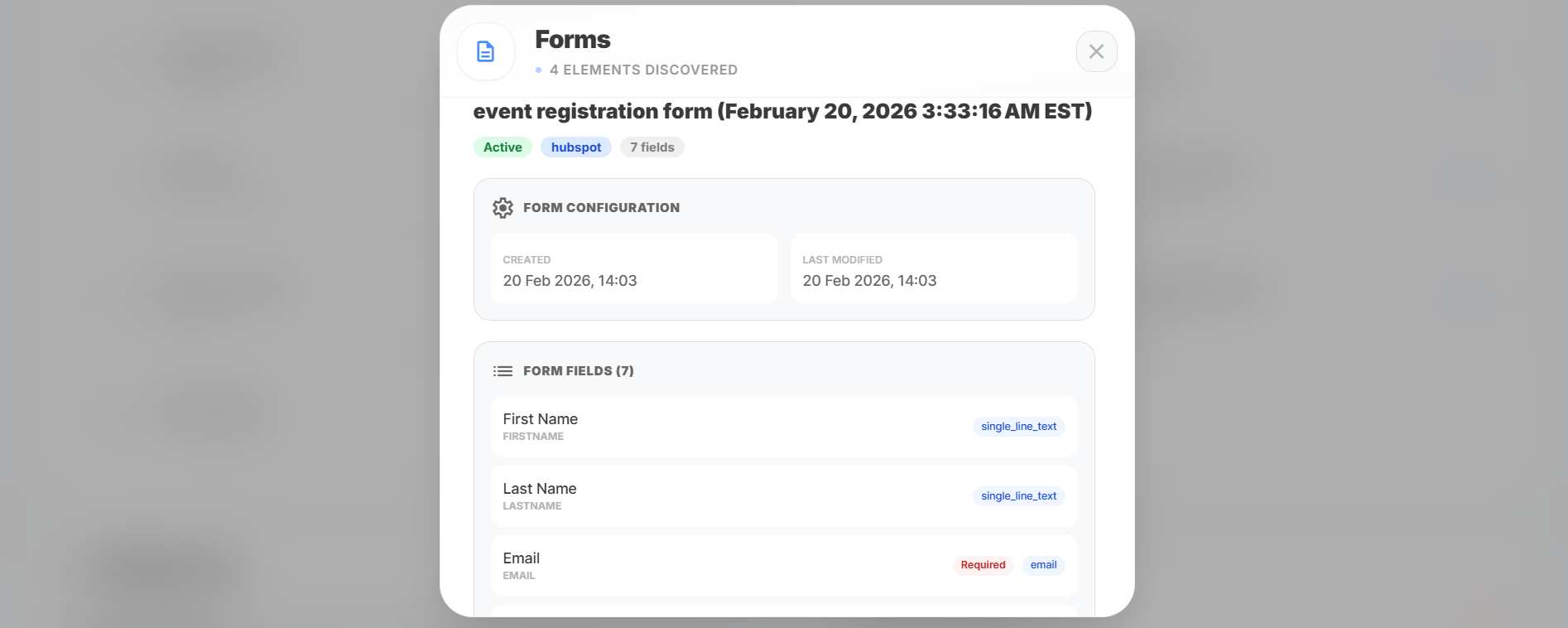
This level of detail helps teams:
Understand how forms capture and structure data
Validate form structures during audits
Identify outdated or redundant forms
Stay Informed with Product Updates
This is not a major feature upgrade, but a small addition to help users stay connected with what’s happening in DiffSpot.
A new “Stay Informed” section has been added to the home page, where users can submit their email address to receive updates on new features, improvements, and product announcements.
It is designed to keep communication simple and ensure users don’t miss important product updates as DiffSpot evolves.
Bringing It All Together
This release is about moving beyond basic scanning and making HubSpot audits more meaningful.
With deeper workflow insights, improved CRM visibility, enhanced reporting, and expanded asset coverage, DiffSpot strengthens its role as a HubSpot portal audit tool that helps teams truly understand their system.
If you need expert guidance, our HubSpot consultants are here to help.
Further Reading
Frequently Asked Questions
-
Most teams perform a HubSpot audit every 3–6 months to keep their CRM organized. However, high-growth or frequently changing portals may require more regular reviews to maintain data quality, automation accuracy, and overall system efficiency.
-
CRM complexity refers to how large and interconnected a portal is, based on objects, properties, workflows, and assets that impact system management and performance.
-
Yes. DiffSpot generates Mermaid-based workflow diagrams that visually map triggers, steps, and conditions, helping users quickly understand automation flow without manually reviewing each workflow step.
-
Asset Complexity Mapping in DiffSpot is a feature that measures your HubSpot portal’s complexity by including multiple asset types like sequences, blogs, lists, and subscription types, giving a more complete and accurate view of your system’s structure.
Related Reading